




























Views
Downloads
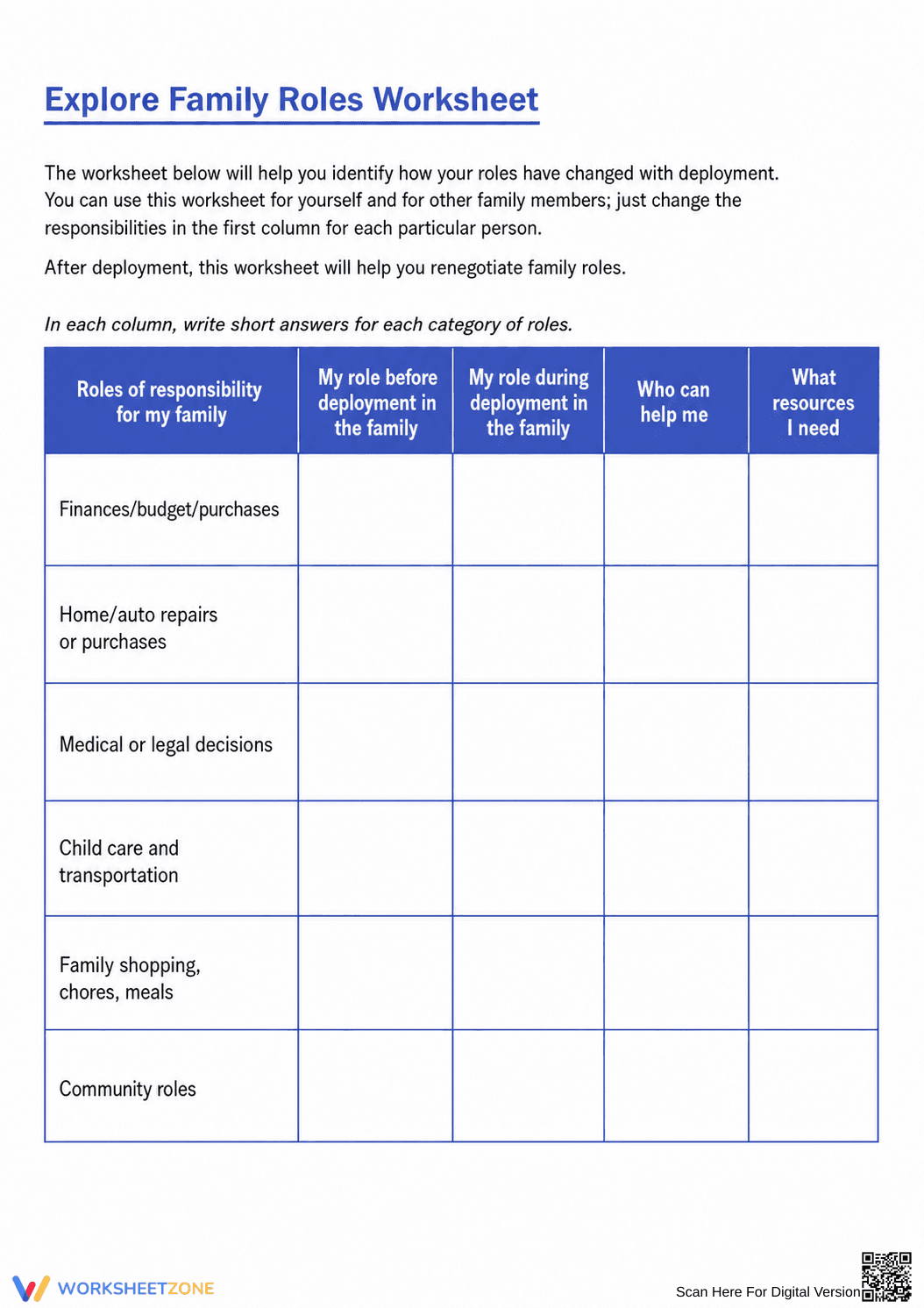

Grade 11 Family Roles — Printable No-Prep Worksheet

Paste this activity's link or code into your existing LMS (Google Classroom, Canvas, Teams, Schoology, Moodle, etc.).
Students can open and work on the activity right away, with no student login required.
You'll still be able to track student progress and results from your teacher account.
This high school social skills worksheet helps students and young adults identify and manage shifting family responsibilities. By analyzing specific household duties before and during major life transitions like deployment, learners develop critical self-awareness and communication skills. The structured format encourages proactive planning and resource identification for emotional and practical support.
At a Glance
- Grade: 11 · Subject: Social Skills
- Standard:
CCSS.ELA-LITERACY.W.11-12.4— Produce clear writing appropriate to task and purpose- Skill Focus: Identifying family roles and support systems
- Format: 1 page · 6 reflection tasks · No answer key · PDF
- Best For: Independent reflection and counseling
- Time: 15–20 minutes
This single-page resource features a reflection table divided into six core areas of household responsibility, including finances, child care, and daily chores. Students fill in four columns per category to track their involvement before and during a major family transition. The final columns prompt learners to identify specific helpers and concrete resources needed to succeed. Because this is a personal reflection exercise, no answer key is required.
- Print (1 minute): The single-page layout prints cleanly in black and white, requiring no special formatting or teacher preparation.
- Distribute (1 minute): Hand out the worksheet alongside a brief introduction about the importance of adapting to family changes.
- Review (3 minutes): Facilitate a quick wrap-up discussion where students can voluntarily share one resource or support system they identified.
Total teacher prep time is under two minutes, making this an excellent emergency sub plan or quick addition to a social-emotional learning module.
This activity aligns with CCSS.ELA-LITERACY.W.11-12.4: Produce clear and coherent writing in which the development, organization, and style are appropriate to task, purpose, and audience. By requiring students to articulate their specific roles, needs, and support networks, the worksheet practices purposeful, audience-aware communication. Both standard codes can be copied directly into lesson plans, IEP goals, or district curriculum mapping tools.
Use this worksheet during small-group counseling sessions focused on life transitions or changing family dynamics. Introduce the activity before a group discussion to give students time to process privately. Alternatively, assign it as an independent task in a life skills class. For formative assessment, observe if students can accurately identify external support networks; those leaving the "Who can help me" column blank may need targeted follow-up. Expect completion in 15 to 20 minutes.
This resource is primarily designed for older teens in grades 11 and 12, young adults, and students in military families experiencing deployment. It is easily differentiated by allowing students to focus only on the rows that apply to their specific living situation. Pair this worksheet with a broader lesson on stress management or a direct instruction session on community resources to maximize its impact.
Integrating structured reflection tools into social-emotional learning helps older students manage complex family transitions with greater resilience and clarity. Aligned with CCSS.ELA-LITERACY.W.11-12.4, this activity requires learners to produce clear writing appropriate to task and purpose while evaluating their shifting household responsibilities. According to a comprehensive RAND AIRS 2024 report on adolescent development and family dynamics, students who explicitly map out their support networks and changing roles during periods of family stress demonstrate significantly lower anxiety levels and better academic persistence. By prompting students to identify both the people who can help them and the specific material resources they need, this worksheet bridges the critical gap between emotional awareness and practical problem-solving. This evidence-based approach ensures that young adults are not just passively experiencing family changes, but actively developing the self-advocacy skills necessary for long-term success, emotional regulation, and household stability.


