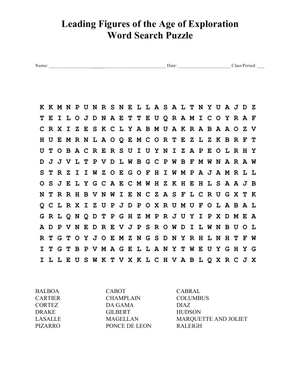
Age of Exploration Worksheets: Maps, Explorers, and Timelines for Grades 4-8
What Age of Exploration Worksheets Cover
Age of exploration worksheets give your history block a concrete structure for teaching a period that spans roughly the early 1400s to the late 1600s, when European nations pushed for new sea routes to Asia. Instead of one dense reading, a strong worksheet set breaks the era into pieces students can actually hold onto: who sailed, why they left, where they went, and what changed afterward. For a grade 4-8 social studies class, that scaffolding is the difference between memorizing a list of names and understanding a chain of decisions that reshaped global trade.
Most printable sets share a few reliable formats. Explorer profile cards ask students to record a navigator's country, sponsor, route, and outcome. Route-mapping pages have students trace voyages across a blank or labeled world map. Timeline sequencing sheets put voyages in order so cause and effect stays visible. Primary-source-style readings pair a short passage with comprehension questions. When you plan a unit, pick formats that match the skill you want to build that day rather than reaching for whatever printed first.
Matching Worksheets to Grade 4-8 Readers
The same topic lands very differently for a fourth grader and an eighth grader, so match the worksheet to the reader in front of you. Upper elementary students do best with shorter passages, word banks, and profile cards that limit each explorer to four or five facts. Give them a labeled map to trace rather than a fully blank one, and keep comprehension questions literal before you push toward inference. A quick way to gauge fit is to read the first passage aloud yourself; if it takes more than a couple of minutes, it is probably too dense for your youngest readers.
Middle school students can handle denser text, open map work, and questions that ask them to compare motives across explorers or weigh the consequences of contact between continents. A practical move is to keep the same core worksheet but swap the question stems: elementary versions ask "what" and "where," while middle school versions ask "why" and "what if." That keeps your prep manageable while still differentiating the cognitive demand, and it lets a mixed-ability class work from one familiar layout.
Pairing Map Work With Explorer Profiles
Geography and history reinforce each other in this unit, and the strongest worksheet routines put them side by side. Have students complete an explorer profile card first, then trace that same explorer's route on a map worksheet. The profile gives them the facts; the map gives those facts a shape. Students start to see why one captain hugged the African coast while another crew sailed west across open ocean toward an unknown continent.
The detail most teachers underuse is the sponsor line on a profile card. When students record who paid for each voyage, the abstract "Gold, Glory, God" motive framework stops being a slogan and becomes evidence they can point to. A class that maps five voyages and notices that most were crown-funded searches for trade routes has effectively built an argument about economic motive without you lecturing it. That single column turns a fact-recall sheet into a genuine source-analysis task, and it gives your stronger readers something to defend in writing.
Timelines and Cause-and-Effect Sequencing
Timeline worksheets are where students stop treating voyages as isolated trivia and start seeing a sequence. When learners physically order expeditions, they can see that later voyages built on earlier maps, rumors, and mistakes. Sequencing sheets also make cause and effect concrete: one crew's route opens a question that the next crew's voyage tries to answer, and the pattern repeats across decades. Color-coding each nation's voyages on the same timeline makes competition between empires visible at a glance.
For a review or intervention group, a cut-and-paste timeline is a low-stress way to check understanding. Students who cannot yet write a full paragraph about causes can still demonstrate that they understand order and consequence by placing events correctly and explaining one link out loud. That gives you formative data without a heavy writing lift, and it keeps struggling readers moving instead of stalling on a blank page.
Building Free Units Into Your Plan
You do not have to build every page yourself. Several free, teacher-vetted collections already sequence this unit, and pulling from them saves hours of prep while keeping your content accurate.
The Core Knowledge Foundation publishes CKHG Unit 3: The Age of Exploration, a free upper-elementary unit that bundles student worksheets, assessments, and a teacher guide covering roughly the 1400s to the 1600s. Teachers can adopt the full sequenced arc or lift a single map or profile page into an existing lesson without rebuilding the unit from scratch.
Guides from The Clever Teacher and the OER Project offer complementary lesson framing and primary-source ideas, so you can mix a ready timeline from one collection with a comprehension reading from another and still keep a coherent unit. Preview any outside page before printing so its reading level and vocabulary match the students you actually teach.
Frequently Asked Questions
1. What grade levels are Age of Exploration worksheets best for?
They fit upper elementary (grades 4-5) and middle school (grades 6-8) social studies. Elementary learners do well with profile cards and labeled maps, while middle schoolers can handle open map work and comparison questions about explorer motives and consequences.
2. How can teachers use these worksheets for small-group or intervention instruction?
Shrink the load to one or two explorers, add a word bank, and use cut-and-paste timelines so students can show understanding of order and cause without heavy writing. Keep an answer key nearby so the group can self-check as they work.
3. What skills do these worksheets build besides history content?
They strengthen map reading and route tracing, sequencing and cause-and-effect reasoning, reading comprehension, and early source analysis when students track who sponsored each voyage and why it mattered to a competing empire.
4. How can teachers pair map worksheets with explorer biography activities?
Have students complete a profile card first, then trace that explorer's route on a map. The profile supplies the facts and the map gives them spatial meaning, so geography and history reinforce each other in a single routine.
5. How can these worksheets support formative assessment?
Use a two-question exit check after each explorer, a quick map label, or a one-link cause-and-effect statement. These fast checks tell you who is ready to move on and who needs a short review group the next day.