




























Views
Downloads

Family Roles & Dynamics Worksheet | Grade 10 Essential

Paste this activity's link or code into your existing LMS (Google Classroom, Canvas, Teams, Schoology, Moodle, etc.).
Students can open and work on the activity right away, with no student login required.
You'll still be able to track student progress and results from your teacher account.
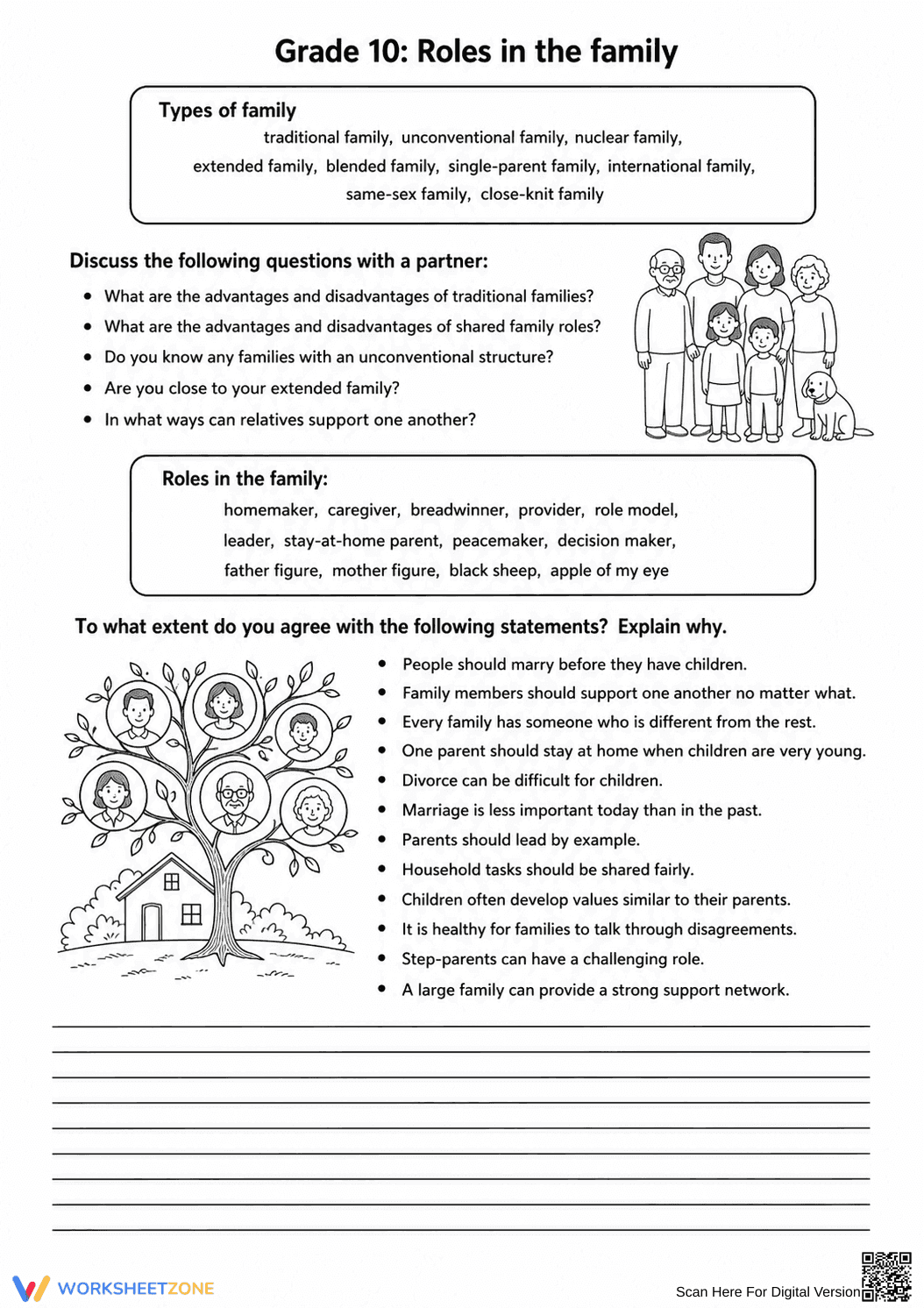
This Grade 10 family roles worksheet facilitates deep analysis of modern household structures and interpersonal dynamics. Students define diverse family types and evaluate societal expectations through structured discussion and reflective writing. It provides a comprehensive framework for exploring complex social units while building critical communication skills and empathy.
At a Glance
- Grade: 10 · Subject: English / Social Skills
- Standard:
CCSS.ELA-LITERACY.SL.9-10.1— Initiate and participate effectively in a range of collaborative discussions- Skill Focus: Family Dynamics & Vocabulary
- Format: 1 page · 17 tasks · Discussion & Writing · PDF
- Best For: Socratic seminars and reflective writing
- Time: 45–60 minutes
This single-page resource features two high-impact vocabulary banks covering family classifications and specific household roles. It includes five open-ended discussion prompts designed for peer interaction and twelve critical-thinking statements where students must justify their level of agreement. The layout provides ample writing space for detailed explanations and evidence-based reasoning at the bottom of the page.
Zero-Prep Workflow
- Print: Select the single-page PDF and print enough copies for your class in under 30 seconds.
- Distribute: Hand out the sheets at the start of the period to serve as both a vocabulary guide and a discussion anchor.
- Review: Facilitate a whole-class debrief using the agreement statements as a "four corners" activity or a structured debate. Total teacher preparation time is less than 2 minutes.
This resource aligns with `CCSS.ELA-LITERACY.SL.9-10.1`, requiring students to propel conversations by posing and responding to questions that relate the current discussion to broader themes or larger ideas. It also supports writing standards by asking for reasoned explanations. Both standard codes can be copied directly into lesson plans, IEP goals, or district curriculum mapping tools.
Use this worksheet during a unit on sociology or as a supplemental activity for literature involving complex family trees. It works exceptionally well as a formative assessment for speaking and listening skills; observe how students use the provided vocabulary (e.g., "breadwinner," "extended family") during their peer discussions. Expected completion time ranges from 45 to 60 minutes.
This is designed for Grade 10 students but is adaptable for Grades 9 and 11. It is particularly effective for English Language Learners (ELL) due to the explicit vocabulary scaffolding provided in the reference boxes. Pair this with a short story or informational text about changing social norms to provide a thematic anchor for the lesson.
According to the RAND AIRS 2024 report, structured discussion frameworks in secondary education significantly improve student engagement with abstract social concepts. This worksheet utilizes CCSS.ELA-LITERACY.SL.9-10.1 to bridge the gap between personal experience and academic analysis. By providing 17 distinct prompts, it ensures that students practice the plain-English skill of initiating and participating in collaborative discussions with diverse partners. Research from Fisher & Frey (2014) suggests that providing specific academic vocabulary, such as the family roles listed here, allows students to engage in higher-order thinking without being hindered by word-retrieval issues. This resource serves as a vital tool for developing the social-emotional intelligence and communicative competence required for college and career readiness in the 21st century.


