


























Views
Downloads
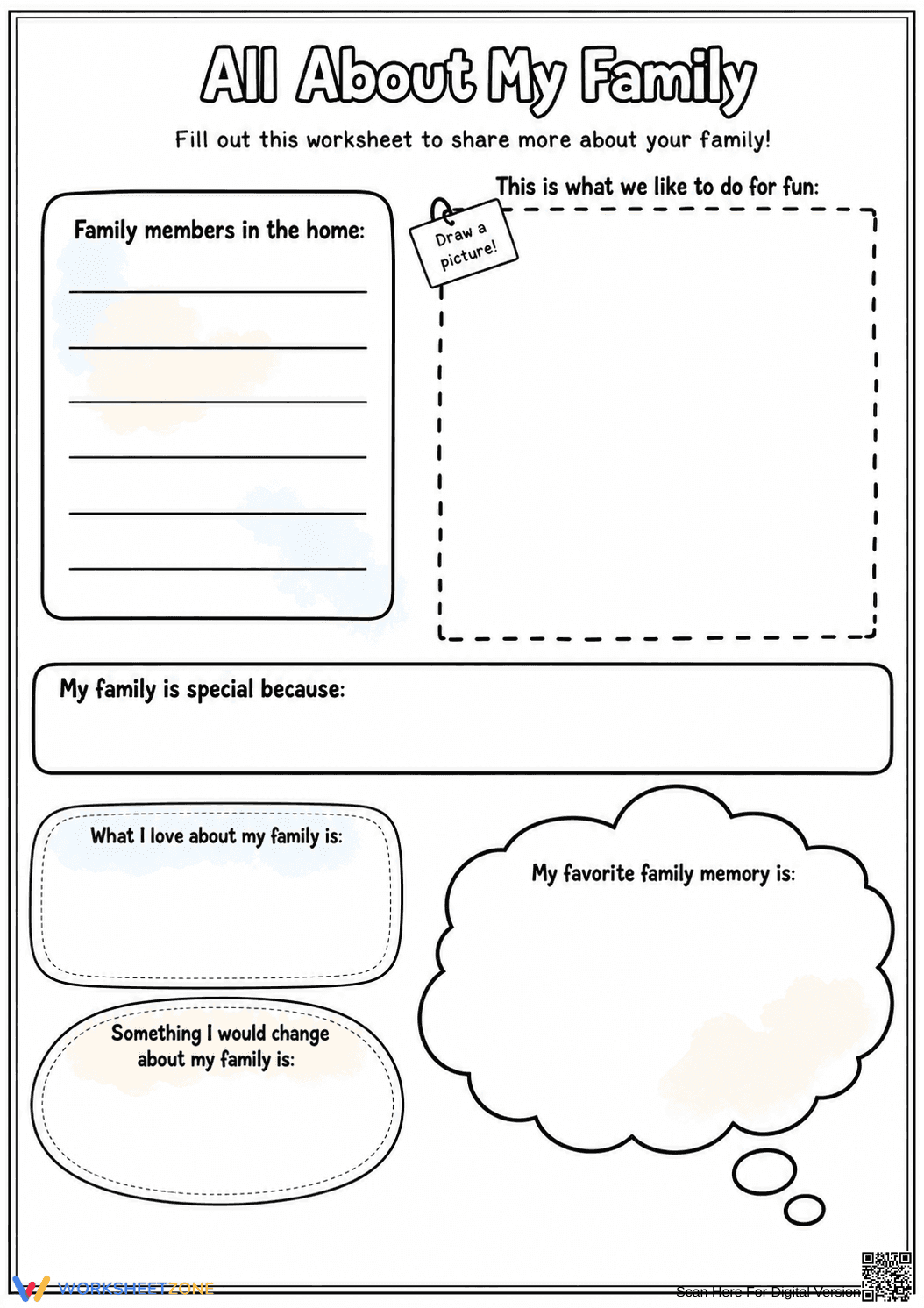

Grade 1-3 Family Roles — Printable No-Prep Worksheet
Paste this activity's link or code into your existing LMS (Google Classroom, Canvas, Teams, Schoology, Moodle, etc.).
Students can open and work on the activity right away, with no student login required.
You'll still be able to track student progress and results from your teacher account.
This Grade 1-3 social skills worksheet helps students explore their unique family dynamics through six reflective prompts. By combining drawing and writing, learners share personal narratives that foster self-awareness and classroom community. It provides a structured, engaging way for children to express feelings about their home life and cherished memories.
At a Glance
- Grade: 1-3 · Subject: Social Skills
- Standard:
CCSS.ELA-LITERACY.W.2.3— Write narratives recounting personal experiences- Skill Focus: Family Roles & Narrative Writing
- Format: 1 page · 6 prompts · No answer key needed · PDF
- Best For: Social-emotional learning and morning work
- Time: 15–25 minutes
This single-page PDF features six distinct interactive zones designed for young learners. It includes a list format for household members, a large drawing box for family activities, and four sentence-completion prompts. The layout uses varied shapes like rectangles, clouds, and ovals to visually separate different thoughts, making the six tasks approachable for students who are still developing fine motor and writing skills.
This zero-prep design allows for immediate classroom implementation. Print the single-page PDF (30 seconds). Distribute the sheets and explain the drawing and writing prompts (1 minute). Review by facilitating a voluntary share-out session where students present their favorite family memory (10-15 minutes). Total teacher preparation time is under two minutes, making it an ideal sub plan or morning work activity.
This resource aligns with CCSS.ELA-LITERACY.W.2.3, which requires students to write narratives that recount well-elaborated events and include details to describe actions, thoughts, and feelings. By prompting students to describe what they love and what they would change, it also supports early speaking and listening skills. Both standard codes can be copied directly into lesson plans, IEP goals, or district curriculum mapping tools.
Use this worksheet during a "Me and My World" social studies unit or as a formative assessment for introductory narrative writing. It is particularly effective during the first week of school to build rapport before direct instruction begins. Observe how students describe their different family aspects to identify those who may need additional social-emotional support. Expect completion in 15 to 25 minutes.
This activity is designed for elementary students in grades 1 through 3, including English Language Learners who benefit from the visual drawing component. It pairs naturally with a read-aloud book about diverse families or an anchor chart listing different types of family members and household roles.
Research from Fisher & Frey (2014) emphasizes that connecting classroom content to a student's personal life and family background significantly increases engagement and retention. This worksheet facilitates that connection by utilizing the CCSS.ELA-LITERACY.W.2.3 standard to bridge the gap between home and school. By asking students to write narratives recounting personal experiences and describe family roles, the activity promotes narrative development while simultaneously supporting social-emotional learning goals. Structured reflection on personal identity and social structures in early elementary years builds the foundational self-awareness necessary for long-term academic success. This one-page resource provides the necessary scaffolding for young writers to transition from simple identification to complex emotional expression. It serves as a vital tool for educators looking to implement culturally responsive teaching practices that honor the diverse family structures present in modern American classrooms.


