Where communication skills worksheets fit in a K-12 SEL routine
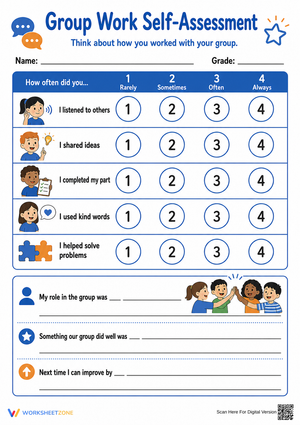
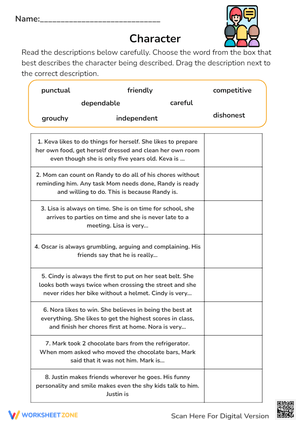
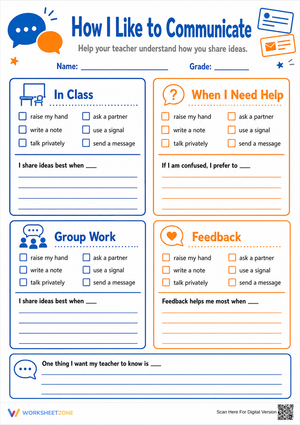
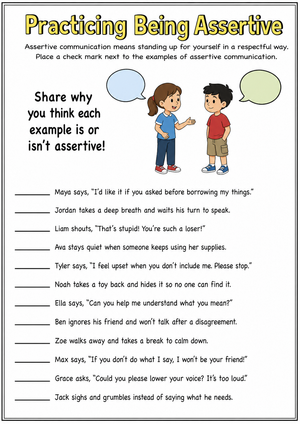
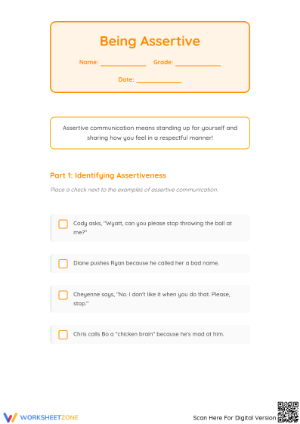
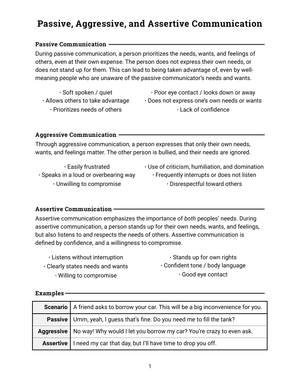
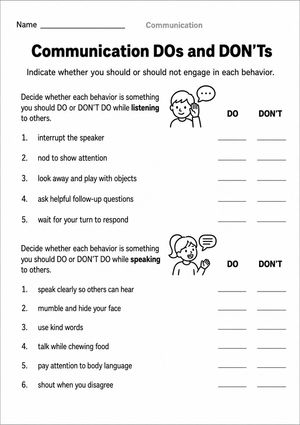
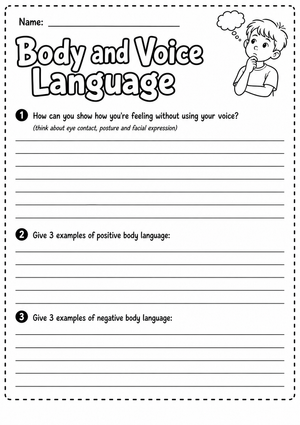
Most teachers don't have a spare block on the schedule set aside for talking practice. That's exactly why communication skills worksheets are useful. They slot into structures you already run: a morning advisory period, a Friday SEL block, a small-group intervention table, or the first ten minutes of a counseling pull-out. Instead of hoping students absorb turn-taking and active listening by osmosis, these pages give you a concrete artifact to teach from, point back to, and revisit week after week.
The pedagogical logic is straightforward. Communication is a relationship skill, and relationship skills improve with explicit instruction paired with frequent, structured chances to practice. A worksheet supplies the explicit part; the partner talk, role-play, and group discussion you build around it supply the practice. Treated that way, the paper is a launchpad rather than the whole lesson, and students leave with language they can actually reuse when a real conversation gets hard.
Core skills these worksheets should target
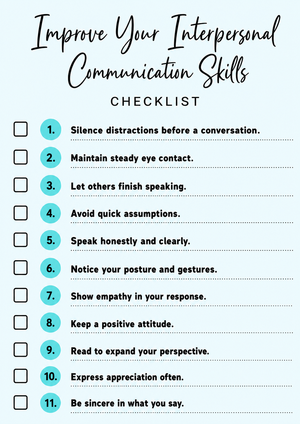
Not every page labeled communication is worth printing. The strongest sets isolate one observable skill at a time, so both you and your students can tell whether it's improving. When you're choosing or building a set, look for pages that practice:
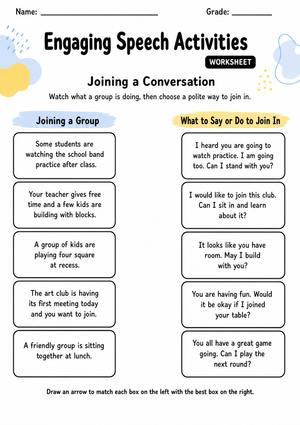
- Turn-taking: waiting for a natural pause, signaling before speaking, and sharing airtime fairly in a group.
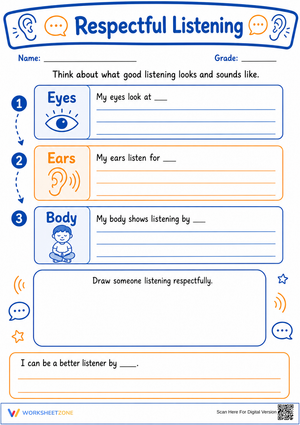
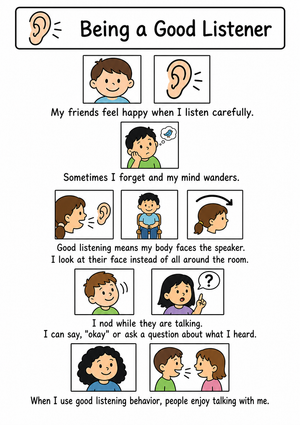
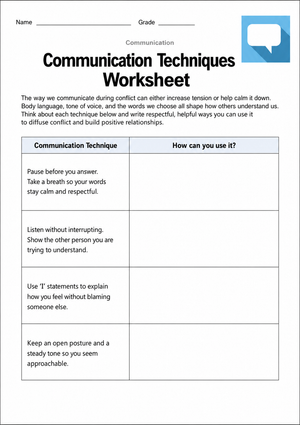
- Active listening: paraphrasing what a partner said before responding, and asking a clarifying question instead of jumping in.
- Staying on topic: keeping a conversation focused and noticing the moment it starts to drift.
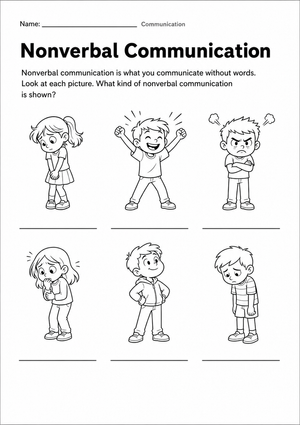
- Reading nonverbal cues: interpreting body language, facial expression, and tone of voice.
- Giving constructive feedback: responding to a peer's idea with language that is specific, kind, and useful.
Matching the skill to the grade band matters as much as the skill itself. Early elementary students need heavy scaffolding around basic turn-taking and listening, while upper-grade students can handle structured debate, perspective-taking, and productive disagreement without shutting down. A worksheet that fits a second grader will bore an eighth grader, and vice versa.
It also helps to pair verbal and nonverbal targets in the same week. A page on asking clarifying questions lands better when students have already practiced reading a confused facial expression, because they learn to notice the cue and then respond to it. Sequencing the skills this way mirrors how real conversations actually unfold, rather than treating each micro-skill as an isolated drill.
Why explicit communication practice pays off
The case for spending scarce instructional minutes here is stronger than many teachers assume.
According to CASEL's Fundamentals of SEL, students who receive systematic social-emotional instruction score an average of 11 percentile points higher on achievement measures than peers who don't. That single data point is why explicit communication practice deserves a permanent spot in the weekly schedule rather than a slot filled only when there happens to be time left over.
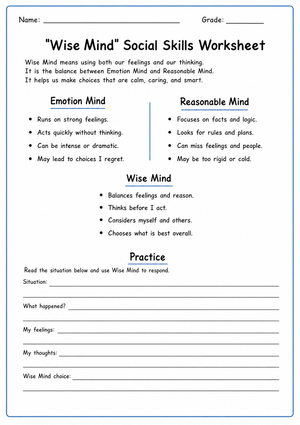
Communication skills sit primarily under two of CASEL's five core competencies, relationship skills and social awareness, so the practice students get on these pages compounds across the rest of your SEL work. Clearer speaking and steadier listening also tend to show up as reduced student stress and smoother group work, which pays you back during every content lesson that depends on collaboration.
Classroom Implementation
A worksheet only changes behavior when you wrap a predictable routine around it. A sequence that holds up across grade levels looks like this:
- Model first: think aloud through one item so students hear the target skill in action before they try it.
- Guided pair practice: students complete a section, then rehearse it with a partner using the exact language printed on the page.
- Group application: move the skill into a real discussion, game, or role-play where the paper is set aside.
- Quick debrief: ask two or three students to name one specific thing a partner did well.
Keep the cadence steady. A short worksheet-anchored routine two or three times a week outperforms one long session a month apart, because communication skills fade quickly without repetition. It also helps to post the sentence stems from recent pages somewhere visible so students reuse that language during content lessons, not only during dedicated SEL time.
One caution: don't let the worksheet become the entire activity. Students can complete a listening page perfectly and still interrupt each other five minutes later. The transfer only happens when the group-application step is non-negotiable, so protect those few minutes even on a busy day.
Using worksheets in small-group and intervention settings
Communication worksheets earn their keep in intervention. For students with social skill deficits or IEP goals tied to pragmatic language, a structured page lowers the demand: the skill is broken into steps, the expected response is visible on the page, and progress is easy to document. Counselors and special education staff can run the same worksheet across several sessions, raising the difficulty each time, from choosing a listening response off a list, to generating one independently, to using it in an unscripted exchange with a peer.
Because the artifact is concrete, it doubles as evidence for progress monitoring. A dated stack of a student's responses shows growth far more convincingly than a note saying a student participated in group, and it gives you something specific to share at an IEP meeting or a parent conference. It's also a quick way to spot a student whose needs exceed classroom-level support and warrant a referral.
Turning worksheets into formative assessment
Here's the move most teachers skip: treat the first worksheet of a unit as a low-stakes diagnostic instead of a graded task. Because each page isolates a single observable skill, a class set doubles as a heat map of exactly who struggles with turn-taking versus who can't yet paraphrase a partner. Sort the finished pages into two fast piles, used the skill and named it but didn't use it, and you have a targeted small group defined by the end of one period, with no separate screener required. That turnaround, from paper to grouped intervention in under thirty minutes, is what makes worksheet-based communication practice worth the print run.
From there, reuse the same page format later in the unit and compare the two side by side. Growth on an identical task is a far cleaner signal than a rubric applied to two different activities.
Frequently asked questions
1. What grade levels are communication skills worksheets appropriate for?
All of K-12, as long as the skill matches the band. Early elementary pages focus on turn-taking, listening, and naming feelings, while middle and high school pages move into perspective-taking, structured disagreement, and constructive feedback.
2. How do these worksheets support students with social skill deficits or IEP goals?
They break a broad goal such as communicating appropriately with peers into visible, teachable steps and produce dated work samples you can use for progress monitoring in intervention or counseling sessions.
3. How often should teachers use communication worksheets in an SEL routine?
Short and frequent beats long and rare. A brief worksheet-anchored routine two or three times a week keeps skills from fading better than one long monthly session ever will.
4. Can they be used for both whole-class instruction and small-group intervention?
Yes. The same page works as a whole-class SEL lesson and, at a slower pace with more repetition, as a small-group or pull-out intervention tool.
5. How do these worksheets connect to broader SEL competencies?
Communication sits mainly under relationship skills and social awareness, two of CASEL's five core competencies, so practicing it strengthens students' broader social-emotional foundation.