


























Views
Downloads


Printable Family Roles Worksheet | Grade K-1 English
Paste this activity's link or code into your existing LMS (Google Classroom, Canvas, Teams, Schoology, Moodle, etc.).
Students can open and work on the activity right away, with no student login required.
You'll still be able to track student progress and results from your teacher account.
This foundational writing worksheet helps early learners articulate the roles and characteristics of their family members. By completing structured sentence starters, students practice basic vocabulary and sentence construction while reflecting on the people in their homes. The activity naturally bridges social-emotional learning with early literacy skills.
At a Glance
- Grade: K · Subject: English
- Standard:
CCSS.ELA-LITERACY.W.K.2— Compose informative texts supplying information about a topic- Skill Focus: Describing family roles
- Format: 3 pages · 8 problems · No answer key · PDF
- Best For: Independent writing practice
- Time: 15–20 minutes
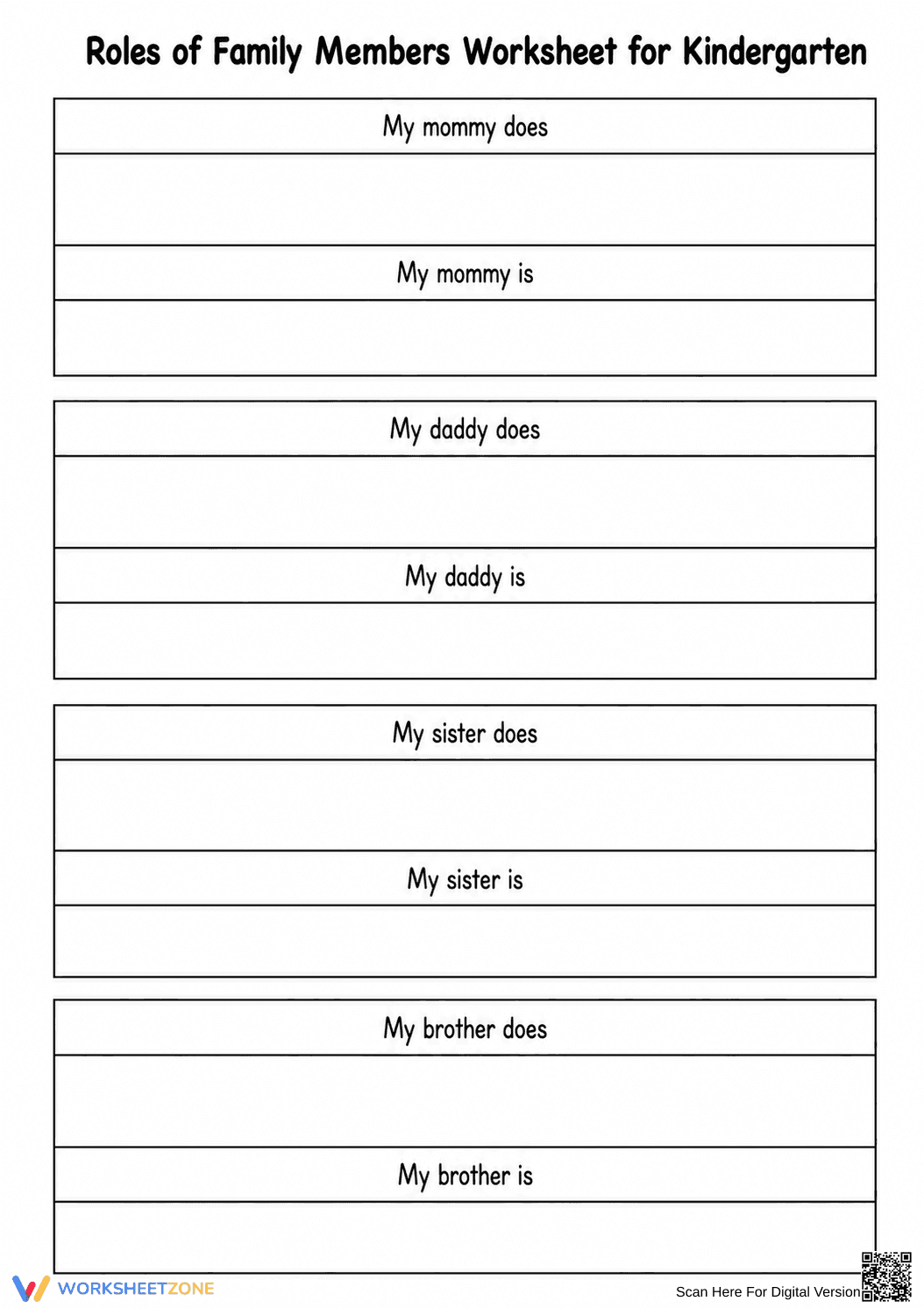
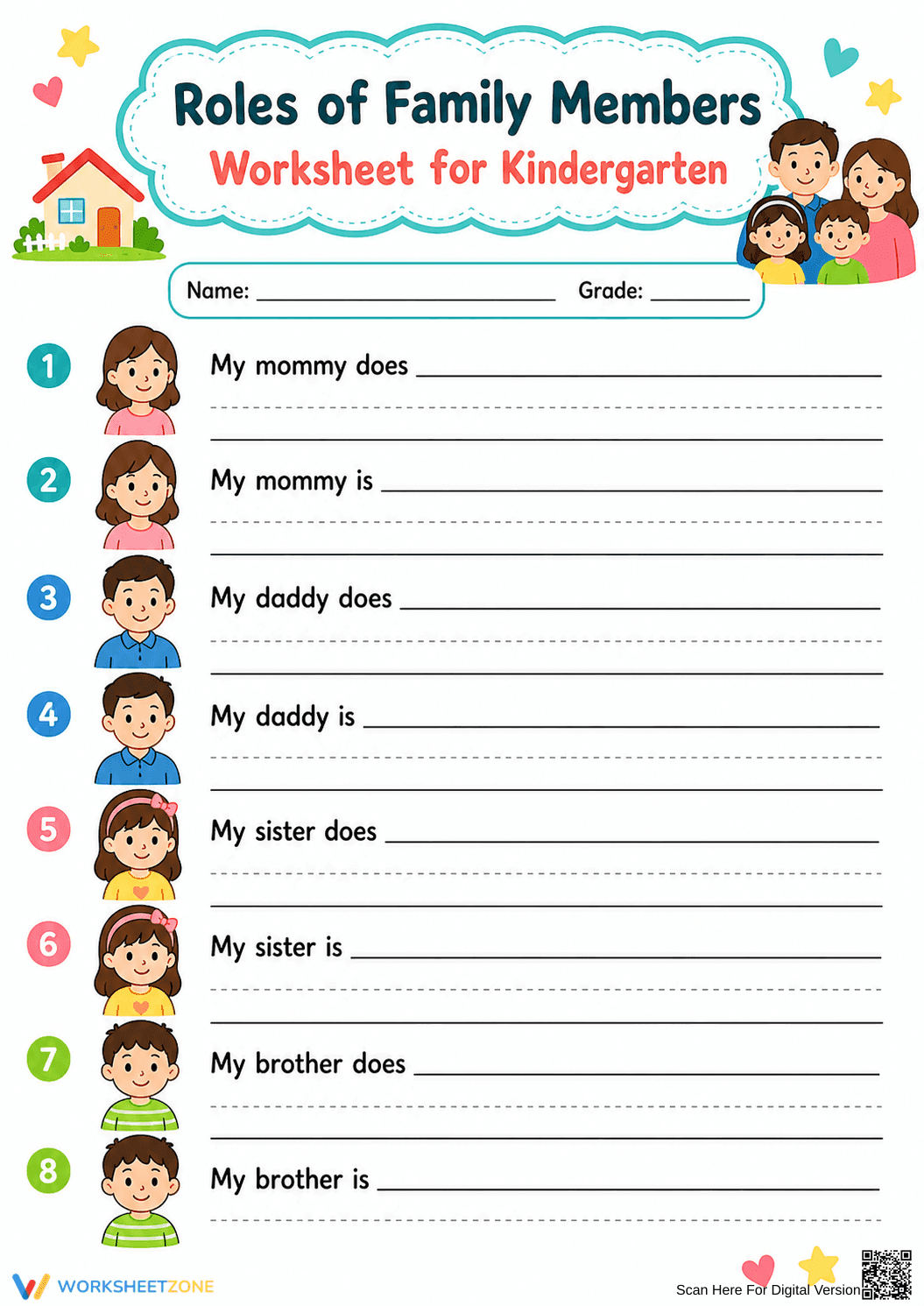
This resource includes three distinct visual variations of the same eight-prompt activity, allowing educators to choose the best format for their learners. Students will find sentence frames such as "My mommy does..." and "My mommy is..." for four common family roles. The most supportive version features colorful character icons and primary dotted writing lines to guide letter formation, while the other versions offer standard blank boxes for drawing or larger text.
Skill Progression
- Guided practice: Teachers can model the first prompt on the board, brainstorming action verbs together as a class.
- Supported practice: Students use the provided sentence frames and primary dotted lines to sound out and write their own descriptive words.
- Independent practice: Learners complete the remaining prompts, applying their growing vocabulary to describe their fathers, sisters, and brothers.
This gradual-release approach ensures young writers feel confident moving from oral brainstorming to independent written expression.
Standards Alignment
This activity aligns with CCSS.ELA-LITERACY.W.K.2: "Use a combination of drawing, dictating, and writing to compose informative/explanatory texts in which they name what they are writing about and supply some information about the topic." It also supports early social studies frameworks regarding family structures. Both standard codes can be copied directly into lesson plans, IEP goals, or district curriculum mapping tools.
How to Use It
Introduce this worksheet during a social studies unit on families or a language arts block focused on descriptive writing. Before independent work, read a picture book about diverse families to activate prior knowledge. As a formative assessment tip, observe whether students are using phonetic spelling to complete the sentence frames or if they rely heavily on drawing. Expect this activity to take 15 to 20 minutes depending on the child's writing fluency.
Who It's For
This resource is designed for kindergarten and early first-grade students developing their foundational writing skills. It is easily differentiated: pre-writers can dictate their answers to an adult or draw pictures in the provided spaces, while more advanced students can write full phonetic sentences. It pairs perfectly with a classroom anchor chart listing common family activities and descriptive adjectives.
Integrating personal experiences into early writing tasks significantly boosts student engagement and vocabulary retention. According to Fisher & Frey (2014), connecting literacy instruction to a child's immediate environment provides the necessary context for meaningful language acquisition. This worksheet targets CCSS.ELA-LITERACY.W.K.2, requiring students to compose informative texts supplying information about a topic. By prompting learners to describe what family members do and who they are, the activity reinforces both expressive language and social awareness. Structured sentence frames lower the cognitive barrier for emergent writers, allowing them to focus on phonetic spelling and idea generation rather than syntax. This targeted practice ensures that foundational literacy skills are developed in a supportive, highly relevant context, bridging the gap between home life and academic expectations.


