




























Views
Downloads

Printable Family Roles Worksheet | Social Skills Guide

Paste this activity's link or code into your existing LMS (Google Classroom, Canvas, Teams, Schoology, Moodle, etc.).
Students can open and work on the activity right away, with no student login required.
You'll still be able to track student progress and results from your teacher account.
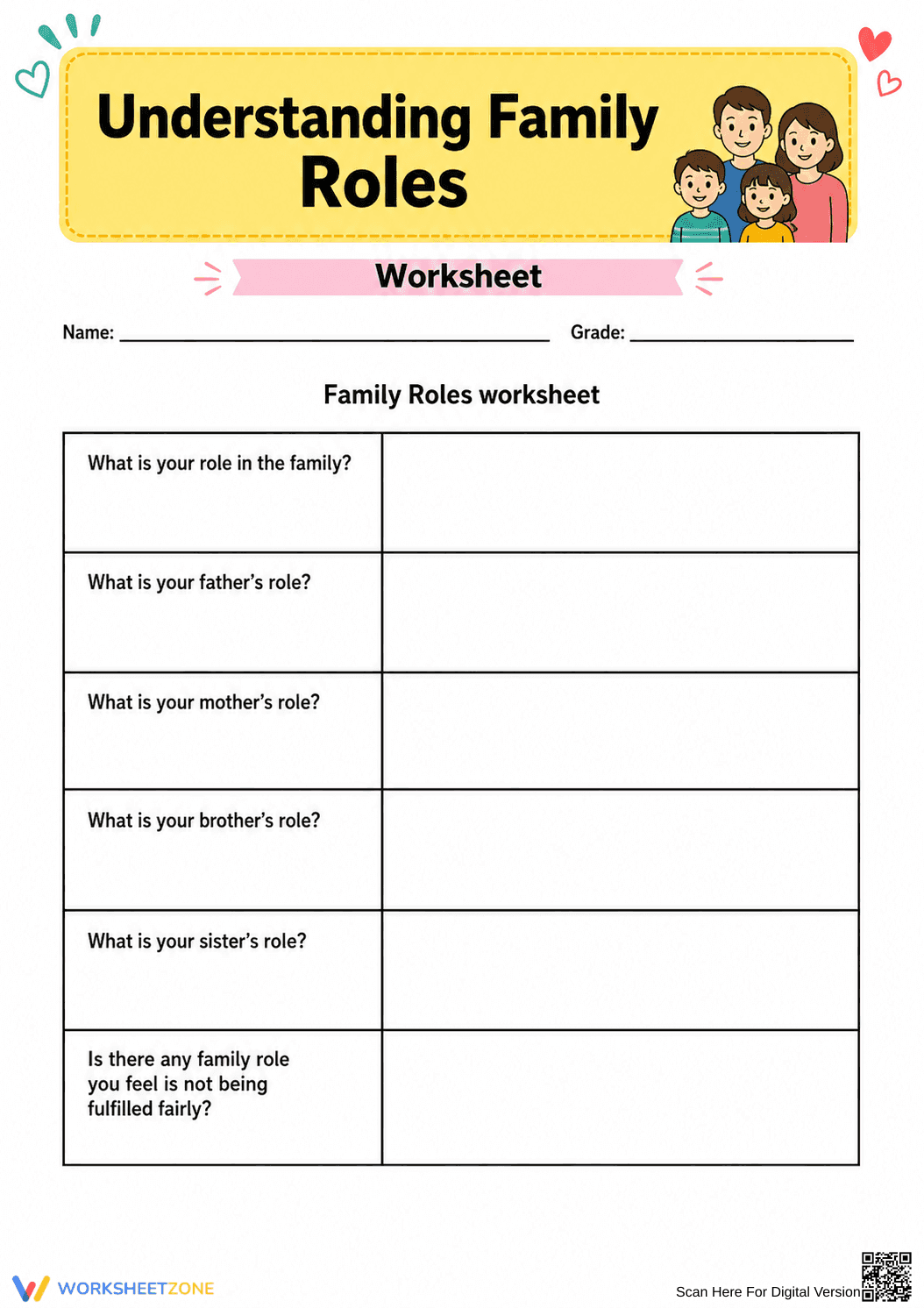
This printable family roles worksheet helps students explore their household dynamics through guided self-reflection. By answering targeted questions about each family member's responsibilities, learners develop greater empathy and social awareness. This exercise encourages critical thinking about fairness and expectations within the home environment.
At a Glance
- Grade: 8 · Subject: Social Emotional Learning
- Standard:
CCSS.ELA-LITERACY.W.8.4— Produce clear and coherent writing appropriate to the task- Skill Focus: Self-reflection and family dynamics
- Format: 1 page · 6 problems · No answer key · PDF
- Best For: Counseling sessions and SEL blocks
- Time: 15–20 minutes
This single-page resource features a straightforward, easy-to-read table format containing six open-ended reflection prompts. Students are asked to define their own role within the family, as well as the roles of their parents and siblings. The final question challenges them to identify any responsibilities they feel are not being fulfilled fairly, prompting deeper analytical thinking. Because responses are highly personal, no answer key is required or included.
This resource is designed for immediate implementation with a simple zero-prep workflow:
- Print (1 minute): The clean, black-and-white table design prints quickly and requires minimal ink.
- Distribute (1 minute): Hand out the single-page PDF to students during homeroom, advisory, or a counseling session.
- Review (5 minutes): Briefly explain the concept of a "role" (e.g., peacemaker, organizer, caregiver) before students begin writing.
Total teacher preparation time is under two minutes, making this an excellent emergency sub plan or quick transition activity.
This activity aligns with CCSS.ELA-LITERACY.W.8.4: "Produce clear and coherent writing in which the development, organization, and style are appropriate to task, purpose, and audience." It also supports broader Social-Emotional Learning (SEL) frameworks by fostering social awareness and relationship skills. Both standard codes can be copied directly into lesson plans, IEP goals, or district curriculum mapping tools.
Educators and counselors can utilize this worksheet in multiple ways. Use it as a warm-up activity before a group discussion on family diversity and household responsibilities. Alternatively, assign it during a one-on-one counseling session to help a student articulate frustrations or misunderstandings at home. As a formative assessment tip, observe whether students focus on practical chores (like taking out the trash) or emotional roles (like being the family comedian), which can guide follow-up conversations. Expect students to complete the writing portion in 15 to 20 minutes.
This worksheet is primarily designed for middle school students, high schoolers, and young adults in college who are developing deeper self-awareness. It is highly effective for school counselors, therapists, and special education teachers working on social skills and perspective-taking. For differentiation, students who struggle with writing can dictate their answers or discuss them orally. Pair this activity with a direct instruction lesson on healthy communication boundaries.
Integrating structured reflection tools into social-emotional learning blocks significantly improves students' ability to articulate complex interpersonal dynamics and build empathy. This worksheet directly targets CCSS.ELA-LITERACY.W.8.4, requiring learners to produce clear and coherent writing appropriate to the task of analyzing family roles and household expectations. According to a RAND AIRS 2024 report, students who regularly engage in guided self-reflection exercises demonstrate a measurable increase in their capacity to resolve peer and family conflicts constructively. By prompting individuals to evaluate the fairness of household responsibilities, this activity bridges the gap between personal experience and structured expressive writing. The open-ended format ensures that learners must synthesize their daily observations into coherent written statements, reinforcing both emotional intelligence and core literacy skills simultaneously in the classroom.


