


























Views
Downloads
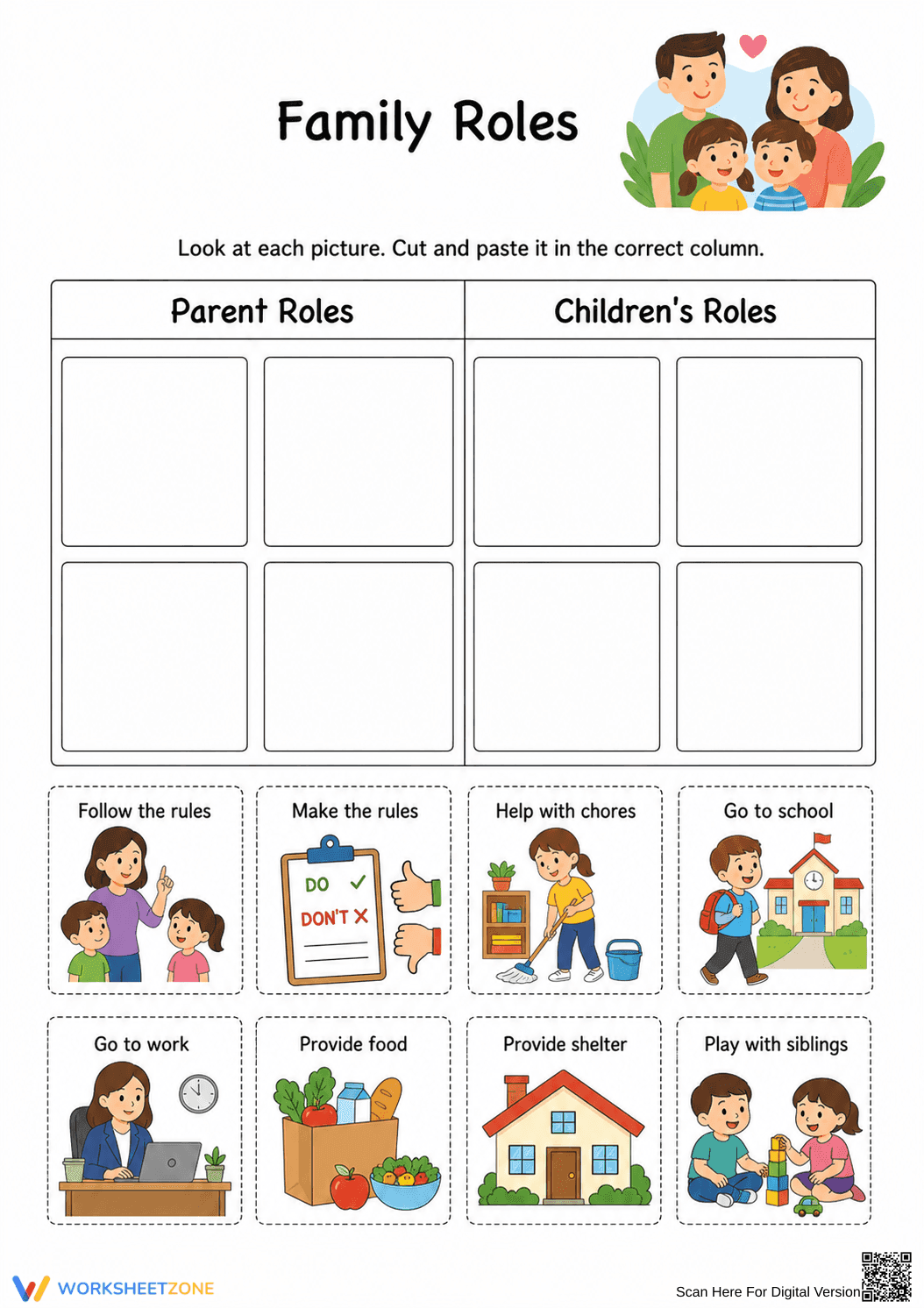

Family Roles Worksheet | Grade 1-3 Essential Printable
Paste this activity's link or code into your existing LMS (Google Classroom, Canvas, Teams, Schoology, Moodle, etc.).
Students can open and work on the activity right away, with no student login required.
You'll still be able to track student progress and results from your teacher account.
This Grade 1-3 family roles worksheet helps students distinguish between the responsibilities of parents and children through a visual sorting activity. By categorizing 8 specific daily tasks, learners develop a foundational understanding of household dynamics. It is an effective tool for building empathy and awareness of community roles before moving into complex social studies topics.
At a Glance
- Grade: 1-3 · Subject: Social Skills
- Standard:
CCSS.ELA-LITERACY.RI.1.3— Describe the connection between individuals and their specific roles or responsibilities- Skill Focus: Identifying family responsibilities
- Format: 1 page · 8 problems · Answer key included · PDF
- Best For: Social-emotional learning and introductory civics
- Time: 10–15 minutes
What's Inside
The resource features a clean, two-column graphic organizer labeled for Parent Roles and Children's Roles. Below the organizer, students find 8 illustrated cards depicting common household actions like "Provide food" and "Follow the rules." The layout is designed for easy cutting and pasting, accompanied by a clear answer key for quick grading and feedback.
Zero-Prep Workflow
This activity requires minimal teacher intervention. First, print the single-page PDF (30 seconds). Next, distribute the sheets to students for independent sorting (10 minutes). Finally, review the completed columns as a whole class to reinforce the concepts (2 minutes). Total teacher prep time is under 2 minutes, making it an ideal sub-plan or morning work option.
Standards Alignment
The primary standard addressed is `CCSS.ELA-LITERACY.RI.1.3`, focusing on describing the connection between individuals and ideas. By analyzing the relationship between a family member and their specific duties, students practice informational text analysis through visual cues. This standard code can be copied directly into lesson plans, IEP goals, or district curriculum mapping tools to ensure compliance.
How to Use It
Use this worksheet during a Social Studies unit on communities or as an SEL activity to discuss household expectations. It works best after direct instruction on family functions. For a formative assessment, observe if students can explain why "Make the rules" belongs in the parent column. Completion typically takes 12 minutes for most second-grade learners.
Who It's For
This resource is designed for early elementary students in Grades 1 through 3, including English Language Learners who benefit from visual supports. It pairs naturally with a classroom anchor chart about community helpers or a read-aloud book regarding different types of families. It is also suitable for special education settings focusing on life skills.
According to the RAND AIRS 2024 report, visual sorting activities significantly improve categorical reasoning in early childhood learners by providing concrete representations of abstract social concepts. This worksheet targets CCSS.ELA-LITERACY.RI.1.3 by requiring students to identify the specific roles and responsibilities that define familial relationships. By engaging with 8 distinct scenarios, students move beyond simple identification toward an understanding of social interdependence. Research from Fisher & Frey (2014) suggests that such scaffolded visual tasks are essential for developing the background knowledge necessary for later complex text analysis. This resource provides a structured environment for students to practice these critical thinking skills while meeting state and national standards for social-emotional development and informational literacy. It serves as a reliable bridge between personal experience and academic social studies frameworks, ensuring students grasp the fundamental building blocks of community life.


