


























Views
Downloads

Essential Family Member Responsibilities Worksheet | Grade 2
Paste this activity's link or code into your existing LMS (Google Classroom, Canvas, Teams, Schoology, Moodle, etc.).
Students can open and work on the activity right away, with no student login required.
You'll still be able to track student progress and results from your teacher account.
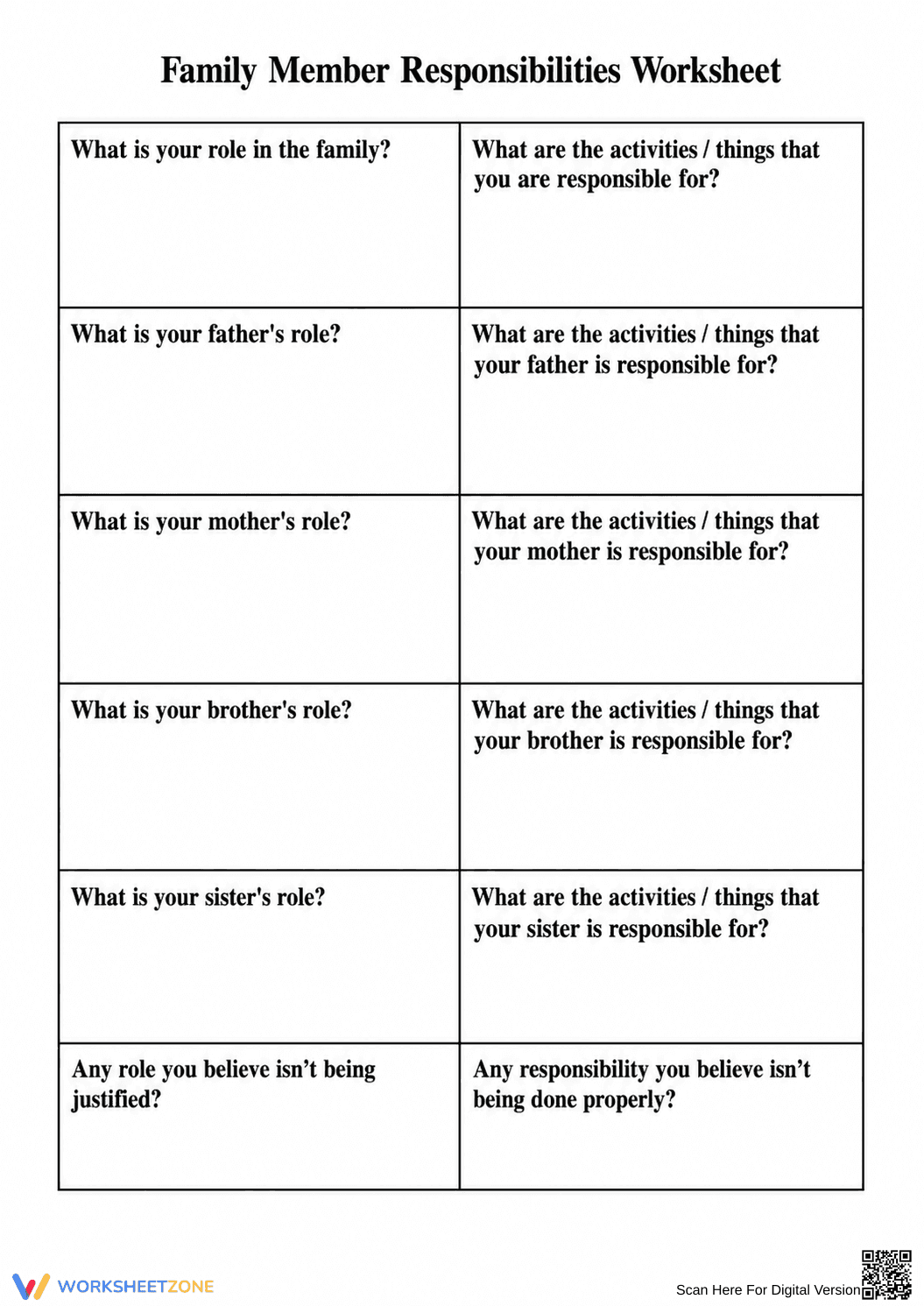
This Grade 2 social skills worksheet provides a structured framework for students to analyze the dynamics of their household. By identifying specific roles and the activities associated with them, learners develop a deeper understanding of community and cooperation within the family unit. This exercise fosters self-awareness and empathy as students reflect on the contributions of others.
At a Glance
- Grade: 2 · Subject: Social Skills
- Standard:
CCSS.ELA-LITERACY.W.2.8— Recall information from experiences to answer questions about family roles.- Skill Focus: Identifying family responsibilities
- Format: 1 page · 12 problems · Open-ended response · PDF
- Best For: Social-emotional learning and family studies
- Time: 15–20 minutes
What's Inside
The worksheet features a clean, two-column table layout with 12 distinct prompts. The left column asks students to define the "role" of specific family members, including themselves, parents, and siblings. The right column requires them to list specific "activities or things" that person is responsible for. The final row introduces critical thinking by asking students to identify roles that may feel unjustified or responsibilities that are not being performed properly, encouraging honest reflection.
Zero-Prep Workflow
This resource is designed for a zero-prep classroom environment. Teachers can print the single-page PDF in less than 30 seconds. Distribution takes approximately 1 minute, as the instructions are self-explanatory and require no additional lecturing. Reviewing the responses can be done through a 5-minute pair-share activity or a whole-class discussion, making the total teacher engagement time minimal while maximizing student reflection.
Standards Alignment
This worksheet aligns with `CCSS.ELA-LITERACY.W.2.8`: "Recall information from experiences or gather information from provided sources to answer a question." By prompting students to look at their daily lives and document the division of labor at home, it meets the requirement for experiential recall. Both standard codes can be copied directly into lesson plans, IEP goals, or district curriculum mapping tools.
How to Use It
Use this worksheet during a Social Studies unit on communities or as part of a Social-Emotional Learning (SEL) block focused on responsibility. It is best assigned after a brief discussion about what "responsibility" means in a group setting. As a formative assessment, observe whether students can distinguish between a "role" (e.g., protector, provider) and a "task" (e.g., washing dishes).
Who It's For
This resource is tailored for students in Grades 1 through 3 who are beginning to understand social structures. It is particularly useful for school counselors or therapists working on family communication. It pairs naturally with an anchor chart about "Helping Hands" or a direct instruction lesson on household cooperation.
According to the RAND AIRS 2024 report on social-emotional learning, structured reflection on personal social environments, such as the family unit, significantly improves a child's ability to understand social hierarchies and cooperative labor. This worksheet facilitates that development by requiring students to articulate the specific responsibilities of their family members. By using the CCSS.ELA-LITERACY.W.2.8 standard as a foundation, the activity bridges the gap between literacy skills and social awareness. Research indicates that when students can name the roles within their immediate community, they are more likely to take ownership of their own tasks and demonstrate increased empathy toward the labor of others. This 12-task reflection tool provides the necessary scaffolding for young learners to move from simple observation to critical analysis of their domestic environment, ensuring a comprehensive understanding of family dynamics and personal accountability.


