




























Views
Downloads
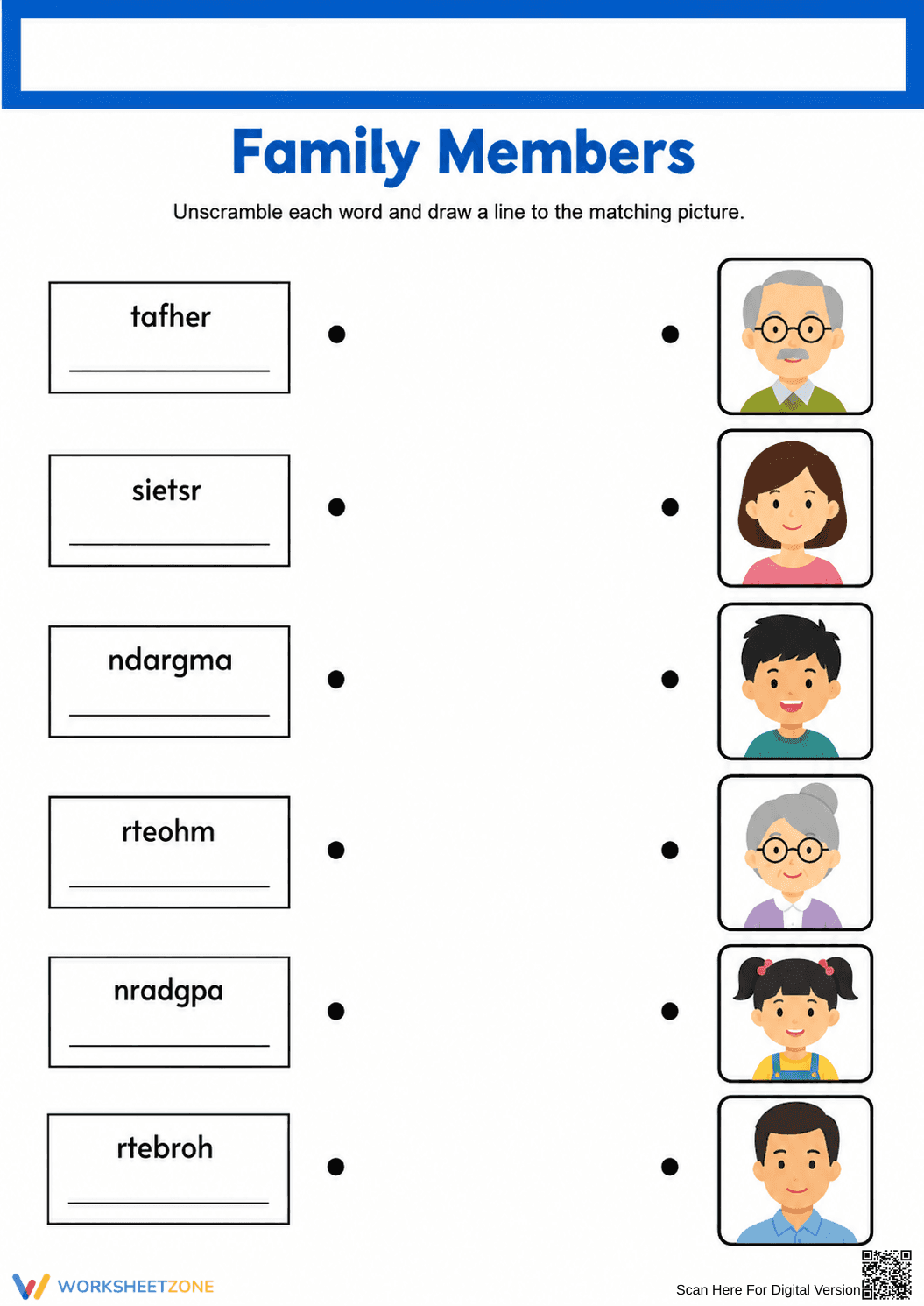

Printable Family Members Matching Worksheet | Grade 1

Paste this activity's link or code into your existing LMS (Google Classroom, Canvas, Teams, Schoology, Moodle, etc.).
Students can open and work on the activity right away, with no student login required.
You'll still be able to track student progress and results from your teacher account.
This printable family members worksheet helps Grade 1 students master essential kinship vocabulary through a dual-task approach. By combining word unscrambling with visual matching, learners solidify their understanding of family roles while practicing foundational spelling conventions. It provides a clear, structured way to introduce social studies concepts within a literacy framework.
At a Glance
- Grade: Grade 1 · Subject: English
- Standard:
CCSS.ELA-LITERACY.L.1.2— Use conventional spelling for words with common spelling patterns and for frequently occurring irregular words.- Skill Focus: Family vocabulary and spelling
- Format: 1 page · 6 tasks · Answer key included · PDF
- Best For: Morning work or vocabulary centers
- Time: 10–15 minutes
This single-page PDF features six common family terms presented as letter scrambles, including "father," "sister," and "grandma." Each scrambled word is accompanied by a dedicated writing line for students to record the correct spelling. To the right, high-quality cartoon illustrations represent each family member, allowing students to draw connecting lines to demonstrate comprehension.
Zero-Prep Workflow
- Print: Generate the single-page PDF for your entire class in under 30 seconds.
- Distribute: Hand out the sheets during a morning transition or as a quiet warm-up activity.
- Review: Go over the answers as a whole group to provide immediate feedback on spelling and identification (2 minutes).
This streamlined workflow makes it an ideal choice for substitute teacher folders or emergency lesson plans when time is limited.
Standards Alignment
This resource aligns with `CCSS.ELA-LITERACY.L.1.2`, which requires students to demonstrate command of the conventions of standard English capitalization, punctuation, and spelling when writing. Specifically, it targets the ability to use conventional spelling for frequently occurring words. This standard code can be copied directly into lesson plans, IEP goals, or district curriculum mapping tools.
How to Use It
Use this worksheet as a formative assessment after a read-aloud about different types of families. Observe if students can phonetically decode the scrambled letters or if they rely solely on the visual cues of the images. Alternatively, assign it as a quiet independent activity during literacy centers to reinforce spelling patterns for high-frequency kinship terms. Expected completion time ranges from 10 to 15 minutes.
Who It's For
This activity is designed for Kindergarten and Grade 1 students, as well as English Language Learners (ELL) who are building their foundational vocabulary. It pairs naturally with an anchor chart displaying family member names or a picture book focused on family diversity. The visual matching component provides necessary scaffolding for students who are still developing their reading fluency.
According to the RAND AIRS 2024 report on early childhood literacy, the integration of visual aids with orthographic tasks significantly improves word retention in primary learners. This worksheet utilizes that principle by requiring students to unscramble letters—a task that builds phonemic awareness and spelling proficiency—before connecting the word to a representative image. By targeting CCSS.ELA-LITERACY.L.1.2, the activity ensures that students are practicing high-frequency vocabulary within a standards-based framework. Research from Fisher & Frey (2014) emphasizes that such "word work" is most effective when it involves multiple modes of representation, such as the text-to-image matching found here. This resource provides a structured environment for students to apply their knowledge of family roles while simultaneously strengthening their command of English conventions. It serves as a reliable tool for educators seeking to bridge the gap between social-emotional learning and core literacy skills in early elementary settings.


