Why Hero's Journey Worksheets In SEL Toolkit
Hero's Journey worksheets give teachers a single framework that does double duty. They teach narrative structure inside a short story or novel unit, and they open honest conversations about resilience, setbacks, and personal growth. For grades 7-10, where students are ready to analyze plot but still need concrete scaffolding, a well-built graphic organizer turns an abstract story pattern into something students can point to, label, and reuse across every text you assign.
The appeal for a busy classroom is practical. One printable can anchor a week of reading analysis, a group poster project, and a personal-narrative writing prompt. Instead of teaching plot structure in isolation, you hand students a map they already recognize from the movies they watch and the books stacked on your shelf.
The 12 Stages Students Will Map
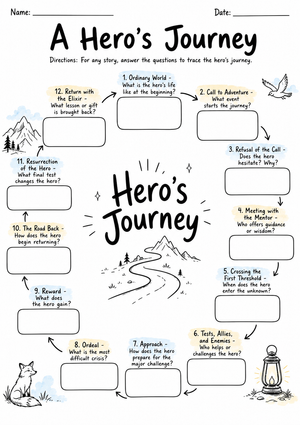
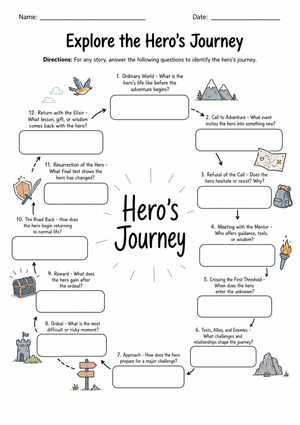
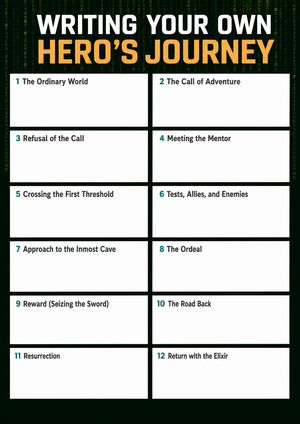
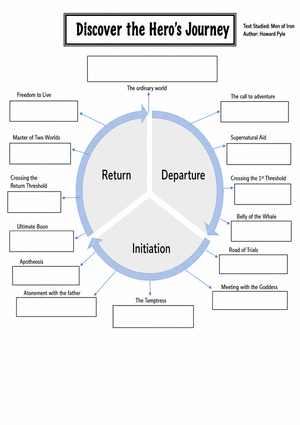
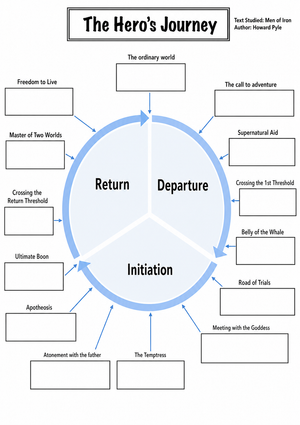
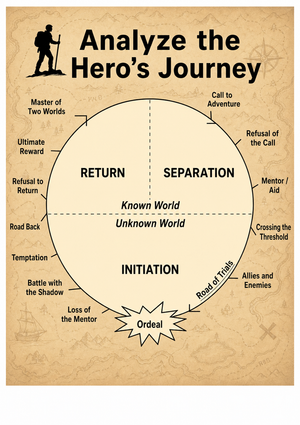
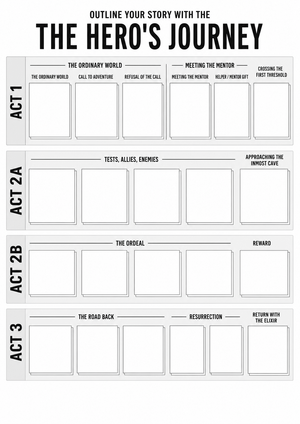
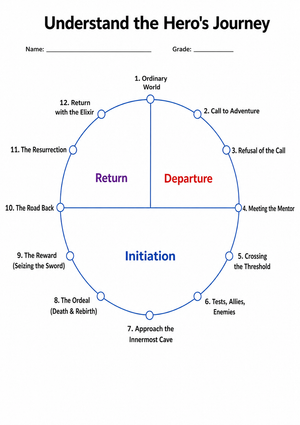
Most classroom versions of the Hero's Journey trace back to Joseph Campbell, who outlined the monomyth across 17 stages in The Hero with a Thousand Faces in 1949. Story analyst Christopher Vogler later condensed that framework into the 12 stages that fit neatly on a single worksheet:
- Ordinary World — the hero's normal life before the story begins
- Call to Adventure — a problem or challenge appears
- Refusal of the Call — the hero hesitates or resists
- Meeting the Mentor — a guide offers advice or tools
- Crossing the Threshold — the hero commits and enters a new world
- Tests, Allies, and Enemies — the hero learns the rules and meets key characters
- Approach — preparation for the biggest challenge
- Ordeal — the hardest moment, a major setback or fear
- Reward — the hero gains something from surviving the ordeal
- The Road Back — the hero turns toward home
- Resurrection — a final test that proves lasting change
- Return with the Elixir — the hero comes home transformed
ReadWriteThink's student interactive frames the Hero's Journey as a repeatable narrative arc students can apply to any story, from myth to film. That's the practical payoff of the 12-stage map: once students label the stages in one familiar movie, they carry the same framework into every novel, short story, and comic you teach all year.
Grade-Banding: Simplified Arcs vs. Full 12-Stage Analysis
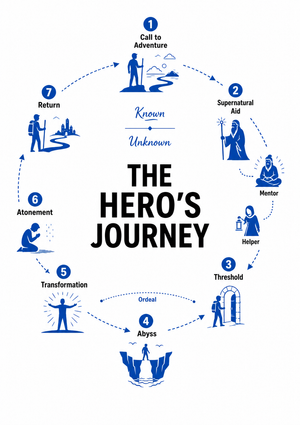
Not every class needs all 12 stages at once. For upper elementary and early middle school, a simplified 5-6 stage version keeps the focus on beginning, challenge, low point, and resolution without overwhelming students who are still building comprehension stamina. You can label these stages in plain language: ordinary life, the big problem, the hardest moment, and the changed hero.
By grades 8-10, students are ready for the full 12-stage analysis. At this level, the worksheet becomes a close-reading tool. Students defend each label with textual evidence, debate where the Ordeal actually falls, and notice when an author bends the pattern on purpose. That kind of disagreement is a sign the framework is working, because it pushes students back into the text to argue their case.
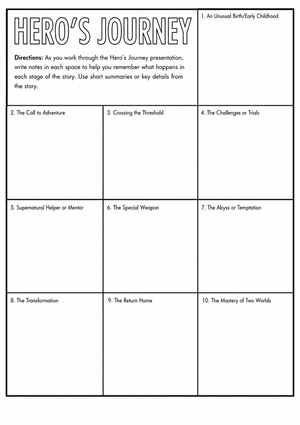
The worksheet also makes differentiation visible. In the same class, you can hand advanced readers a blank 12-stage organizer while struggling readers receive a version with the first three stages already labeled as a model. Everyone works with the same framework and the same text, but the level of support matches where each student is.
Where Narrative Structure Meets Social-Emotional Learning
The reason Worksheetzone files these worksheets under behavior and social skills is that the same map that explains plot also explains growth. When students see that every hero refuses the call, faces an ordeal, and returns changed, setbacks stop looking like failure and start looking like an expected stage of any worthwhile journey.
Here is the move experienced teachers use: assign the Ordeal stage first, not last. Because the Ordeal is where the hero's lowest point lives, students who map it early stop treating their own hard moments as evidence they can't succeed. Reframing one of 12 stages as a normal, temporary low point gives struggling readers and reluctant writers a concrete vocabulary for perseverance, and it turns an abstract SEL goal like resilience into a specific, labeled box on a page they can revisit all semester.
Perspective-taking follows naturally. When students compare how two characters, or two classmates, would map the same event onto the journey, they practice seeing a challenge through more than one lens. That habit is exactly what makes the Hero's Journey a fit for character education, not just literary analysis.
Using These Worksheets In SEL and ELA Classes
Start with a shared text everyone knows so the pattern is obvious before it gets subtle. A popular animated film or a widely read novel lets the whole class practice labeling stages together. Once students trust the map, move them into smaller texts where the pattern is less clear.
- Map a movie: small groups choose a film and build a poster placing each scene on the correct stage, then present their reasoning.
- Narrative arc template: students complete the graphic organizer for the class novel, citing one piece of evidence per stage.
- Formative check: a quick exit ticket asking students to name the Ordeal and Reward tells you fast who understands rising and falling action.
- Personal journey draft: students map a real challenge of their own onto the stages as a prewriting step for a personal narrative.
Group poster projects work especially well because they make student thinking public. As groups defend where a scene belongs, you hear the reasoning behind their labels, and disagreements between groups become a quick, low-stakes class discussion about how flexible the framework really is.
Frequently Asked Questions
1. What are the 12 stages of the Hero's Journey used in classroom worksheets?
The 12 stages are Ordinary World, Call to Adventure, Refusal, Meeting the Mentor, Crossing the Threshold, Tests/Allies/Enemies, Approach, Ordeal, Reward, Road Back, Resurrection, and Return with the Elixir. Most printable worksheets list these in order with space for students to add evidence from the text.
2. What grade levels are Hero's Journey worksheets appropriate for?
They fit best in grades 7-10, where narrative structure is a core focus. A simplified 5-6 stage version works for upper elementary and middle school, while the full 12-stage analysis suits grades 8-12 and grade-specific sets.
3. How can teachers use the Hero's Journey to support social-emotional learning?
Have students map a personal challenge onto the stages, treating the Ordeal as a normal low point rather than a failure. This reframes setbacks as an expected part of growth and gives students concrete language for resilience and perspective-taking.
4. What books or movies work best for a Hero's Journey activity?
Any story with a clear arc works, from widely taught myths and novels to popular films and comic books. Start with a text the whole class already knows so the pattern is easy to spot, then move to less obvious examples.
5. How long does a typical Hero's Journey lesson take?
A single introductory lesson using one worksheet fits in one class period. A full unit that includes a group poster project, a class novel analysis, and student presentations usually runs one to two weeks depending on your schedule.