


























Views
Downloads

Essential Family Roles Worksheet | Grade 5 Social Skills
Paste this activity's link or code into your existing LMS (Google Classroom, Canvas, Teams, Schoology, Moodle, etc.).
Students can open and work on the activity right away, with no student login required.
You'll still be able to track student progress and results from your teacher account.
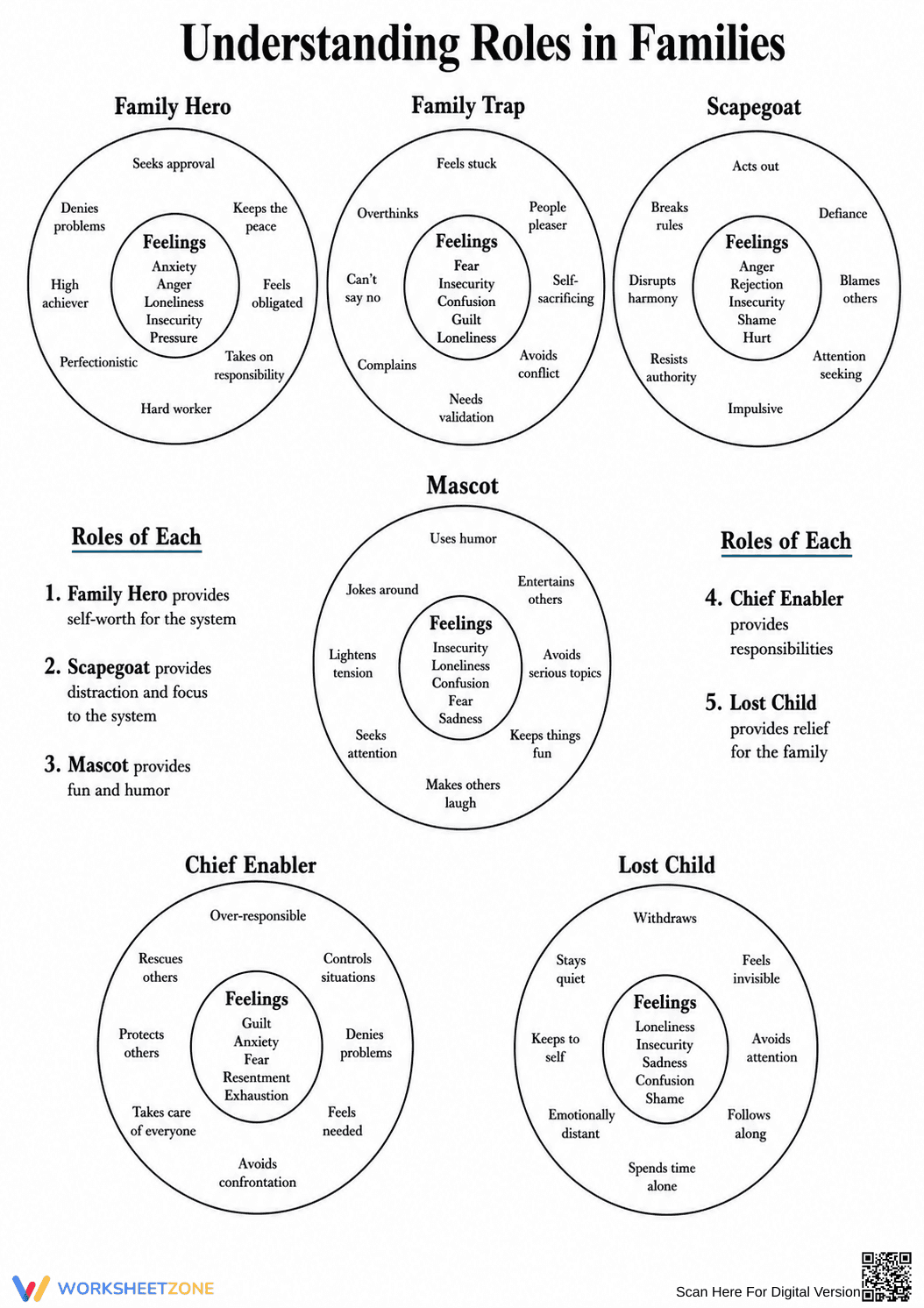
This worksheet provides a comprehensive visual guide for students to identify and understand complex family dynamics. By categorizing specific behaviors and internal feelings into six distinct roles, learners develop the vocabulary needed to discuss social structures and interpersonal relationships. This resource facilitates emotional intelligence and critical analysis of how individuals function within a group.
At a Glance
- Grade: 5 · Subject: Social Skills
- Standard:
CCSS.ELA-LITERACY.RI.5.3— Explain the relationships or interactions between two or more individuals- Skill Focus: Identifying family roles and dynamics
- Format: 1 page · 6 diagrams · Reference guide · PDF
- Best For: Social-emotional learning and group discussion
- Time: 20–30 minutes
What's Inside: The worksheet features six detailed circular diagrams representing the Family Hero, Family Trap, Scapegoat, Mascot, Chief Enabler, and Lost Child. Each diagram shows observable behaviors on the outer ring and internal feelings in the center. Below the visual aids, a concise summary explains the specific function each role serves within the family system, providing a clear 1-page reference.
Zero-Prep Workflow: This resource is designed for immediate classroom implementation with a total teacher preparation time of under 2 minutes. First, print the single-page PDF for each student. Next, distribute the sheets and allow students 10 minutes for silent reading and self-reflection. Finally, facilitate a 15-minute review or group discussion based on the provided role descriptions. It is an ideal "grab-and-go" resource for school counselors or as a sub plan.
Standards Alignment: The primary alignment is `CCSS.ELA-LITERACY.RI.5.3`, which requires students to explain the relationships or interactions between individuals in a text. By analyzing how the "Mascot" provides humor or the "Chief Enabler" provides responsibility, students practice identifying cause-and-effect relationships. This standard code can be copied directly into lesson plans, IEP goals, or district curriculum mapping tools.
How to Use It: Use this worksheet during a unit on social structures or as a formative assessment for emotional literacy. In a classroom setting, assign students to small groups to discuss which behaviors they have observed in fictional characters from literature. Alternatively, use it as a private reflection tool for students to better understand their own social interactions. Completion typically takes 25 minutes.
Who It's For: This resource is tailored for Grade 5 students but is highly adaptable for middle school social-emotional learning programs. It serves as an excellent pairing for character-driven novels or health curriculum units. School counselors and social workers will find it particularly useful for small-group interventions or individual counseling sessions focused on self-awareness.
According to research by Fisher & Frey (2014) on the gradual release of responsibility, providing students with clear visual frameworks like the "Understanding Roles in Families" worksheet is essential for mastering complex social-informational texts. The worksheet aligns with CCSS.ELA-LITERACY.RI.5.3 by requiring students to synthesize behavioral data with emotional outcomes to explain interpersonal interactions. By utilizing these 6 specific role diagrams, educators can bridge the gap between abstract psychological concepts and concrete student observations. This structured approach ensures that learners can identify the function of individuals within a system, a key component of both literacy and social-emotional development. Such evidence-based tools are critical for fostering the analytical skills necessary for navigating diverse social environments and achieving academic proficiency in informational reading tasks.


