




























Views
Downloads

Essential Family Roles Chart | Grade 5 Social Skills

Paste this activity's link or code into your existing LMS (Google Classroom, Canvas, Teams, Schoology, Moodle, etc.).
Students can open and work on the activity right away, with no student login required.
You'll still be able to track student progress and results from your teacher account.
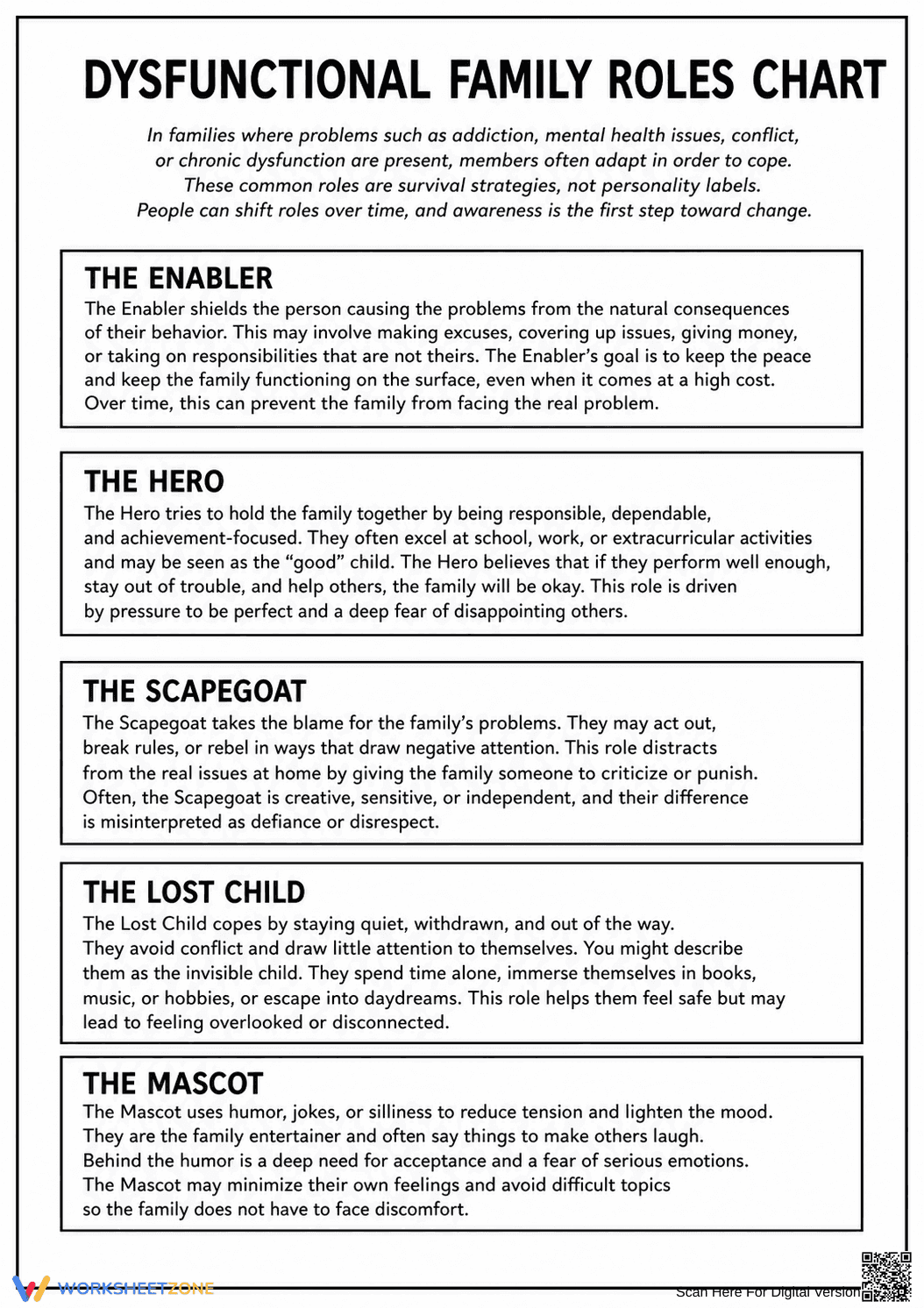
This Grade 5 social skills worksheet provides a clear framework for understanding complex interpersonal dynamics within a family unit. By defining five specific roles—The Enabler, The Hero, The Scapegoat, The Lost Child, and The Mascot—students learn to identify behavioral patterns and survival strategies. This resource facilitates critical self-awareness and empathy in social-emotional learning contexts.
At a Glance
- Grade: 5 · Subject: Social Skills
- Standard:
CCSS.ELA-LITERACY.RI.5.3— Explain the relationships or interactions between individuals in a text- Skill Focus: Behavioral Role Identification
- Format: 1 page · 5 informational blocks · Reference Chart · PDF
- Best For: Social-emotional learning and group counseling
- Time: 15–20 minutes
What's Inside: This single-page reference chart features five distinct sections, each dedicated to a common family role. Each section includes a clear title, a description of the role's primary function, and specific behavioral examples. The layout is designed for high readability, using bold headers and structured paragraphs to help students distinguish between the different survival strategies used in dysfunctional systems.
Zero-Prep Workflow
- Print: Select the single-page PDF and print enough copies for your group in under 30 seconds.
- Distribute: Hand out the charts as a silent reading activity or a guided reference during a social-emotional learning lesson.
- Review: Facilitate a 15-minute discussion where students identify the primary goal of each role with zero additional teacher preparation.
This workflow is designed for immediate implementation, making it an ideal resource for school counselors, social workers, or as a reliable sub plan for health and wellness classes.
Standards Alignment
This worksheet aligns with `CCSS.ELA-LITERACY.RI.5.3`: "Explain the relationships or interactions between two or more individuals, events, ideas, or concepts in a historical, scientific, or technical text based on specific information in the text." By analyzing how each family member interacts with the "problem parent" or the family unit, students practice high-level informational text analysis. Both standard codes can be copied directly into lesson plans, IEP goals, or district curriculum mapping tools.
How to Use It
Use this chart during a direct instruction lesson on family dynamics to provide a concrete vocabulary for abstract concepts. It works exceptionally well as a formative assessment tool; ask students to highlight one behavior from each role that they have observed in media or literature. Expected completion for a reading and reflection session ranges from 15 to 20 minutes depending on the depth of the following discussion.
Who It's For
This resource is designed for Grade 5 students, though it is highly adaptable for middle school social skills groups. It is particularly effective for students receiving Tier 2 behavioral supports or those participating in small-group counseling. Pair this chart with a character analysis of a popular novel to see these roles in action through a literary lens.
According to research by Fisher & Frey (2014) on scaffolded social-emotional learning, providing students with clear, categorized frameworks for complex human interactions significantly improves their ability to process social information and develop self-regulation. This worksheet utilizes the CCSS.ELA-LITERACY.RI.5.3 standard to help students explain the relationships and interactions between individuals based on specific textual evidence. By identifying the five distinct roles—Enabler, Hero, Scapegoat, Lost Child, and Mascot—learners move beyond surface-level reading to deep conceptual understanding of behavioral motivations. This structured approach is essential for developing the social-emotional vocabulary necessary for healthy interpersonal communication. The use of a reference chart as a primary text allows for immediate application in classroom discussions or counseling sessions, ensuring that students can cite specific characteristics when describing family dynamics. This resource bridges the gap between reading comprehension and real-world social application for upper elementary students.


