




























Views
Downloads

Printable Family Roles Worksheet | Grade 1 Social Skills

Paste this activity's link or code into your existing LMS (Google Classroom, Canvas, Teams, Schoology, Moodle, etc.).
Students can open and work on the activity right away, with no student login required.
You'll still be able to track student progress and results from your teacher account.
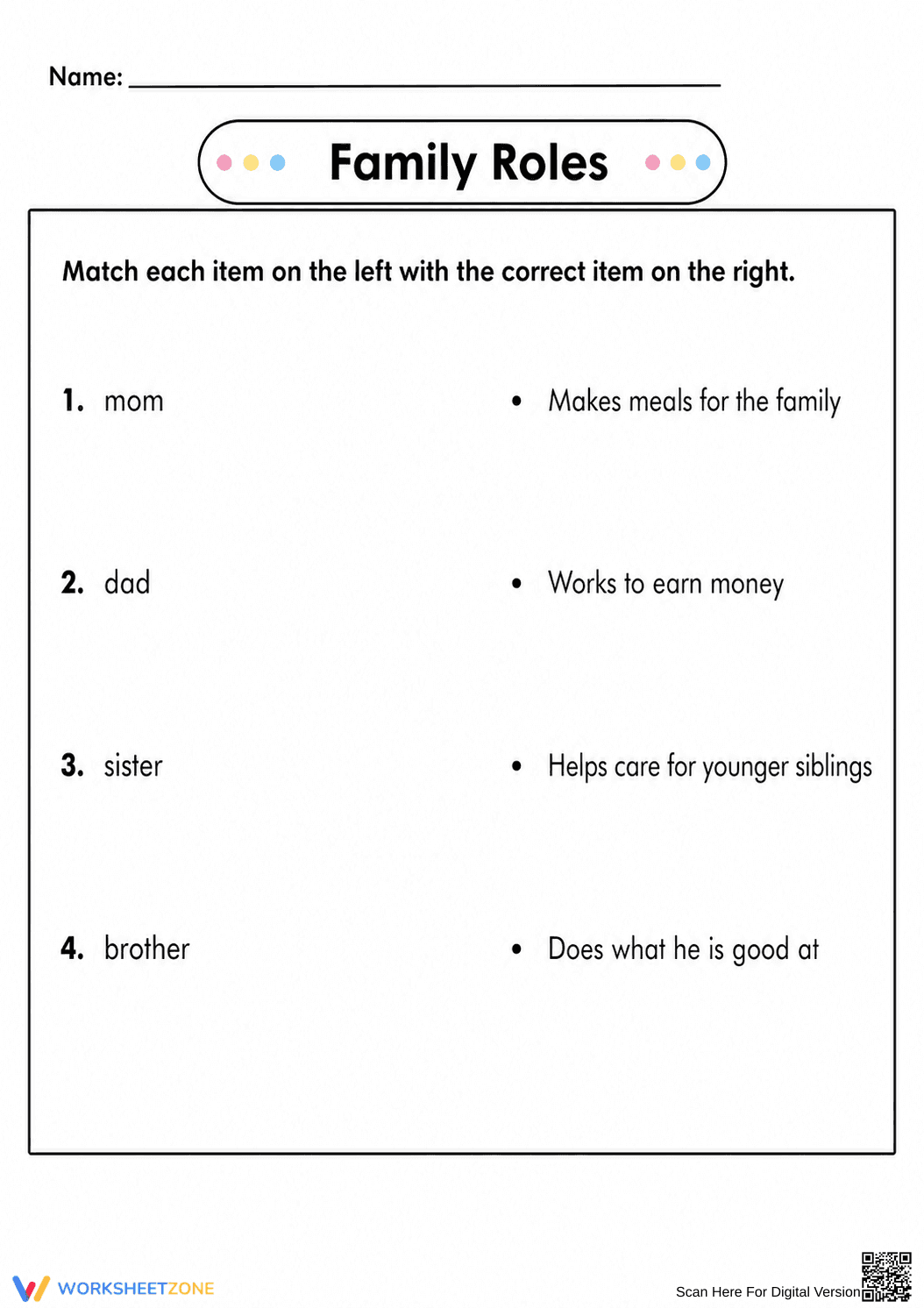
This Grade 1 family roles worksheet helps students identify and connect specific family members to their daily responsibilities. By engaging in a structured matching activity, young learners develop a foundational understanding of household dynamics and social structures. It provides a clear, visual way to explore how different individuals contribute to a supportive family environment.
At a Glance
- Grade: 1 · Subject: Social Skills
- Standard:
CCSS.ELA-LITERACY.RI.1.3— Describe the connection between individuals and their roles in a text- Skill Focus: Family Roles & Responsibilities
- Format: 1 page · 4 problems · Answer key included · PDF
- Best For: Early social studies and behavior lessons
- Time: 10–15 minutes
Inside this single-page PDF, you will find a clean, distraction-free layout featuring four primary family members: mom, dad, sister, and brother. Each member is paired with a specific descriptive role, such as preparing meals or earning money. The worksheet includes a clear instruction line and a dedicated space for the student's name, making it ready for immediate distribution in any classroom setting.
Zero-Prep Workflow
- Print: Open the PDF and print the single-page sheet for your entire class in under 30 seconds.
- Distribute: Hand out the worksheets and read the instructions aloud to ensure all students understand the matching task (1 minute).
- Review: Use the included answer key to review the roles as a whole group, facilitating a discussion about diverse family structures (5 minutes).
Total teacher preparation time is under 2 minutes, making this an ideal resource for sub-plans, morning work, or a quick social studies filler.
Standards Alignment
This worksheet aligns with `CCSS.ELA-LITERACY.RI.1.3`, which requires students to describe the connection between two individuals, events, ideas, or pieces of information in a text. By matching family members to their specific duties, students practice identifying logical relationships and functional roles. Both standard codes can be copied directly into lesson plans, IEP goals, or district curriculum mapping tools.
How to Use It
Use this worksheet during a "Community and Family" unit to introduce the concept of shared responsibility. It works best after a read-aloud about different types of families or household chores. As a formative assessment, observe if students can explain why they chose a specific match, which reveals their understanding of social roles. Expected completion time ranges from 10 to 15 minutes depending on reading level.
Who It's For
This resource is tailored for Grade 1 students, including English Language Learners who benefit from the simple vocabulary and direct associations. It pairs naturally with an anchor chart depicting various household chores or a picture book about family life. It is also suitable for special education settings focusing on social-emotional awareness and basic life skills for students in Grade 2.
According to the RAND AIRS 2024 report, early exposure to social-emotional learning frameworks significantly improves a child's ability to understand complex social hierarchies and interpersonal relationships. This worksheet addresses these needs by focusing on the standard CCSS.ELA-LITERACY.RI.1.3, which helps students identify connections between individuals and their specific roles. By engaging in this matching task, students move beyond simple identification toward an understanding of functional relationships within a group. Research from Fisher & Frey (2014) emphasizes that structured, low-stakes practice with familiar concepts—like family—builds the cognitive schema necessary for more abstract social studies topics in later grades. This 1-page resource provides 4 targeted tasks that serve as a bridge between personal experience and academic literacy, ensuring that young learners can articulate how members of a community support one another through distinct, valuable contributions.


