


























Views
Downloads

Family Roles Printable Worksheet | Grades 1-3 Social Skills
Paste this activity's link or code into your existing LMS (Google Classroom, Canvas, Teams, Schoology, Moodle, etc.).
Students can open and work on the activity right away, with no student login required.
You'll still be able to track student progress and results from your teacher account.
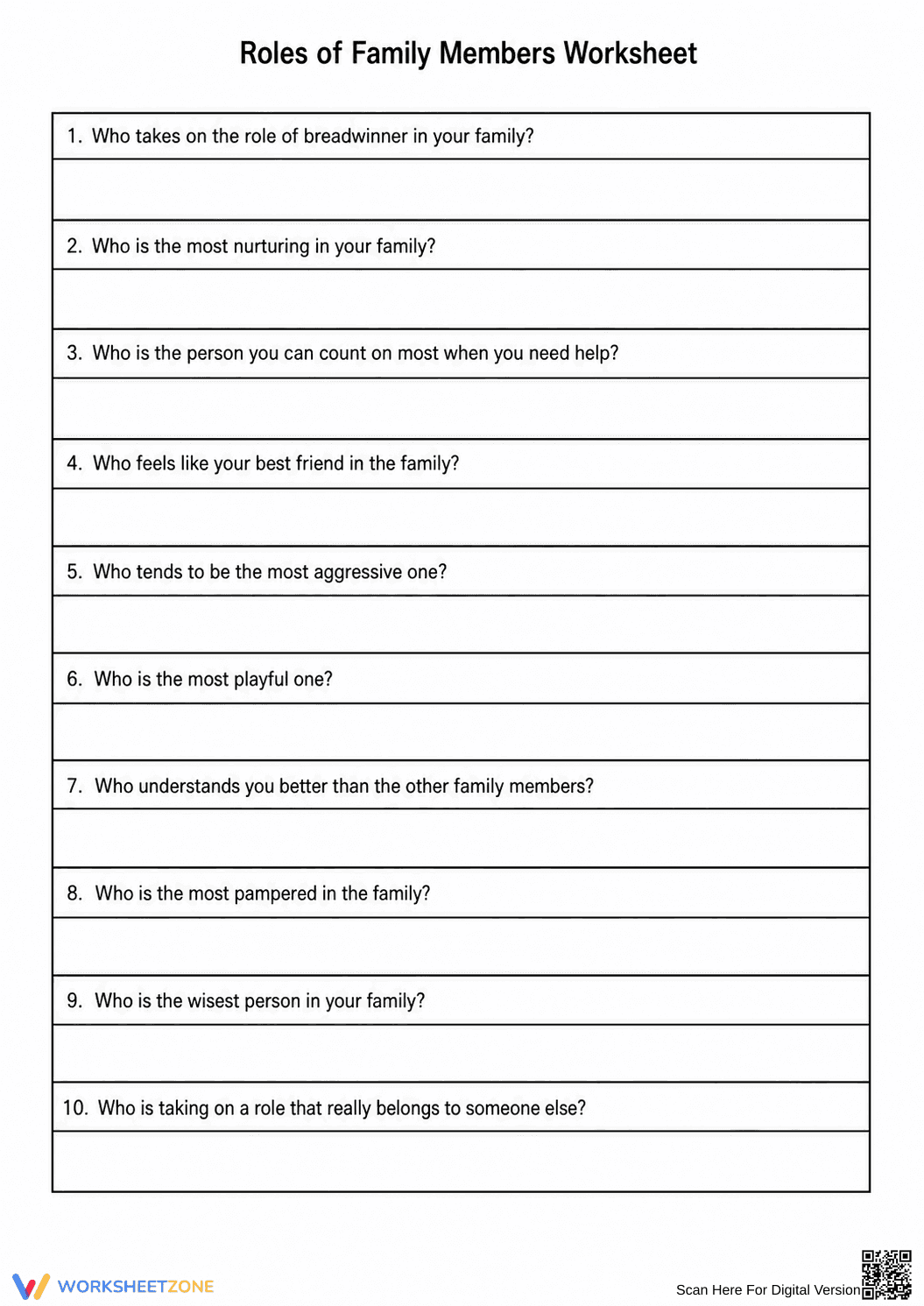
This printable social skills worksheet helps young students identify and reflect on the unique roles within their own families. By answering guided questions about family dynamics, learners practice self-awareness and emotional intelligence while developing their ability to articulate personal experiences and relationships in writing.
At a Glance
- Grade: 1–3 · Subject: Social Skills
- Standard:
CCSS.ELA-LITERACY.W.2.8— Recall information from personal experiences to answer questions- Skill Focus: Family Dynamics & Self-Reflection
- Format: 1 page · 10 problems · No answer key · PDF
- Best For: Morning work or SEL blocks
- Time: 15–20 minutes
Inside this single-page resource, educators will find ten open-ended reflection questions designed to prompt thoughtful consideration of family structures. Students are asked to identify which family members embody specific traits or responsibilities, such as being the most nurturing, acting as the breadwinner, or serving as a primary confidant. Because the responses rely entirely on personal experience, there is no answer key required, making it a highly individualized exercise.
This resource is designed for immediate classroom implementation with a zero-prep workflow.
- Print (1 minute): The single-page PDF format ensures quick batch printing for the entire class.
- Distribute (1 minute): Hand out the worksheets during morning meeting or a dedicated social-emotional learning period.
- Review (0 minutes): No teacher preparation or background reading is necessary, as the prompts rely entirely on the students' own lived experiences.
Total teacher prep time is under two minutes, making this an excellent emergency sub plan or filler activity.
This worksheet aligns with primary standard CCSS.ELA-LITERACY.W.2.8: Recall information from experiences or gather information from provided sources to answer a question. It also supports foundational social-emotional learning competencies related to social awareness and relationship skills. Both standard codes can be copied directly into lesson plans, IEP goals, or district curriculum mapping tools.
Teachers can utilize this worksheet as an independent reflection activity during a broader unit on communities and families. It serves as an excellent primer before a group discussion about how different families operate and the value of diverse household structures. As a formative assessment tip, observe how students interpret complex vocabulary words like "nurturing" or "breadwinner," providing gentle guidance or real-world examples if they struggle to connect the terms to their own relatives. Expected completion time ranges from 15 to 20 minutes.
This activity is primarily designed for early elementary students in grades 1 through 3 who are beginning to explore social dynamics outside of themselves. It is easily differentiated by allowing younger or struggling writers to dictate their answers to a teacher or peer helper. It pairs naturally with read-aloud books about diverse family structures or introductory lessons on community helpers and household responsibilities.
Integrating structured reflection on family dynamics into the early elementary curriculum significantly enhances students' social-emotional development and self-awareness. By addressing CCSS.ELA-LITERACY.W.2.8, which requires students to recall information from personal experiences to answer questions, this worksheet bridges the gap between academic writing and emotional intelligence. According to a comprehensive EdReports 2024 review of social-emotional learning materials, activities that prompt students to connect vocabulary to their lived experiences foster deeper comprehension and empathy. When children articulate the roles of their family members, they build a foundational understanding of community structures and interpersonal relationships. This simple, reflective exercise not only builds essential writing fluency but also validates the diverse home environments of all learners, creating a more inclusive and supportive classroom culture.


