


























Views
Downloads
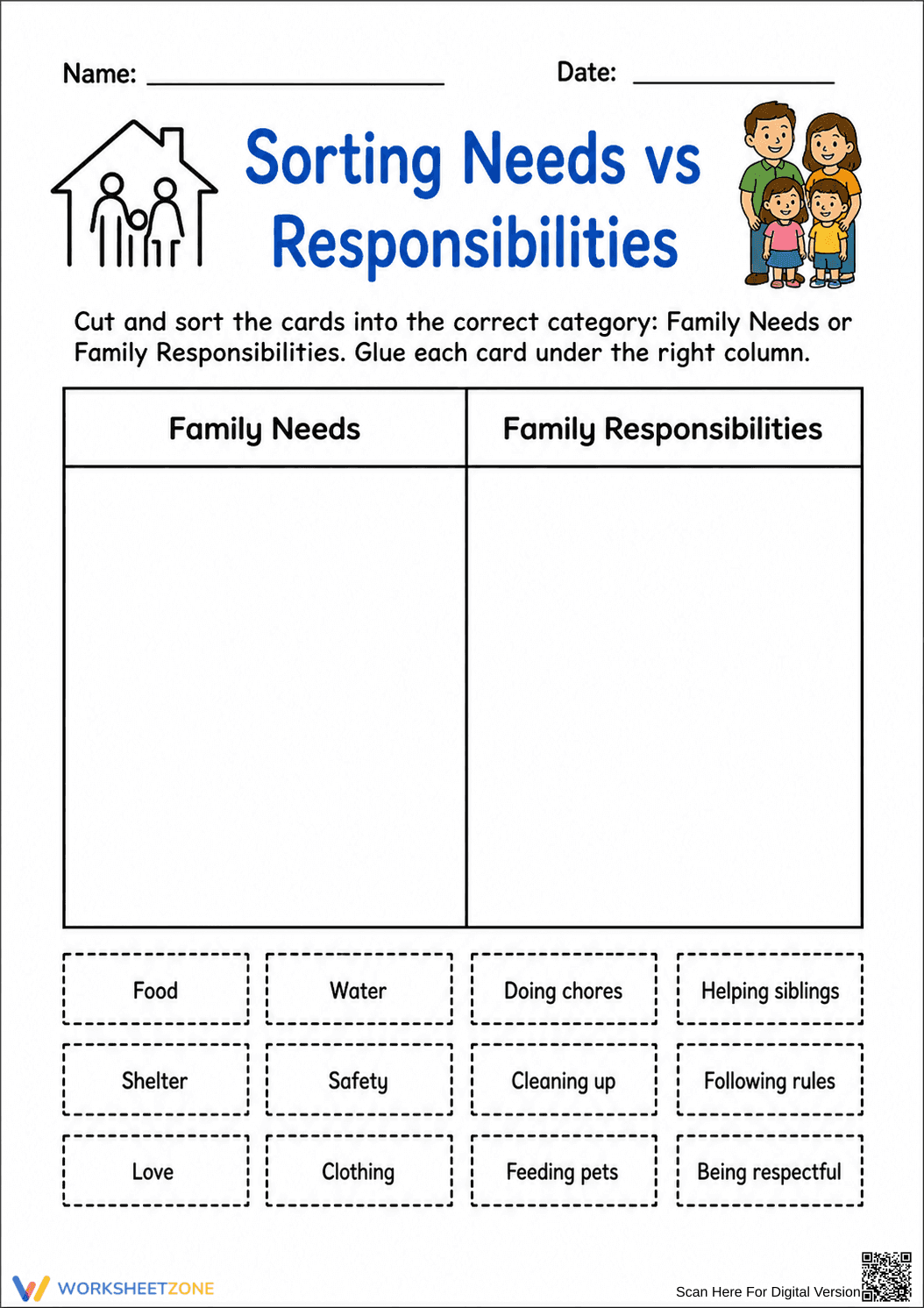

Grade 2 Family Roles — Printable No-Prep Worksheet
Paste this activity's link or code into your existing LMS (Google Classroom, Canvas, Teams, Schoology, Moodle, etc.).
Students can open and work on the activity right away, with no student login required.
You'll still be able to track student progress and results from your teacher account.
This foundational social skills worksheet helps students distinguish between essential family needs and personal responsibilities. By categorizing everyday concepts like food, shelter, and doing chores, young learners develop a clearer understanding of household dynamics and their own role within the family structure.
At a Glance
- Grade: 2 · Subject: Social Skills
- Standard:
CCSS.ELA-LITERACY.L.2.5.A— Identify real-life connections between words and their use- Skill Focus: Sorting Needs vs. Responsibilities
- Format: 1 page · 12 problems · Answer key included · PDF
- Best For: Independent practice
- Time: 15–20 minutes
This single-page resource features a hands-on cut-and-paste activity designed to engage tactile learners. Students are presented with a two-column chart labeled "Family Needs" and "Family Responsibilities." Below the chart, 12 dashed-line cards contain specific household concepts, ranging from basic survival requirements like water and safety to active duties like feeding pets and cleaning up. A complete answer key is provided to ensure accurate grading and facilitate class discussions.
Designed for immediate classroom implementation, this zero-prep resource follows a simple workflow:
- Print (1 minute): Generate enough copies for the entire class directly from the PDF file.
- Distribute (1 minute): Hand out the worksheets along with scissors and glue sticks.
- Review (3 minutes): Briefly explain the difference between a need (something required to live) and a responsibility (a duty or task).
With under two minutes of total teacher prep time, this activity is an excellent addition to emergency sub plans or morning work routines.
This activity aligns with CCSS.ELA-LITERACY.L.2.5.A: "Identify real-life connections between words and their use (e.g., describe foods that are spicy or juicy)." By sorting vocabulary terms into logical categories, students demonstrate their comprehension of nuanced word relationships within a real-world context. Both standard codes can be copied directly into lesson plans, IEP goals, or district curriculum mapping tools.
Integrate this worksheet during a broader social studies or social-emotional learning unit on community and family roles. It serves as an excellent independent practice activity following direct instruction on household contributions. As a formative assessment tip, observe students while they sort the cards before gluing; this provides an opportunity to correct misconceptions in real time. Most students will complete the sorting and pasting within 15 to 20 minutes.
This resource is primarily designed for second and third-grade students developing their understanding of social structures. The visual, hands-on nature of the cut-and-paste format provides built-in differentiation for kinesthetic learners and students who benefit from manipulatives. It pairs perfectly with a whole-class anchor chart detailing the rights and responsibilities of community members.
Aligning instructional materials with CCSS.ELA-LITERACY.L.2.5.A to identify real-life connections between words and their use is a critical component of early vocabulary acquisition. According to Fisher & Frey (2014), providing students with structured categorization tasks significantly enhances their ability to internalize new concepts and apply them to their daily lives. When children actively sort terms related to family needs and responsibilities, they move beyond rote memorization and begin to analyze the functional relationships between different social expectations. This cognitive processing supports both language development and social-emotional growth, ensuring that foundational vocabulary is anchored in meaningful, real-world contexts. By integrating these targeted sorting activities into the curriculum, educators can effectively bridge the gap between abstract terminology and practical understanding, fostering deeper comprehension and long-term retention of essential social studies concepts.


