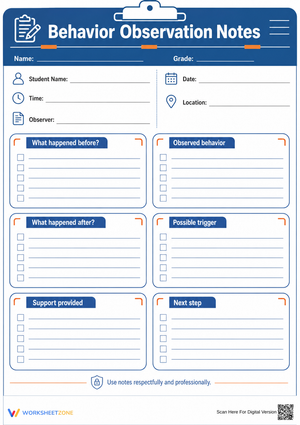
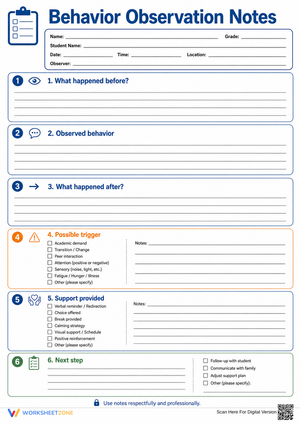
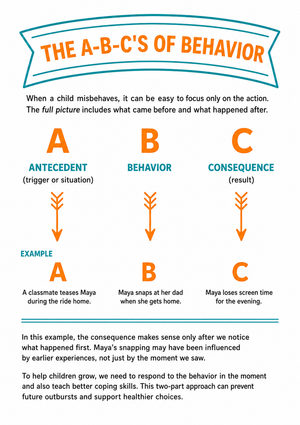
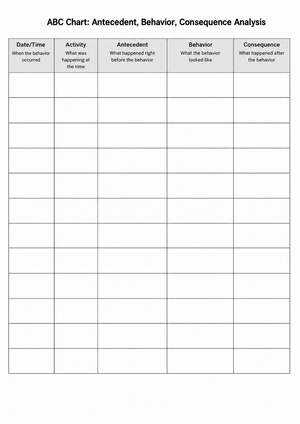
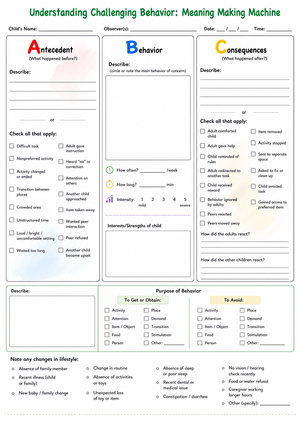
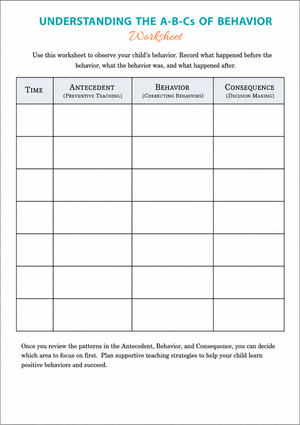
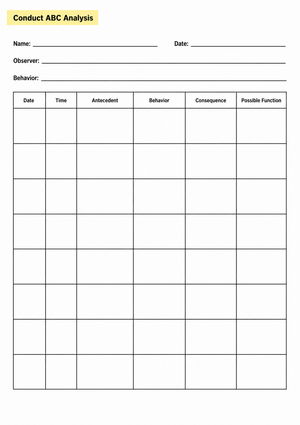
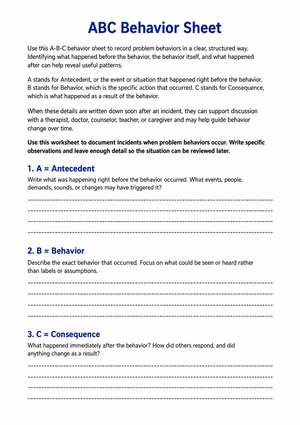
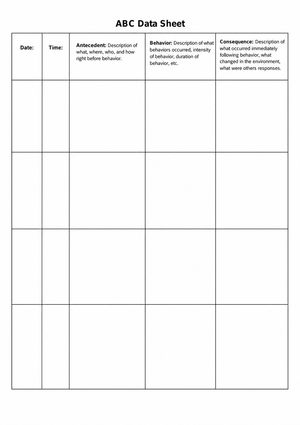
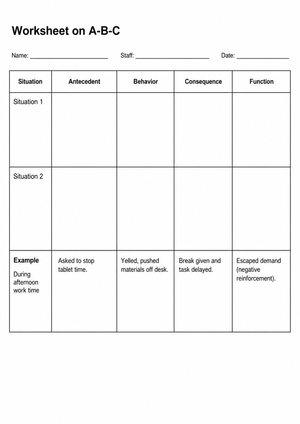
When a student escalates during a math task demand or a transition to recess, the details matter. Who was nearby? What instruction had just been given? What happened the moment after the behavior occurred? Antecedent behavior consequence worksheets give special education teachers, behavior interventionists, and general education staff a fast way to capture that sequence while it is still fresh, instead of trying to reconstruct it from memory at the end of the day.
Filling Out the Sheet During a Real Classroom Incident
Teachers rarely have five minutes to write a paragraph while managing a classroom, so the worksheet has to work in short bursts. Jot the antecedent and behavior in a few words the moment the incident starts to resolve, then add the consequence once the student is settled or has moved to a different activity. Waiting until the end of the period to fill in all three columns from memory tends to produce vague, generalized entries that are far less useful during later analysis.
ABC data is meant to be collected over a short, defined window rather than indefinitely. Teams typically gather ABC data for just a few days at the start of a functional behavior assessment, then shift to frequency or duration tracking once a likely pattern has emerged. Treating the ABC phase as time-limited keeps staff from logging incidents past the point where the data is adding new information.
Using ABC Data to Identify the Function of Behavior
The real value of an ABC worksheet is not the individual entries but the pattern across several of them. When a behavior specialist or IEP team reviews a stack of completed sheets, they are looking for repetition: does the behavior consistently follow a specific type of task demand? Does it consistently result in the student leaving the room, getting adult attention, or accessing a preferred item? These patterns point toward the likely function of the behavior, commonly grouped as escape, attention, access, or sensory.
Once a function is identified, small-group or 1:1 intervention planning can target the actual cause instead of just reacting to the behavior itself. A student escaping a difficult writing task needs a different intervention than a student seeking peer attention during independent work, even if the surface behavior looks similar in both cases.
Connecting ABC Charts to Formal FBA and BIP Documentation
For students already flagged for a functional behavior assessment, ABC worksheets become part of the formal record the special education team reviews when drafting a behavior intervention plan. Consistent, dated entries from multiple staff members and settings give the team a clearer picture than a single observation, and they help justify the function hypothesis that shapes the eventual BIP goals and replacement behaviors.
Because these worksheets often get referenced later in an IEP meeting or a district-level review, legible handwriting and consistent terminology across staff members are worth reinforcing at the start of data collection. A shared worksheet format, used the same way by every adult logging incidents, keeps the data comparable across settings.
Adapting the Worksheet for Different School Settings
A general education classroom, a resource room, and unstructured time like recess or transitions each produce different antecedents and require slightly different notes. In a general education classroom, task demand and peer proximity are often the most relevant fields. In a resource room, staff may want to note which specific skill or accommodation was in use. During recess or transitions, noting the specific activity, noise level, or change in routine can reveal triggers that never show up during structured instruction.
Keeping the same three-column ABC structure across all these settings, with a few setting-specific notes added, lets a team compare data collected by different staff members without needing to translate between formats.
Frequently Asked Questions
1. How long should teachers collect ABC data before drawing conclusions about a behavior's function?
ABC data is typically collected for a short window, often just a few days, at the start of a functional behavior assessment before the team switches to frequency or duration tracking once a likely pattern has emerged.
2. What is the difference between an ABC chart and a full functional behavior assessment?
An ABC chart is one data collection tool used within a functional behavior assessment. The FBA is the broader process that combines ABC data, frequency or duration data, interviews, and record review to determine the function of a behavior and inform a behavior intervention plan.
3. Who should complete ABC worksheets in a school setting?
General education teachers, special education teachers, and related service providers all commonly complete ABC worksheets to support FBA documentation required in the special education process.
4. How specific should antecedent and consequence entries be for the data to be useful?
Entries should name the specific task, adult response, or environmental factor involved rather than a general summary, since vague entries make it difficult to identify a consistent pattern across incidents.
5. Can ABC worksheets be used for behaviors outside of special education, like general classroom management?
Yes. The same antecedent, behavior, and consequence structure can help any classroom teacher notice patterns behind disruptive or off-task behavior, even when a formal FBA has not been initiated.