


























Views
Downloads

Family Roles Worksheet | Grade 1 Printable
Paste this activity's link or code into your existing LMS (Google Classroom, Canvas, Teams, Schoology, Moodle, etc.).
Students can open and work on the activity right away, with no student login required.
You'll still be able to track student progress and results from your teacher account.
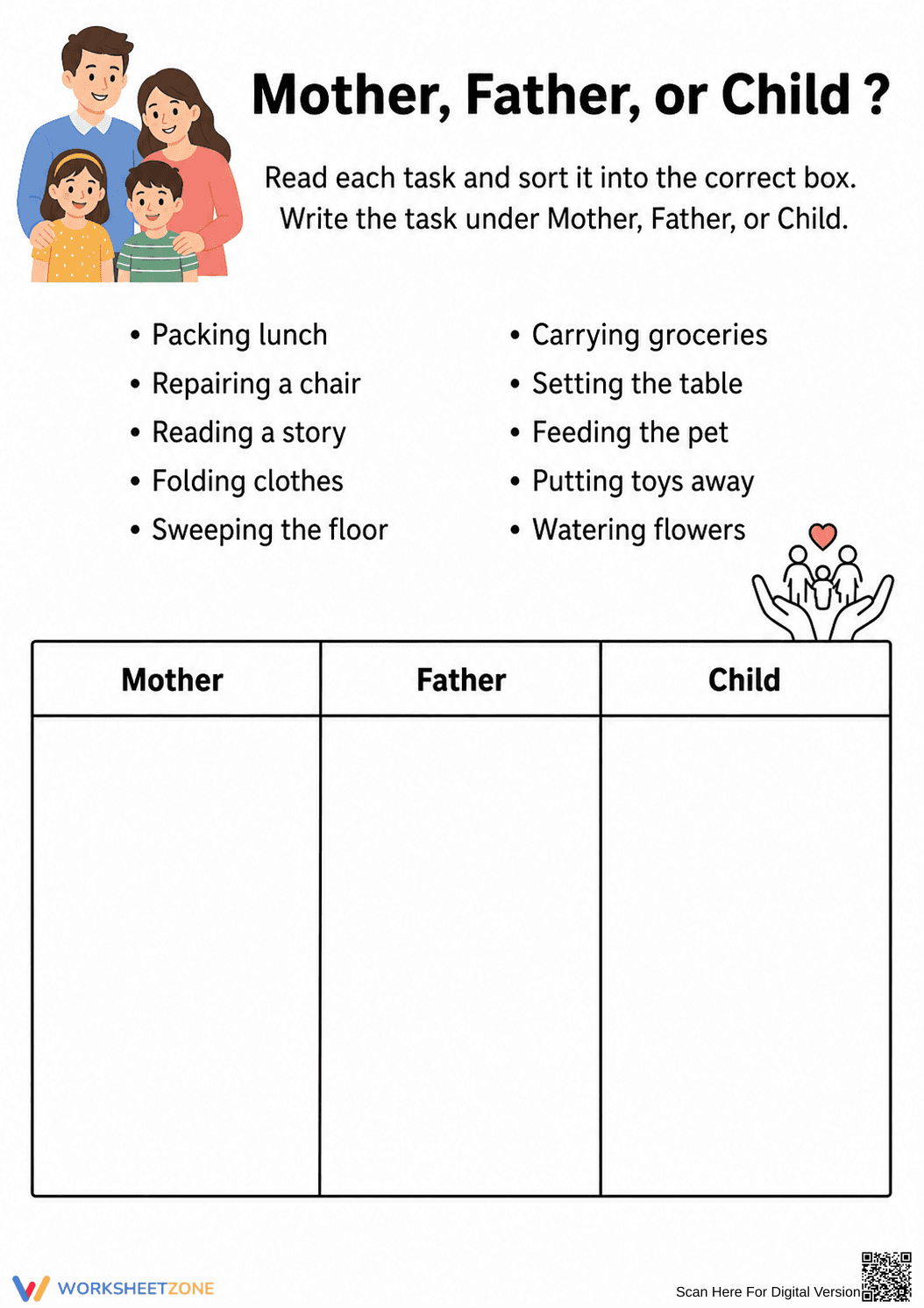
This Grade 1 social skills worksheet helps students understand family roles and shared responsibilities by sorting everyday household chores. By categorizing tasks into columns for different family members, young learners build essential social awareness, practice reading comprehension, and recognize the value of teamwork and cooperation at home.
At a Glance
- Grade: 1 · Subject: Social Skills
- Standard:
CCSS.ELA-LITERACY.L.1.5.A— Sort words into categories to understand concepts- Skill Focus: Categorizing Family Roles
- Format: 1 page · 10 problems · PDF
- Best For: Independent practice
- Time: 10–15 minutes
Inside this single-page resource, students will find a straightforward categorization activity featuring a list of ten common household tasks, such as packing lunch, folding clothes, and feeding the pet. Below the list is a clear, three-column graphic organizer labeled Mother, Father, and Child. Students read each chore and write it in the column that best represents who typically completes that task in their own home, providing a structured yet personalized learning experience.
This resource is designed for a smooth, zero-prep classroom experience.
- Print (1 minute): The single-page layout is highly ink-efficient and ready to print immediately.
- Distribute (1 minute): Hand out the worksheets along with pencils. No additional materials or complex instructions are required.
- Review (3 minutes): Briefly read the ten chores aloud with the class to ensure vocabulary comprehension before they begin sorting.
Total teacher preparation time is under two minutes, making this an excellent option for morning work, social-emotional learning blocks, or emergency sub plans.
This worksheet is aligned to primary standard CCSS.ELA-LITERACY.L.1.5.A: Sort words into categories (e.g., colors, clothing) to gain a sense of the concepts the categories represent. By sorting household chores into specific family roles, students practice foundational vocabulary and classification skills while exploring social studies themes. Both standard codes can be copied directly into lesson plans, IEP goals, or district curriculum mapping tools.
Teachers can use this worksheet during a broader social studies or SEL unit on communities and families. It serves as an excellent independent practice activity after a whole-class discussion about how different households share responsibilities. As a formative assessment tip, observe how students categorize the tasks and use their choices to spark a follow-up conversation about how family roles can look different in every home. Expected completion time is 10 to 15 minutes.
This activity is ideal for first and second-grade students developing their reading comprehension and social awareness skills. Because the sorting relies on personal experience, it naturally differentiates for diverse family structures and backgrounds. It pairs perfectly with a read-aloud book about family teamwork or a classroom anchor chart detailing classroom versus home responsibilities.
Integrating social-emotional learning with foundational literacy skills is a highly effective instructional strategy for early elementary classrooms. When students practice sorting words into categories to understand concepts, as outlined in CCSS.ELA-LITERACY.L.1.5.A, they build critical cognitive frameworks. According to CASEL and supported by EdReports 2024, embedding social awareness topics like family roles into everyday academic tasks helps children develop a stronger sense of community and personal responsibility. This worksheet bridges that gap by asking students to actively reflect on their home environments while practicing essential reading and categorization skills. By evaluating who completes specific chores, learners not only reinforce their vocabulary but also gain a deeper appreciation for shared effort and cooperation. This dual-focus approach ensures that instructional time is maximized, supporting both academic growth and essential social-emotional development in young learners.


