


























Views
Downloads
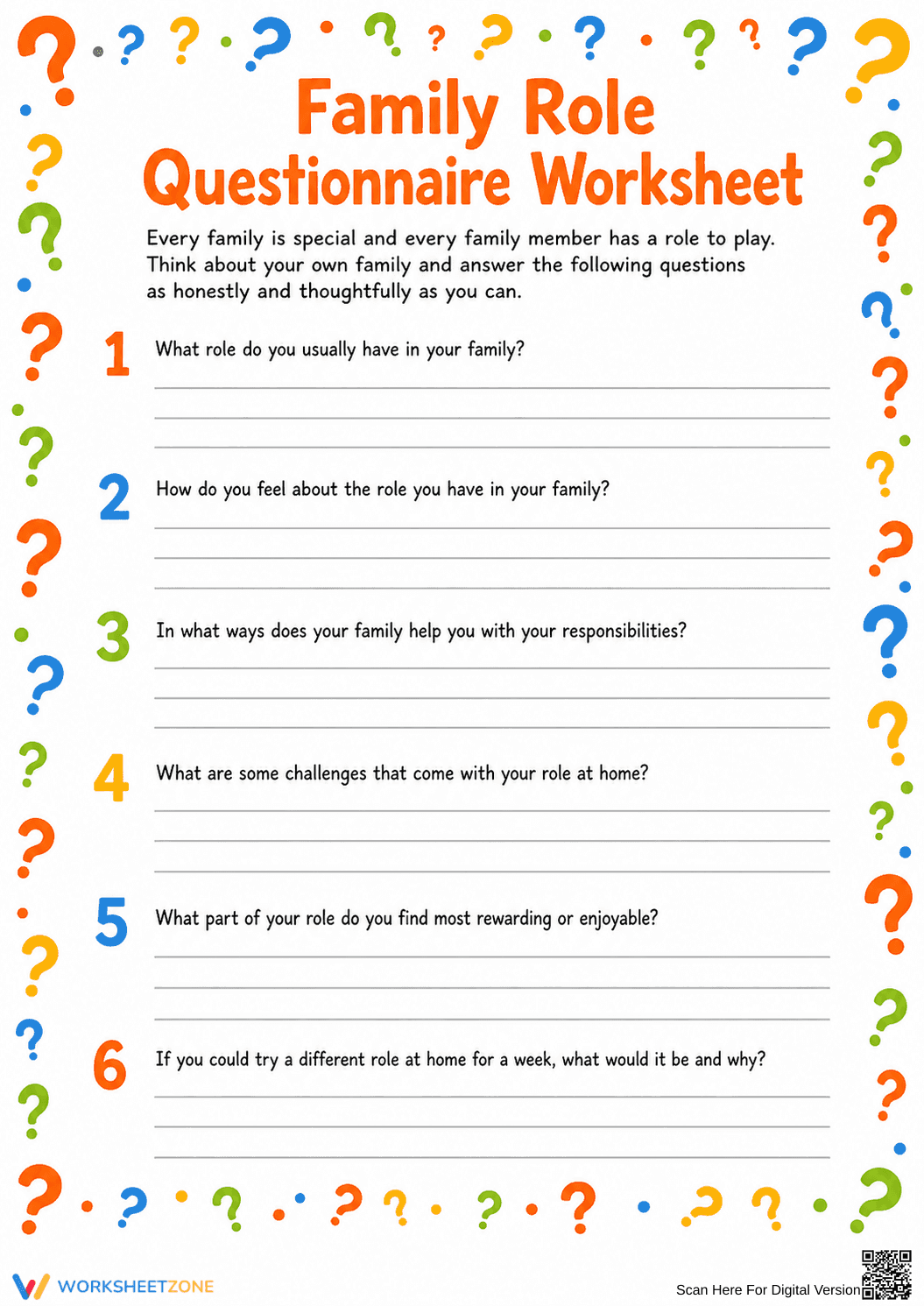

Printable Family Roles Questionnaire | Grade 4 SEL
Paste this activity's link or code into your existing LMS (Google Classroom, Canvas, Teams, Schoology, Moodle, etc.).
Students can open and work on the activity right away, with no student login required.
You'll still be able to track student progress and results from your teacher account.
This printable family roles questionnaire helps students reflect on their unique contributions and responsibilities at home. By answering guided prompts, learners practice self-awareness and written expression while exploring family dynamics. This resource fosters social-emotional growth and encourages meaningful conversations about teamwork, challenges, and personal feelings within the household.
At a Glance
- Grade: 4 · Subject: Social Emotional Learning
- Standard:
CCSS.ELA-LITERACY.W.4.4— Produce clear and coherent writing appropriate to the task.- Skill Focus: Self-Reflection and Communication
- Format: 1 page · 6 problems · No answer key · PDF
- Best For: Morning work or SEL blocks
- Time: 15–20 minutes
This single-page worksheet features six open-ended reflection questions framed by a colorful, engaging border. Students are prompted to identify their current role in their family, express how they feel about it, and recognize the support they receive from others. Additional questions challenge learners to articulate the difficulties and rewards of their responsibilities, culminating in a creative prompt asking what different role they would like to try for a week. Because responses are highly personal, no answer key is required.
This resource is designed for a seamless, zero-prep classroom experience.
- Print (1 minute): Simply download the PDF and print a class set. The colorful border prints beautifully in grayscale if needed.
- Distribute (1 minute): Hand out the worksheet during morning meeting, advisory, or a dedicated SEL block.
- Review (5 minutes): Briefly read the instructions aloud and encourage students to answer honestly.
Total teacher prep time is under two minutes. It is highly self-explanatory, making it an excellent, stress-free addition to a substitute teacher's emergency lesson plan.
Aligned to primary standard CCSS.ELA-LITERACY.W.4.4: Produce clear and coherent writing in which the development and organization are appropriate to task, purpose, and audience. This activity also supports broader social-emotional learning competencies related to self-awareness and relationship skills. Both standard codes can be copied directly into lesson plans, IEP goals, or district curriculum mapping tools.
Use this questionnaire as an independent reflection activity before a whole-class discussion on community and family structures. It serves as an excellent icebreaker or get-to-know-you activity at the beginning of the school year. Alternatively, assign it as a take-home activity to encourage family dialogue. As a formative assessment observation tip, circulate the room while students write to gauge their comfort level with expressing personal feelings and their ability to construct complete, coherent sentences. Expect students to complete the writing portion in 15 to 20 minutes.
This worksheet is ideal for upper elementary and middle school students developing their self-awareness and emotional vocabulary. It naturally differentiates itself, as students can respond with varying levels of depth and complexity based on their writing abilities. Pair this questionnaire with a direct instruction lesson on empathy or a read-aloud story featuring strong family dynamics to deepen the learning experience.
Integrating self-reflection activities like this questionnaire into the classroom is vital for developing students' social-emotional competencies and written communication skills. By aligning with CCSS.ELA-LITERACY.W.4.4 to produce clear and coherent writing appropriate to the task, educators ensure that SEL activities also reinforce core academic standards. According to a RAND AIRS 2024 report, structured reflection tasks significantly improve students' self-awareness and their ability to articulate complex personal emotions, which directly correlates with improved classroom behavior and peer relationships. When students analyze their family roles, they build foundational empathy and perspective-taking skills. This targeted practice not only strengthens their emotional intelligence but also provides meaningful, context-rich opportunities to practice expressive writing in a safe, supportive environment.


