


























Views
Downloads

Identifying Family Roles Worksheet | Essential Grade 9-12
Paste this activity's link or code into your existing LMS (Google Classroom, Canvas, Teams, Schoology, Moodle, etc.).
Students can open and work on the activity right away, with no student login required.
You'll still be able to track student progress and results from your teacher account.
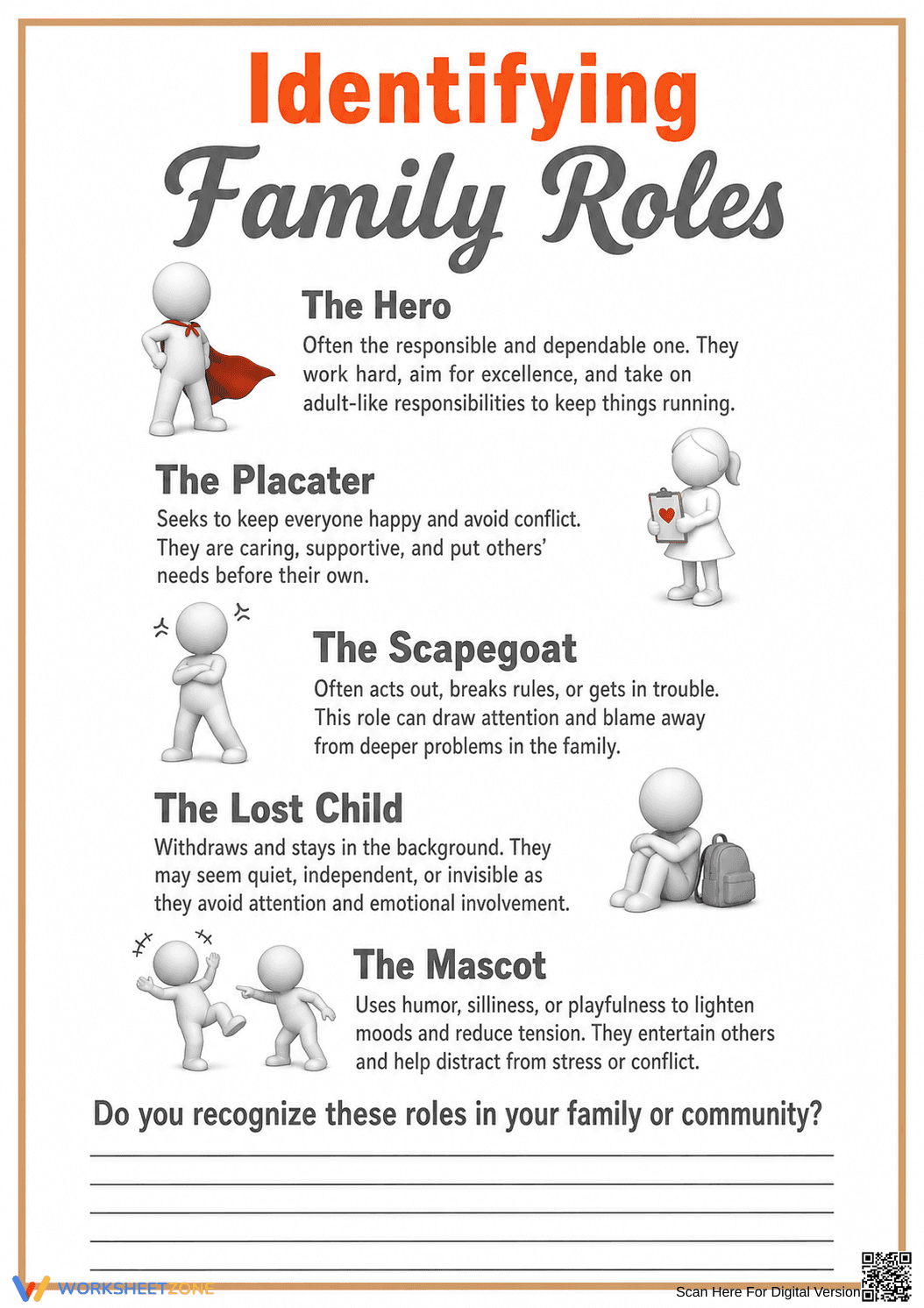
This Identifying Family Roles worksheet provides a structured framework for high school students to analyze complex interpersonal dynamics. By defining five common archetypes within family systems, the resource helps learners recognize patterns of behavior and their underlying motivations. Students will gain a deeper understanding of how individual roles contribute to the overall health of a family unit.
At a Glance
- Grade: 9-12 · Subject: Behavior Activities
- Standard:
CCSS.ELA-LITERACY.RI.9-10.4— Determine the meaning of key terms and technical phrases in a text- Skill Focus: Family Systems Theory
- Format: 1 page · 6 tasks · No answer key · PDF
- Best For: Psychology or Health class reflection
- Time: 15–20 minutes
The worksheet features a clean, one-page layout containing five distinct sections for specific roles: The Hero, The Placater, The Scapegoat, The Lost Child, and The Mascot. Each section includes a concise definition, typical characteristics, and a representative icon. The document concludes with an open-ended reflection prompt and ruled lines for student responses, facilitating a transition from conceptual understanding to personal application.
Zero-Prep Workflow
- Print (30 seconds): Download the PDF and print copies for your class or small group.
- Distribute (30 seconds): Hand out the worksheets as a quiet starter activity or as part of a guided lesson on social dynamics.
- Review (15 minutes): Allow students time to read the definitions and complete the written reflection. Total teacher preparation time is under 2 minutes.
Standards Alignment
This resource aligns with CCSS.ELA-LITERACY.RI.9-10.4: "Determine the meaning of words and phrases as they are used in a text, including figurative, connotative, and technical meanings." By mastering the technical vocabulary of family systems, students build essential literacy skills. This standard code can be copied directly into lesson plans, IEP goals, or district curriculum mapping tools.
How to Use It
Assign this worksheet during a psychology unit on developmental stages or a health class focused on relationships. It works best after an initial discussion about family structures. As a formative assessment, observe which roles students identify most readily to gauge their grasp of the concepts. Expect completion within 15 to 20 minutes, depending on the depth of the reflection.
Who It's For
This material is designed for high school students in Grades 9-12, though it is also appropriate for mature middle schoolers. It is a valuable tool for school counselors, social workers, and health educators. For a complete lesson, pair this worksheet with an anchor chart illustrating healthy communication patterns or a short case study video.
This educational resource focuses on the identification of specific behavioral archetypes within family systems, specifically the Hero, Placater, Scapegoat, Lost Child, and Mascot. By aligning with CCSS.ELA-LITERACY.RI.9-10.4, the worksheet requires students to determine the meaning of specialized terminology and symbols within a social-emotional context. Research by Fisher & Frey (2014) emphasizes the importance of scaffolded reflection in developing adolescent social-emotional literacy and complex text comprehension. The worksheet provides a structured framework for students to analyze interpersonal dynamics, moving from literal definitions to personal application. This transition supports the development of metacognitive skills and empathy, which are critical components of high school health and psychology curricula. By utilizing clear visual cues and concise descriptions, the material ensures that students can accurately categorize complex social behaviors. This resource serves as a foundational tool for understanding dysfunctional family patterns and promoting healthier relational awareness in secondary education settings.


