A student slams a notebook shut after a low quiz grade, ready to argue with a teacher before reading the feedback. Another student notices frustration rising, takes a breath, and asks a clarifying question instead. The difference between those two reactions is exactly what Wise Mind worksheets are built to teach, and they give teachers a concrete, repeatable tool for building that pause into daily classroom routines.
What Wise Mind Actually Means
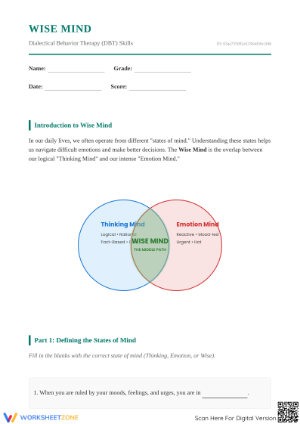
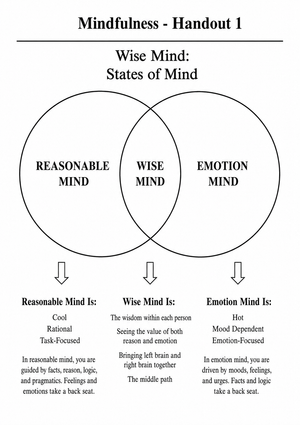
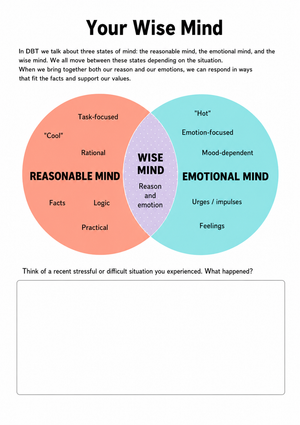
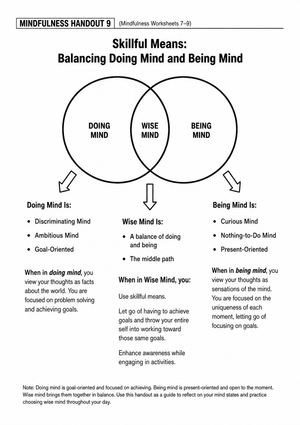
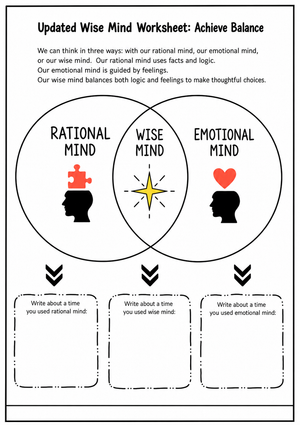
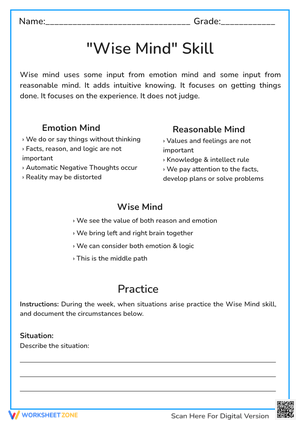
Wise Mind comes from Dialectical Behavior Therapy, a framework originated by psychologist Marsha M. Linehan. In DBT language, a person operates from one of three states: Emotional Mind, where feelings drive judgment; Reasonable Mind, where facts and logic drive judgment; and Wise Mind, the overlap where someone acknowledges what they feel while still weighing facts, logic, and long-term goals before acting.
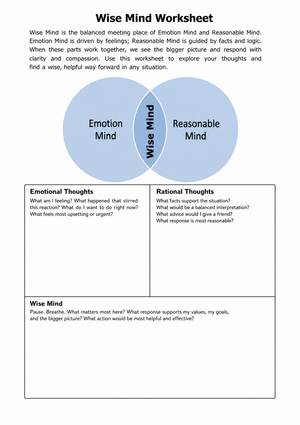
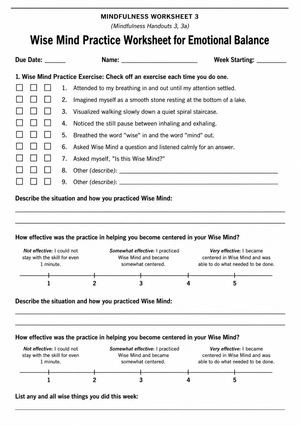
For classroom purposes, this is not a diagnosis or a clinical label. It is a shared vocabulary students can use to name what is happening internally before a decision turns into a behavior incident. A Wise Mind Diagram worksheet typically asks students to recall a specific moment and sort it: did I act from Emotional Mind, Reasonable Mind, or Wise Mind, and what did that choice cost or gain me.
The clinical origin of this tool matters for how teachers should frame it. DBT skills training handouts developed by Linehan describe Wise Mind as a state reached through practice, not a personality trait a student either has or lacks. That framing shifts classroom use away from labeling a student as impulsive and toward teaching a specific, learnable skill: pausing between the emotional signal and the response.
Age-Appropriate Language for Different Grade Bands
Elementary students need the vocabulary simplified. Instead of Emotional Mind and Reasonable Mind, younger students can work with Feeling Brain and Thinking Brain, then build toward Wise Mind as the brain that listens to both. A worksheet for this age group works best with pictures or a simple three-column sort rather than open-ended writing.
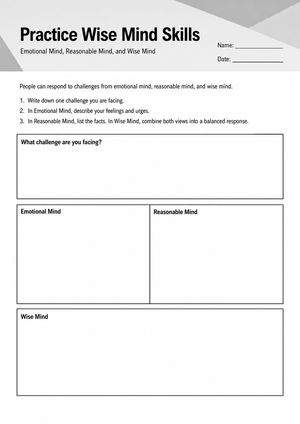
Middle and high school students can use the original DBT terminology directly, since many are already encountering emotional regulation language in advisory periods or counseling programs. At this level, worksheets can ask for a full written reflection: describe the trigger, describe the emotional pull, describe the logical read, and describe the wise-mind response that considered both.
Classroom Implementation
Start with a whole-class introduction using a low-stakes shared example, such as a hypothetical scheduling conflict, before ever asking students to apply the framework to their own behavior. This keeps the first exposure non-threatening and builds shared vocabulary the class can reference later.
Keep a stack of blank Wise Mind Diagram worksheets available at a calm-down or reflection area rather than only distributing them during formal lessons. Students who need this tool most often need it in the moment, not during a scheduled SEL block, and ready access matters more than a polished lesson plan.
Use the worksheet as a formative check-in during morning meeting or advisory rather than only as a consequence tool. When students associate Wise Mind language with routine reflection instead of only discipline, they are more likely to use the vocabulary voluntarily during an actual conflict.
Frequently Asked Questions
1. What is the Wise Mind concept and where does it come from?
Wise Mind is a Dialectical Behavior Therapy concept developed by psychologist Marsha M. Linehan. It describes the balance point between Emotional Mind, where feelings drive a decision, and Reasonable Mind, where facts and logic drive a decision.
2. What grade levels are Wise Mind worksheets appropriate for?
The framework can be adapted from elementary through high school. Younger students benefit from simplified terms like Feeling Brain and Thinking Brain, while middle and high school students can typically use the original DBT vocabulary directly.
3. How can a classroom teacher use a Wise Mind worksheet without formal DBT training?
Teachers can use the worksheet as a structured reflection tool rather than a clinical intervention, focusing on helping students name an emotional reaction and a factual reaction separately before deciding on a response.
4. How is Wise Mind different from a general emotional check-in worksheet?
A general check-in usually asks a student to name a feeling. A Wise Mind worksheet goes further by asking the student to compare that feeling against the facts of the situation and describe a response that accounts for both.
5. How often should Wise Mind worksheets be used with students who need support with impulse control?
Regular, low-stakes use, such as during a weekly advisory check-in, tends to build more durable habits than only introducing the worksheet after a behavior incident, since repetition helps students access the framework in the moment it is actually needed.