




























Views
Downloads
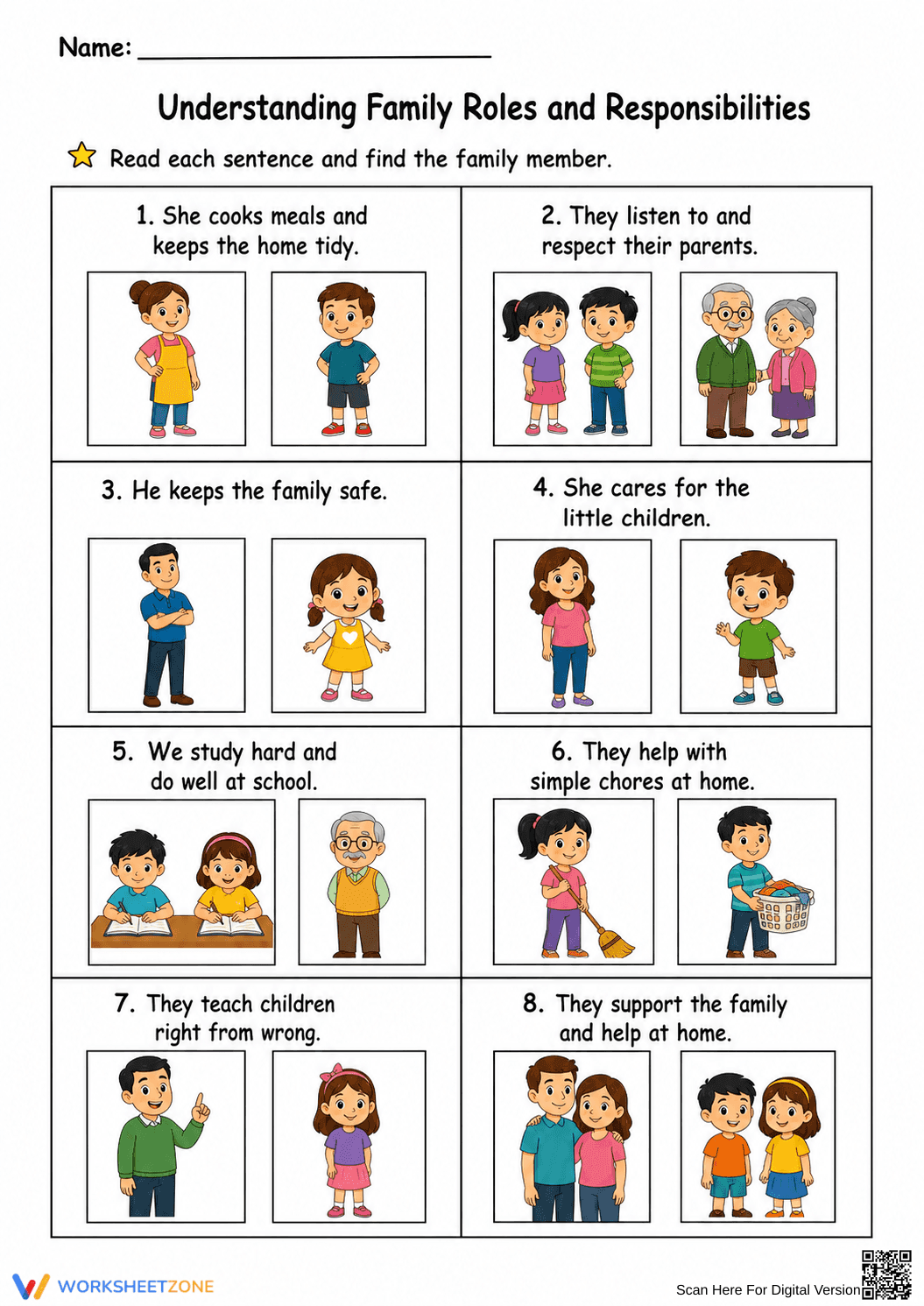

Grade 1 Family Roles — Printable No-Prep Worksheet

Paste this activity's link or code into your existing LMS (Google Classroom, Canvas, Teams, Schoology, Moodle, etc.).
Students can open and work on the activity right away, with no student login required.
You'll still be able to track student progress and results from your teacher account.
This Grade 1 reading comprehension worksheet helps young learners connect simple sentences to visual context clues. Students read short descriptions of household responsibilities and identify the correct family member from paired illustrations, building foundational vocabulary and reinforcing essential social studies concepts about family dynamics.
At a Glance
- Grade: 1 · Subject: English
- Standard:
CCSS.ELA-LITERACY.RI.1.7— Use illustrations and details to describe key ideas- Skill Focus: Reading Comprehension & Family Vocabulary
- Format: 1 page · 8 problems · Answer key included · PDF
- Best For: Independent practice or morning work
- Time: 10–15 minutes
This single-page resource features eight distinct matching tasks. For each problem, students read a straightforward sentence describing a common household role or responsibility, such as keeping the family safe or helping with simple chores. Below the text, two colorful cartoon illustrations are provided. Students must use their reading comprehension skills to select the character that accurately matches the described action. A complete answer key is included for quick grading.
- Print (1 min): Simply print the single-page PDF. No cutting, laminating, or special materials are required.
- Distribute (1 min): Hand out the worksheet during morning work, literacy centers, or social studies blocks.
- Review (3 mins): Quickly check student responses using the provided answer key or review together as a whole class.
With under two minutes of total teacher prep time, this resource is an excellent addition to any emergency sub plan or busy instructional day.
Aligned to primary standard CCSS.ELA-LITERACY.RI.1.7: Use the illustrations and details in a text to describe its key ideas. This activity also supports early vocabulary acquisition by pairing text with clear visual representations. Both standard codes can be copied directly into lesson plans, IEP goals, or district curriculum mapping tools.
This worksheet functions perfectly as an independent practice activity after a whole-group lesson on family structures or community helpers. Alternatively, use it during literacy centers to reinforce reading simple sentences with visual supports. As a formative assessment tip, observe whether students are relying solely on the pictures or actively attempting to decode the text before making their selection. Expected completion time is 10 to 15 minutes.
This resource is primarily designed for kindergarten and first-grade students developing early reading skills. It is highly effective for English Language Learners (ELLs) who benefit from the strong visual scaffolds when acquiring new vocabulary related to family members and household chores. Pair this worksheet with a read-aloud book about families to deepen the thematic connection.
Integrating visual supports with text is a critical component of early literacy instruction. According to Fisher & Frey (2014), providing students with clear visual scaffolds significantly enhances their ability to comprehend and retain new vocabulary. This worksheet directly applies this research by requiring students to use illustrations and details to describe key ideas, aligning with CCSS.ELA-LITERACY.RI.1.7. By matching descriptive sentences about household responsibilities to the correct character illustrations, young learners actively practice decoding while building essential background knowledge about family dynamics. The structured format reduces cognitive load, allowing students to focus on meaning-making rather than complex task navigation. This evidence-based approach ensures that foundational reading skills are developed alongside important social-emotional concepts, making it a highly effective tool for early childhood classrooms.


