If you support a student with autism in a US K-12 classroom, you already know that social skills rarely develop the same way they do for typically developing peers. Greetings, turn-taking, and reading a classmate's tone can take direct, repeated instruction rather than incidental learning. Social skills for autism worksheets give special education teachers, inclusion teachers, school counselors, speech-language pathologists, and paraprofessionals a concrete, repeatable tool for that instruction, one that fits neatly into a small-group block, a resource room pull-out, or an independent practice station.
Scaffolding IEP Goal Areas with Worksheets
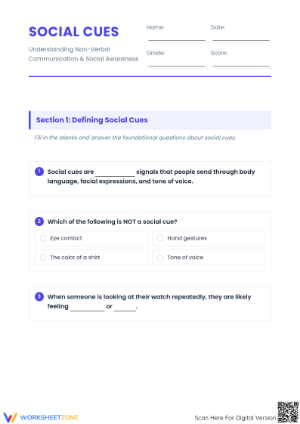
Common IEP goal categories for students with autism include communication skills, such as greetings and initiating requests, and emotional regulation skills, such as asking for a break or tolerating a change in routine. Worksheets can be built or selected to map directly onto these categories:
- Greeting and conversation starters: sequencing cards or fill-in-the-blank scripts for saying hello, asking a question, and responding to a peer
- Turn-taking: worksheets that walk through waiting, watching, and taking a turn in a game or group activity
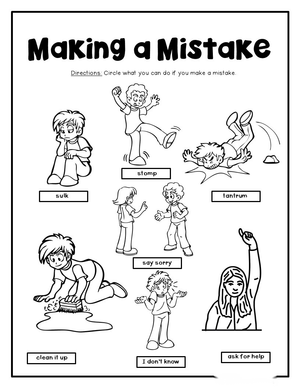
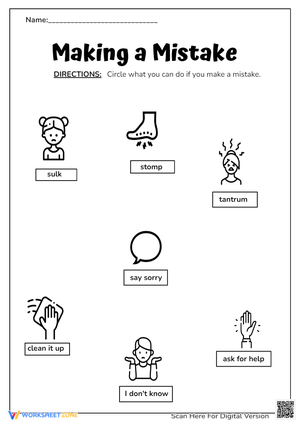
- Emotional regulation: worksheets that pair a feeling word with a coping strategy, such as asking for a break or using a calm-down step
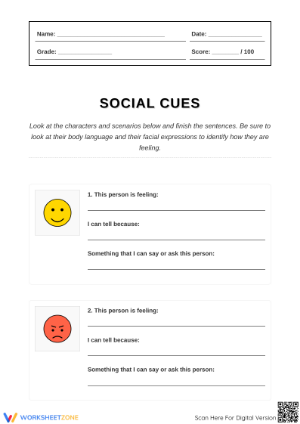
- Perspective-taking: short scenario worksheets asking a student to identify how a character might feel and why
When a worksheet ties directly to a stated IEP goal, it stops being a generic activity and becomes evidence you can reference at a progress review meeting.
Structuring a Weekly Small-Group Social Skills Block
Many special education teachers run social skills instruction in a small group, since that format allows facilitated practice and peer interaction that a one-on-one session cannot replicate. A simple weekly structure might include one day introducing a new skill with modeling and a worksheet, two days of guided practice worksheets with role-play, one day of a low-stakes application activity such as a structured lunch group or recess buddy system, and one day of review plus a brief data check.
Keeping the same worksheet format across the week, just with a new target skill, reduces the cognitive load of learning new instructions and lets the student focus on the social content instead of figuring out what the page is asking them to do.
Classroom Implementation
To put this into practice, start by picking one or two target skills tied to current IEP goals rather than working through a worksheet packet in order. Introduce the skill with modeling, use the worksheet for guided and independent practice, and schedule a specific real-world moment within the same day or week to apply it. Keep a simple data sheet next to the worksheet stack so scoring takes seconds, not minutes. For general education teachers supporting inclusion, coordinate with the special education teacher or speech-language pathologist so the same worksheet language and prompting hierarchy get used consistently across settings, which supports generalization and keeps everyone on the same page during team meetings.
Frequently Asked Questions
1. What social skills should worksheets for autism target first in the classroom?
Start with foundational skills already named in the student's IEP, most commonly greetings, initiating requests, and basic turn-taking, since these show up constantly across the school day and give the most immediate opportunities for practice and generalization.
2. How do teachers connect social skills worksheets to IEP goals and progress monitoring?
Choose or design worksheets that mirror the exact language of the IEP goal, add a simple scoring column such as independent or prompted, and record results weekly so the data can be summarized directly into a progress report.
3. Can general education teachers use these worksheets in an inclusion setting?
Yes. General education teachers can use the same worksheets during whole-class social-emotional learning time or small group stations, ideally coordinating with the special education teacher so the skill sequence and vocabulary stay consistent for the student across settings.
4. How often should social skills worksheets be used each week for meaningful progress?
Most small-group social skills blocks run three to five days a week with short sessions of fifteen to twenty minutes, pairing worksheet practice with modeling and a real application opportunity so the skill has multiple chances to generalize.
5. What is the difference between social skills worksheets and social narratives or social stories?
Social narratives describe a specific situation and expected behavior in story form to build understanding, while social skills worksheets typically provide structured practice activities, such as sequencing, matching, or scenario response, that let a student rehearse and apply a skill directly.