





























Essential Molarity Worksheet | Grades 9-12 Science
Paste this activity's link or code into your existing LMS (Google Classroom, Canvas, Teams, Schoology, Moodle, etc.).
Students can open and work on the activity right away, with no student login required.
You'll still be able to track student progress and results from your teacher account.
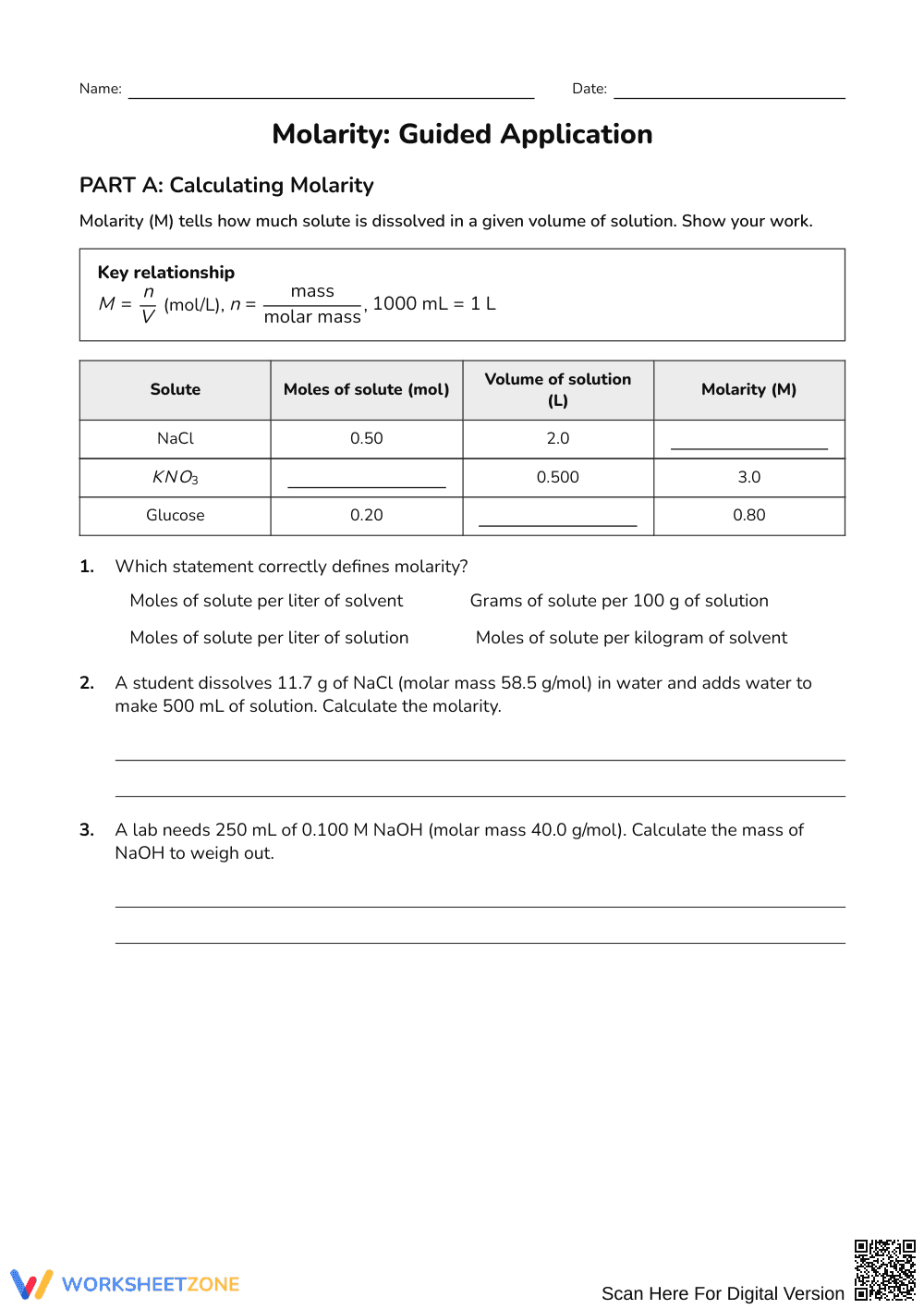
This comprehensive chemistry worksheet guides high school students through calculating solution concentrations, interpreting particulate models, predicting dilutions, and analyzing spectroscopic data. Students calculate molarity from grams and milliliters, analyze particle diagrams, apply the dilution formula, and connect absorbance to solute concentration across 21 structured application tasks.
At a Glance
- Grade: Grades 9–12 · Subject: Science
- Standard: High School Physical Science — Calculate concentration and model solutions at particulate and macroscopic levels
- Skill Focus: Molarity and Solution Chemistry
- Format: 4 pages · 21 problems · Answer key included · PDF
- Best For: High school chemistry guided problem-solving
- Time: 45–60 minutes
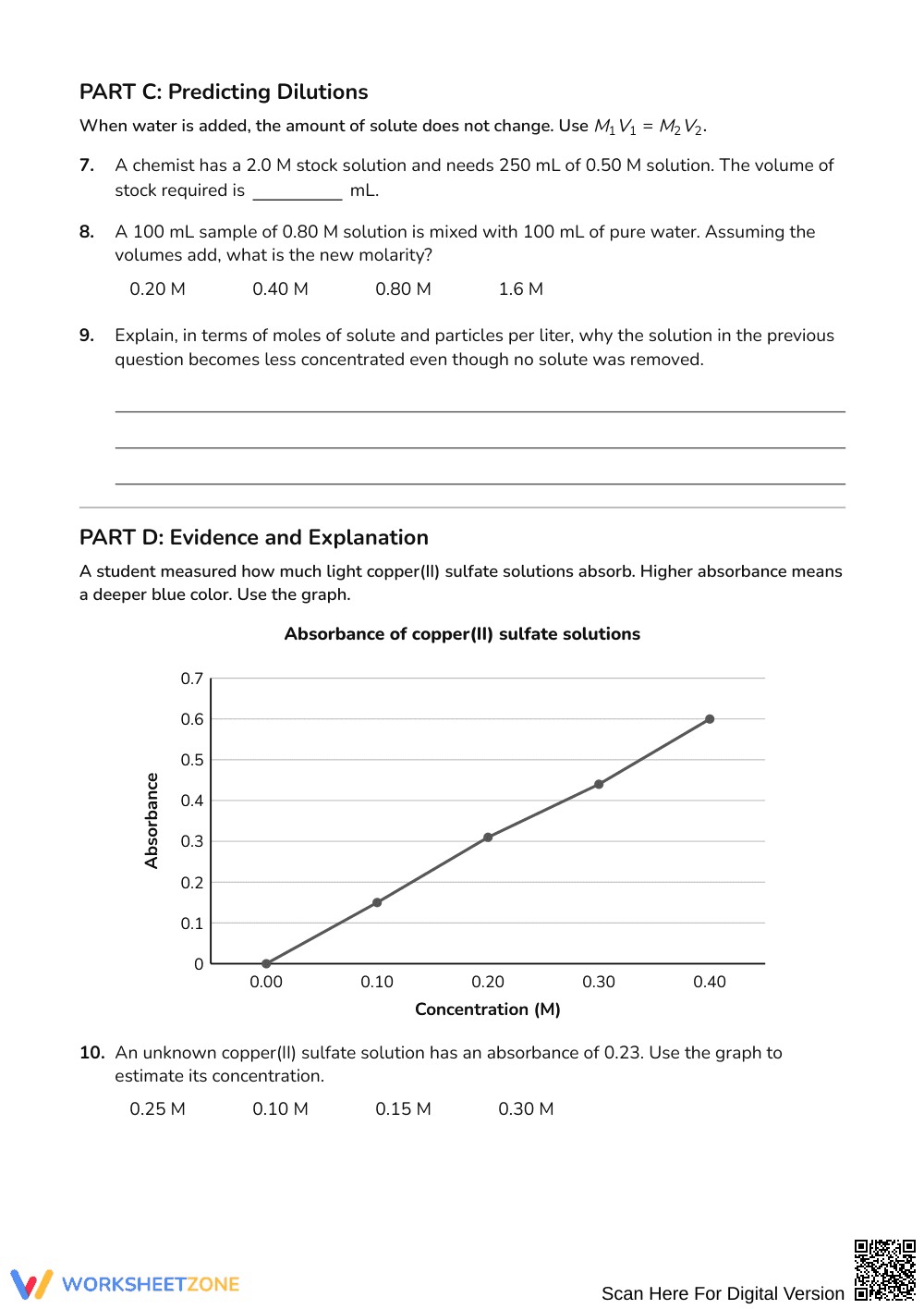
Across four student-facing pages, learners encounter clear formula reference boxes, data completion tables, particle beakers, and graphical representations of copper(II) sulfate absorbance. The 21 tasks balance quantitative molar mass conversions with conceptual explanations, supported by a full four-page answer key detailing step-by-step mathematical setups.
Skill Progression
- Guided Practice (Part A, 6 tasks): Students compute molarity using provided formulas, convert grams to moles, and calculate required solute mass with explicit formula references.
- Supported Practice (Parts B & C, 8 tasks): Learners interpret submicroscopic dot diagrams of beakers to explain concentration shifts and use the dilution equation M1V1 = M2V2 with partial conceptual prompts.
- Independent Practice (Part D, 7 tasks): Students read calibration curves independently to determine unknown concentrations and synthesize particulate models with thermal energy changes during dissolution.
This deliberate sequence reflects the gradual release of responsibility model, moving learners from formulaic computation to authentic graphical analysis.
Standards Alignment
Aligned with high school chemistry expectations for solution chemistry and quantitative reaction relationships, this resource targets the mathematical definition of molarity and particulate representations of matter. Students demonstrate how mass, volume, and chemical amount relate quantitatively. Standard references can be copied directly into lesson plans, IEP goals, or district curriculum mapping tools.
How to Use It
Assign Parts A and B immediately following initial direct instruction on moles and solution volume. During classwork, circulate to observe how students interpret Beakers Y and Z in Part B; students who struggle to articulate why equal concentrations can have different particle counts benefit from immediate small-group reteaching. Parts C and D work effectively as paired practice during the subsequent lab block, requiring 45 to 60 minutes for complete collaborative completion.
Who It's For
This resource serves general chemistry, honors chemistry, and introductory physical science students mastering stoichiometry foundations. Teachers can differentiate by providing highlighted formula cards for emerging problem solvers while tasking advanced students with explaining endothermic and exothermic dissolution enthalpies in Part D. It pairs naturally with a hands-on copper sulfate spectrophotometry lab or an interactive particle-simulation demonstration.
High school science instruction requires bridging mathematical calculations with submicroscopic reasoning. Research from Fisher & Frey (2014) highlights that structured guided practice with explicit representations builds durable conceptual understanding in chemistry problem-solving. This 4-page worksheet systematically links molarity formulas to particle models and empirical absorbance data across 21 rigorous tasks. By grounding abstract concentration formulas in visual beaker diagrams and real-world dissolution phenomena, students develop both procedural fluency and qualitative mastery. Science teachers can deploy this complete packet alongside lab investigations to reinforce quantitative literacy and analytical reasoning in solution chemistry units.


