




























Essential Molarity Models Worksheet | Grades 9–12 Science
Paste this activity's link or code into your existing LMS (Google Classroom, Canvas, Teams, Schoology, Moodle, etc.).
Students can open and work on the activity right away, with no student login required.
You'll still be able to track student progress and results from your teacher account.
This chemistry worksheet develops conceptual understanding of solution concentration by requiring high school students to construct, analyze, and revise particle-level models. Learners connect macroscopic calculations to microscopic interactions, tracking solute particles, dissociation stoichiometry, dilution effects, and thermochemical energy transfers across four rigorous practice sections.
At a Glance
- Grade: Grades 9–12 · Subject: Science
- Standard: Construct and revise scientific models showing particle relationships and energy flows in solutions
- Skill Focus: Molarity modeling, dissociation, dilution, and dissolution thermodynamics
- Format: 4 pages · 24 problems · Answer key included · PDF
- Best For: Chemistry unit practice or formative assessment
- Time: 45–60 minutes
What's Inside
Across 4 structured pages, students complete 24 analytical tasks featuring particle diagrams, dissociation tables, Beer's law calibration data, and calorimetry problems. The resource provides complete worked explanations and quantitative answers for every prompt, helping students diagnose conceptual errors in ionic dissociation, volume expansion, and bond-breaking energy requirements.
Skill Progression
- Guided Practice (Part A, Tasks 1–6): Students examine paired particle diagrams to define molarity quantitatively and explain why equal particle counts yield different concentrations across unequal liquid volumes.
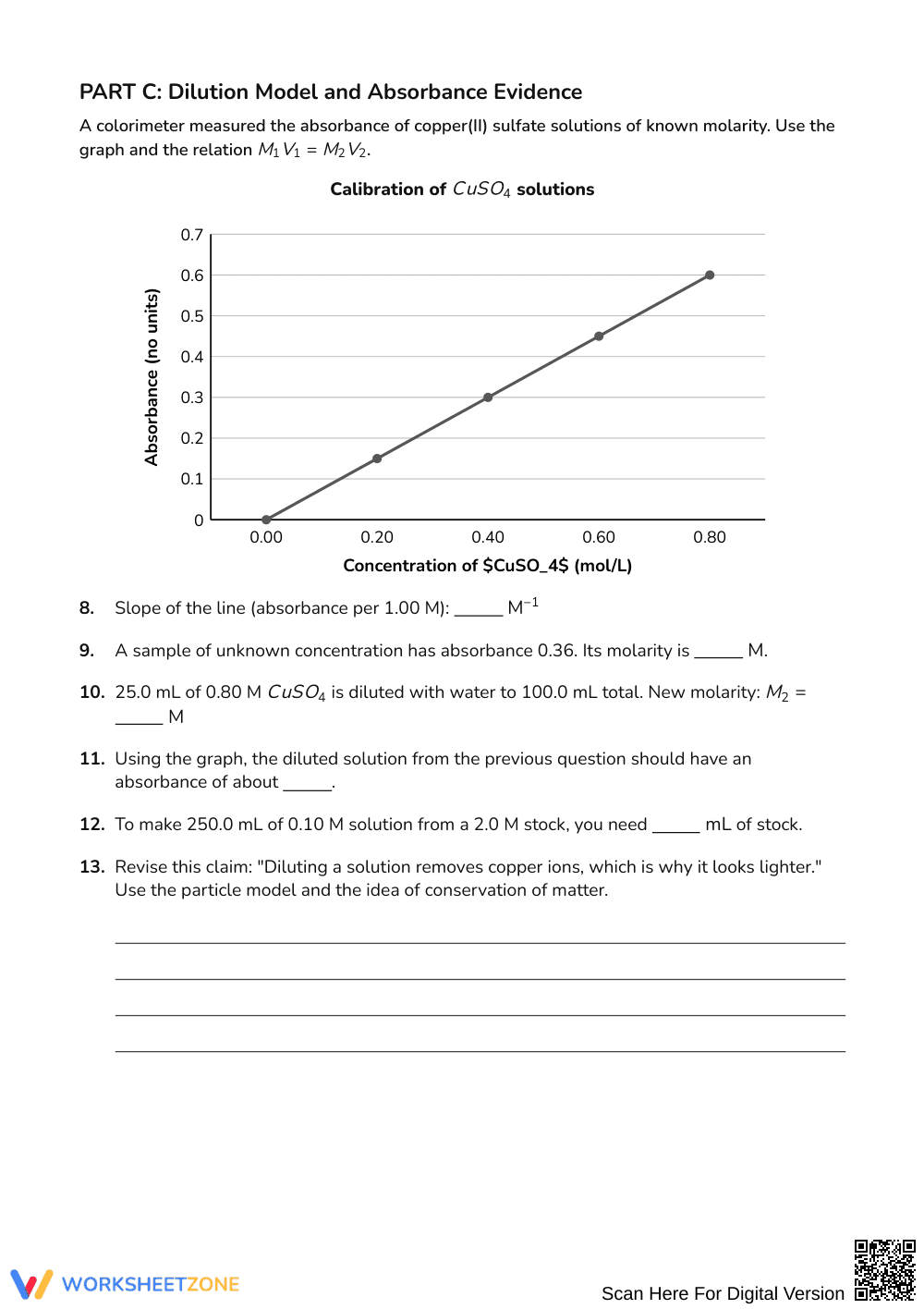
- Supported Practice (Parts B & C, Tasks 7–18): Learners critique flawed student claims about ionic dissociation, complete ion concentration tables, evaluate colorimeter calibration curves, and compute dilution factors using M₁V₁ = M₂V₂.
- Independent Practice (Part D, Tasks 19–24): Students calculate calorimetry values (q and ΔH) for dissolving ammonium nitrate and write particle-level explanations detailing the net energy absorbed during solute separation and hydration.
This sequence follows an intentional gradual-release structure, moving from concrete visual models to quantitative dilution relationships and multi-step thermochemical reasoning.
Standards Alignment
This resource aligns with high school physical science standards for developing and using models to describe the submicroscopic structure of matter and the conservation of energy during chemical and physical changes. Students explicitly evaluate model limitations, revise flawed particle representations, and quantify concentrations. Standard descriptions can be copied directly into lesson plans, IEP goals, or district curriculum mapping tools.
How to Use It
Assign Parts A and B directly after introducing solution concentration and dissociation to address common misconceptions about polyatomic and ionic solutes. Use Parts C and D following laboratory investigations on Beer's law spectroscopy or calorimetry. While circulating, observe whether students account for total dissolved ion molarity or confuse physical dilution with chemical removal of solute. Most students complete the full 4-page sequence in 45 to 60 minutes.
Who It's For
This worksheet serves general high school chemistry, honors chemistry, and introductory AP Chemistry students who need targeted practice connecting particulate diagrams to mathematical calculations. Pair this packet with a hands-on colorimetry lab or a physical simulation demonstrating dissolution at the molecular scale.
High school chemistry classrooms require focused practice connecting particulate representations to macroscopic observations. According to findings highlighted by Fisher & Frey (2014), structured modeling tasks that incorporate guided critique and evidence-based revision accelerate conceptual mastery in scientific problem-solving. This 24-task worksheet supports high school physical science standards by engaging learners directly in drawing, evaluating, and refining solution models. Students examine glucose particle density, determine total cation and anion concentrations from ionic dissociation equations, analyze colorimetric dilution data, and compute dissolution enthalpy using experimental calorimetry measurements. By confronting common misunderstandings—such as the mistaken belief that dilution destroys solute particles or that dissolved ionic compounds remain intact—this resource provides educators with reliable, actionable diagnostic evidence. The thorough 4-page answer key supports rapid grading, small-group intervention, and independent student self-assessment during chemistry unit reviews.


