




























Proven Molarity Variables Worksheet | Grades 9–12 Science
Paste this activity's link or code into your existing LMS (Google Classroom, Canvas, Teams, Schoology, Moodle, etc.).
Students can open and work on the activity right away, with no student login required.
You'll still be able to track student progress and results from your teacher account.
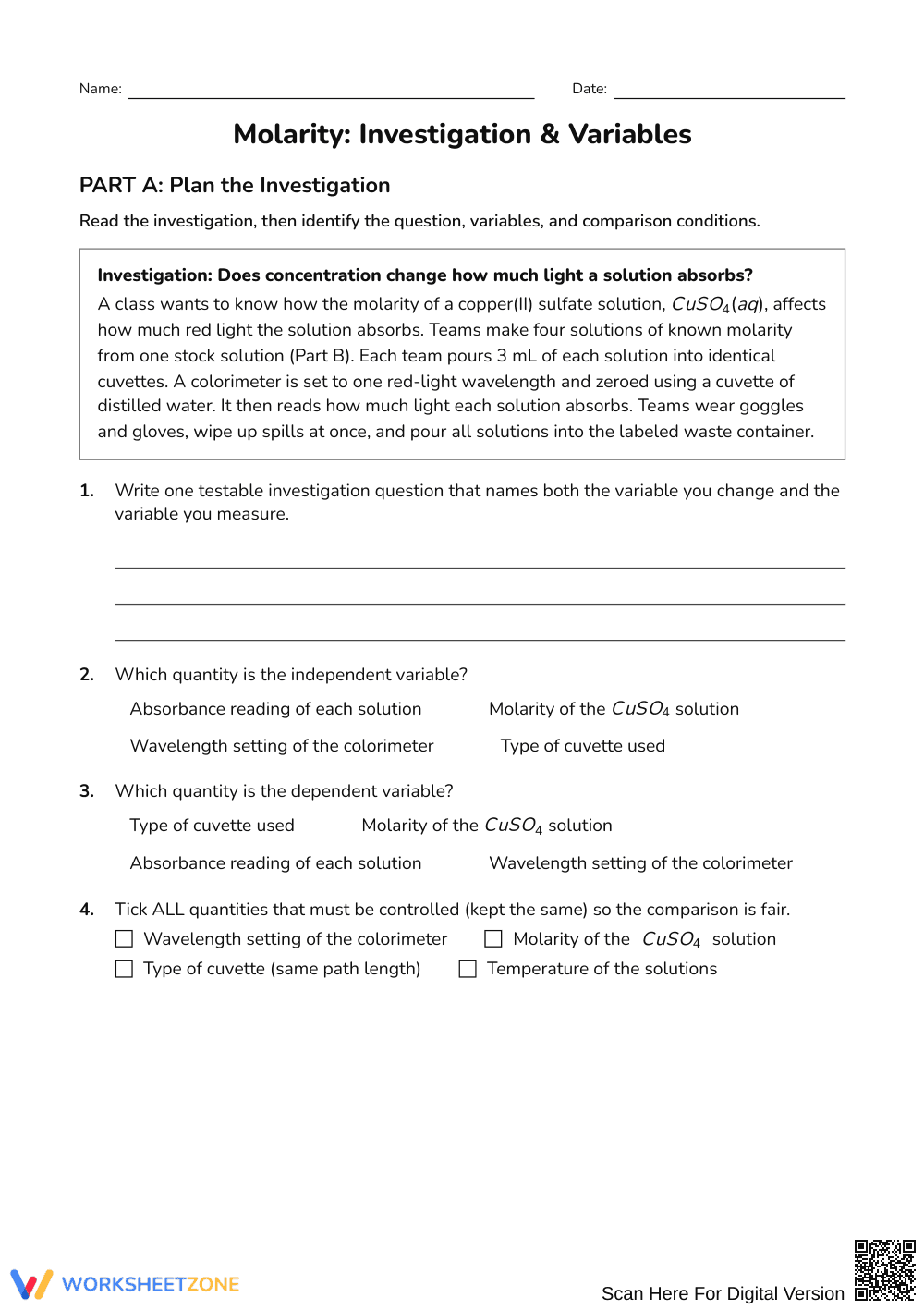
This four-page science worksheet equips high school chemistry students to plan investigations, manipulate experimental variables, and interpret empirical evidence in molarity experiments. Through 23 structured problems, learners connect particle-level solution concentration to colorimeter absorbance readings while systematically distinguishing independent variables, dependent variables, and controlled comparison conditions across authentic laboratory scenarios.
At a Glance
- Grade: Grades 9–12 · Subject: Science
- Standard: Investigation & Design — Identify variables, control conditions, and evaluate evidence in concentration experiments
- Skill Focus: Molarity experimental design, dilution math, and evidence evaluation
- Format: 4 pages · 23 problems · Answer key included · PDF
- Best For: High school chemistry lab prep and data analysis
- Time: 45–60 minutes
What's Inside
The activity provides four instructional parts spanning four student pages. Students analyze an authentic colorimetry scenario, complete dilution calculation tables using stock solutions, evaluate particulate representations of ions, and interpret absorbance data. A comprehensive four-page teacher answer key provides full calculation steps, expected qualitative explanations, and reasoning for multiple-choice selections.
Skill Progression
- Guided practice (Part A & Part B, 10 problems): Students deconstruct an investigation to label independent, dependent, and controlled variables, supported by defined lab parameters and a worked molarity dilution example.
- Supported practice (Part C, 7 problems): Learners translate particle models into quantitative predictions, complete a linear absorbance data table, and interpolate values for unknown solutions.
- Independent practice (Part D, 6 problems): Students independently explain light absorption mechanisms at the submicroscopic scale and evaluate procedural errors in volumetric preparation.
This sequence reinforces the gradual-release model, moving from structured experimental planning to independent scientific reasoning and error analysis.
Standards Alignment
This worksheet aligns with high school physical science performance expectations for scientific inquiry, concentration calculations, and matter-energy interactions. Students plan controlled investigations, calculate molar concentrations, and correlate particulate ion density with macroscopic spectroscopy data. Both standard codes can be copied directly into lesson plans, IEP goals, or district curriculum mapping tools.
How to Use It
Use this worksheet directly after introducing solution molarity and before students conduct wet-lab colorimetry. It functions effectively as a pre-lab conceptual framework or as a structured post-lab data analysis assessment requiring 45 to 60 minutes. During instruction, circulate while students complete Part B to verify that they recognize liquid volumes are not strictly additive when preparing volumetric flasks.
Who It's For
This resource serves high school chemistry and advanced physical science students mastering laboratory procedures. Scaffolds such as particulate diagrams support emerging bilingual learners, while multi-step dilution math challenges advanced students. Pair this activity with an introductory spectrophotometry simulation or an aqueous solutions anchor chart.
Developing secondary science literacy requires students to connect mathematical representations of concentration with experimental design and physical evidence. According to Fisher & Frey (2014), structured instructional frameworks that transition students from guided variable identification to independent evaluation cultivate durable scientific reasoning and analytical precision. In this resource, learners identify independent, dependent, and controlled variables, compute stock solution dilutions, and evaluate spectrophotometric absorbance data through particle models. The four-page sequence incorporates 23 scaffolded tasks that progress from foundational laboratory planning to multi-step error analysis. By demanding that students justify predictions using submicroscopic ion interactions rather than rote algorithmic recall, the activity reinforces core competencies in scientific argumentation and quantitative analysis. This structured inquiry practice prepares high school chemistry students for rigorous laboratory execution, advanced standards-based assessments, and collaborative data-driven problem solving across diverse secondary scientific disciplines.


