





























Complete Molarity Processes Worksheet | Grades 9–12 Science
Paste this activity's link or code into your existing LMS (Google Classroom, Canvas, Teams, Schoology, Moodle, etc.).
Students can open and work on the activity right away, with no student login required.
You'll still be able to track student progress and results from your teacher account.
This four-page chemistry worksheet provides structured practice in sequencing solution preparation, calculating dilutions, and analyzing concentration changes. High school students order volumetric procedures, interpret particle diagrams, read Beer's law calibration curves, and evaluate endothermic dissolving energetics. Students build both conceptual understanding and procedural fluency to master molarity dynamics across laboratory processes.
At a Glance
- Grade: Grades 9–12 · Subject: Science
- Standard: Sequence laboratory solution preparation steps and explain particle changes during dilution
- Skill Focus: Molarity processes, step sequencing, and concentration changes
- Format: 4 pages · 30 problems · Full 4-page answer key included · PDF
- Best For: Secondary chemistry laboratory preparation and post-lab review
- Time: 45–60 total minutes
What's Inside
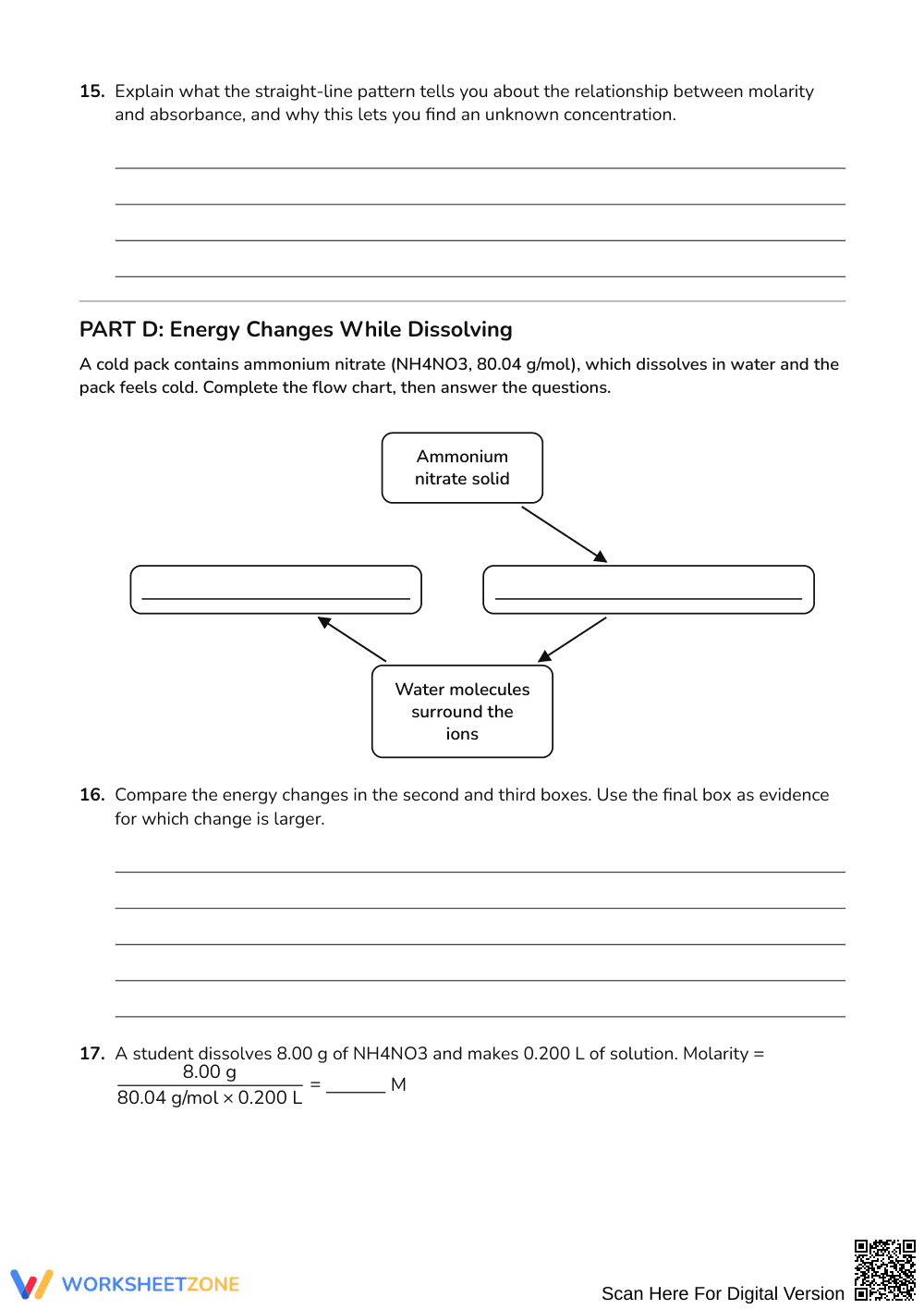
This 4-page worksheet contains 30 sequential tasks supported by a 4-page answer key with complete worked calculations. Students encounter ordering tasks for volumetric flask preparation, submicroscopic particle diagrams illustrating dilution, a multi-stage serial dilution table, a Beer's law calibration graph, and a dissolution flowchart comparing lattice and hydration energetics.
Skill Progression
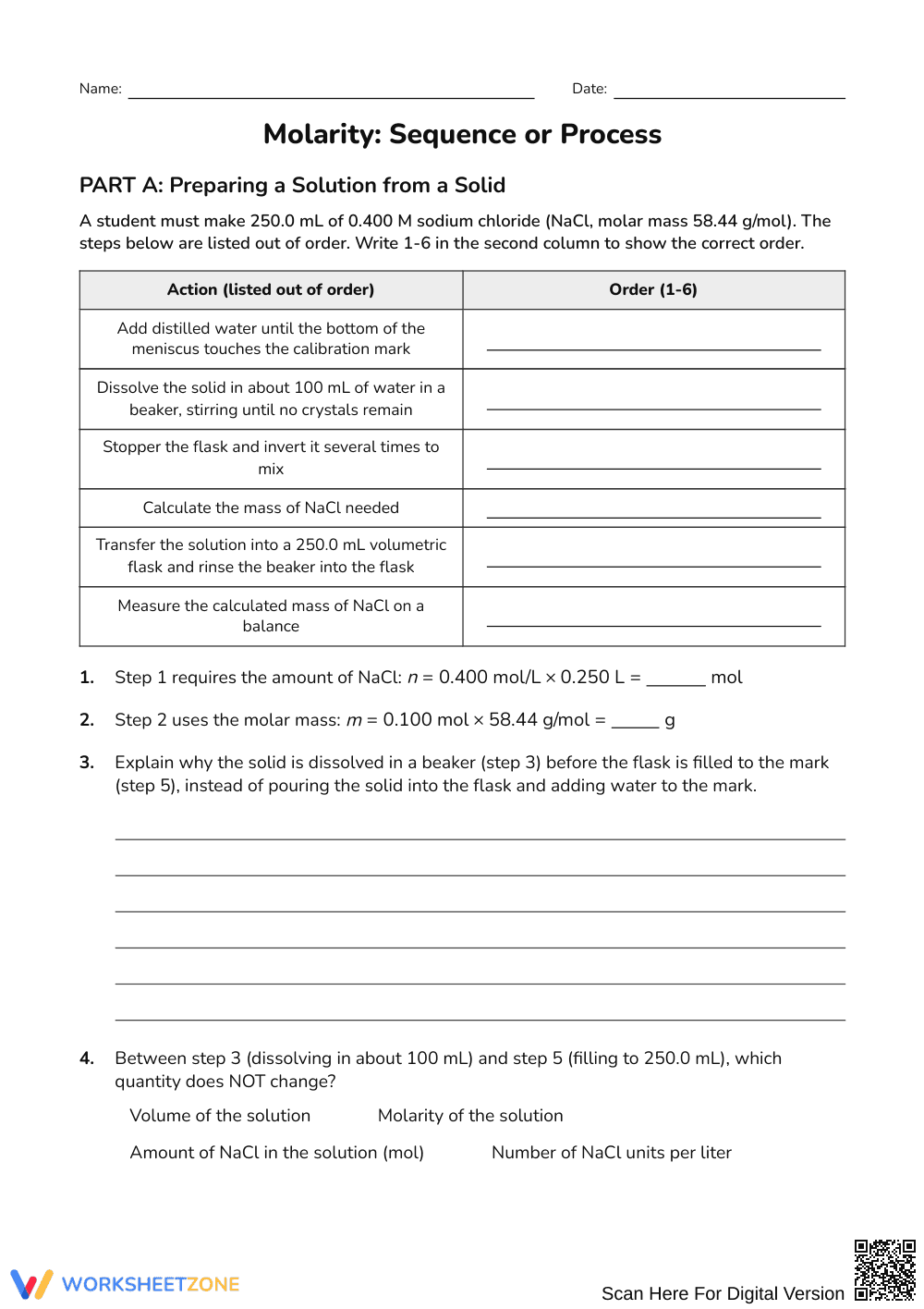
- Guided practice (Tasks 1–8): Students order six steps to prepare 250.0 mL of 0.400 M NaCl, calculating mass with explicit formulas and explaining why dissolving precedes final dilution.
- Supported practice (Tasks 9–18): Learners use particle models to evaluate dilution, justify M₁V₁ = M₂V₂, and calculate values across a three-stage serial dilution table.
- Independent practice (Tasks 19–30): Students analyze a copper(II) sulfate spectrophotometric calibration curve, reverse-calculate stock concentrations, and evaluate endothermic energy changes on a dissolution flowchart.
This structure employs a gradual-release model, progressing from guided procedural steps to independent analytical problem-solving.
Standards Alignment
This worksheet aligns with high school chemistry expectations for solution preparation, stoichiometry, and dilution modeling. Students calculate molar concentrations, interpret particle representations, and analyze proportional data from Beer's law curves. Supporting goals address thermal energy changes in chemical dissolution. Both standard codes can be copied directly into lesson plans, IEP goals, or district curriculum mapping tools.
How to Use It
Use this worksheet after direct instruction on molarity formulas and before wet-lab solution preparation. During class, observe student reasoning on Part A to check whether they realize moles remain constant prior to final dilution. Complete the 30 tasks in 45 to 60 minutes, or assign Parts C and D as a post-lab assessment.
Who It's For
This resource is designed for high school chemistry students mastering aqueous solution chemistry. Provide the Part B particle model as visual support for struggling learners, while challenging advanced students to calculate multi-step serial dilution ratios independently. Pair this activity with a physical volumetric flask demonstration.
Mastering chemical solution concentration requires students to connect procedural laboratory manipulations with submicroscopic particulate models and macroscopic mathematical relationships. According to Fisher & Frey (2014), structured gradual release of responsibility scaffolds complex technical tasks by first establishing procedural sequences before demanding independent multi-step mathematical synthesis. This four-page science resource develops student mastery in ordering stages in molarity processes and explaining step-to-step changes in concentration, particle spacing, and energy. By progressing from volumetric flask solution preparation through particulate dilution modeling, serial dilution calculations, Beer's law spectrophotometric curves, and dissolution thermochemistry, the material bridges laboratory protocols with algebraic execution. Secondary chemistry learners identify invariant quantities during dilution, verify mathematical equations using visual dot models, and determine unknown concentrations through calibration data. The 30 targeted tasks provide high school educators with verified evidence of student readiness for independent laboratory investigation and advanced solution stoichiometry.


