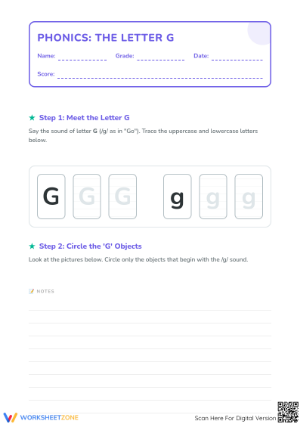
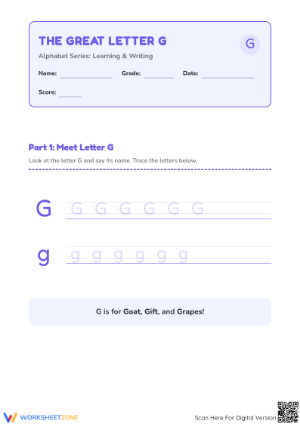
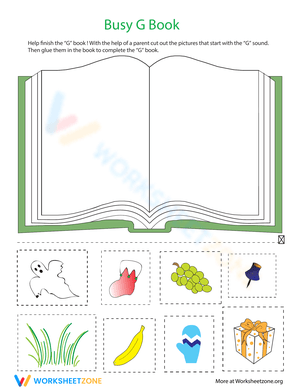
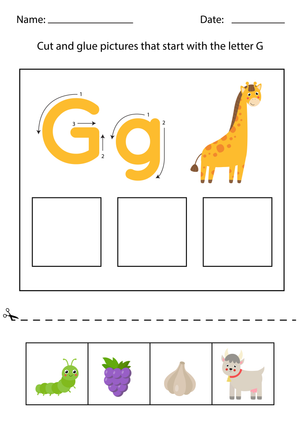
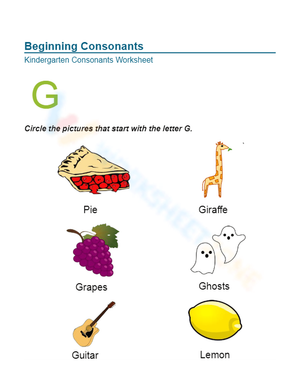
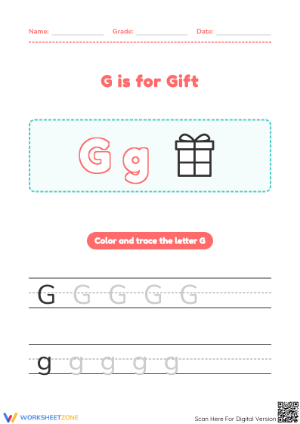
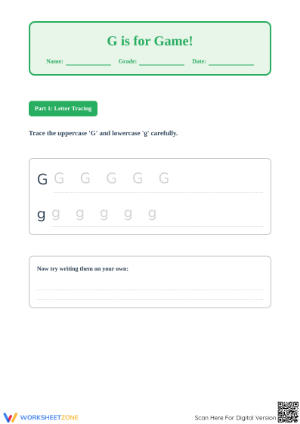
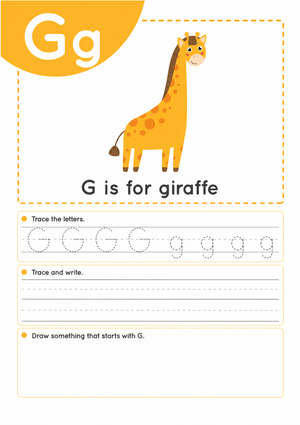
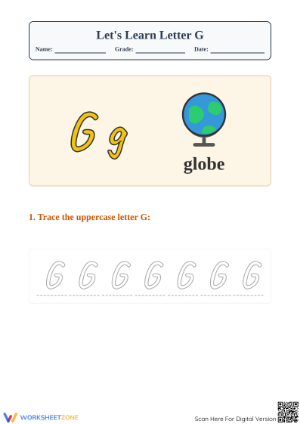
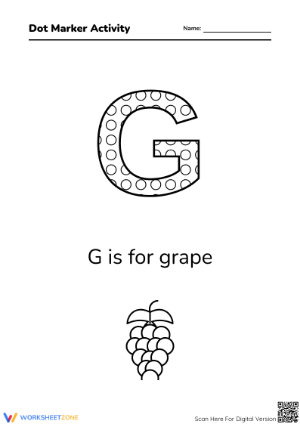
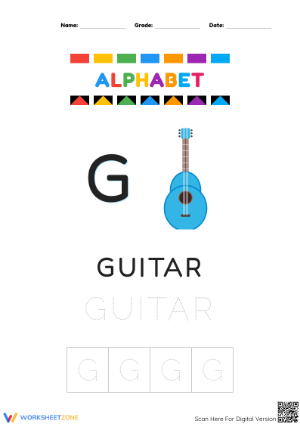
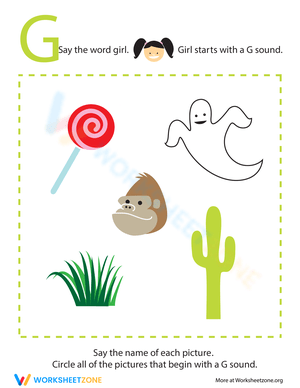
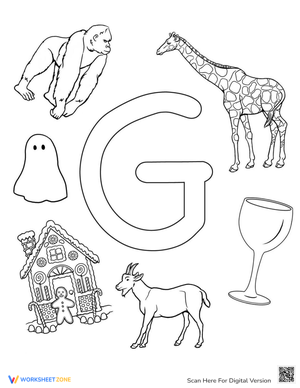
These letter g beginning sound printable worksheets for kindergarten give teachers a focused, low-prep entry point into one of the most fundamental tasks in early phonics: connecting the sound at the start of a spoken word to the letter on a page. Each worksheet centers on a single repeatable routine — students look at a picture, name the word, listen for the first sound, and link it to the letter G. That tight loop, practiced across multiple short sessions, builds the sound-symbol association that beginning readers rely on once they start decoding unfamiliar words.
Student Mistakes Worth Anticipating Before the Lesson
The most frequent error on beginning-sound work isn't actually a phonics mistake — it's a vocabulary mistake. A student who calls the picture of a goat a sheep will circle the wrong answer for a completely valid reason. Before logging that response as a sound-discrimination gap, ask the student to name the picture. In most cases, correcting the label resolves the phonics error immediately, which is worth knowing before you start a reteach sequence that the child doesn't need.
A second pattern involves students who confuse /g/ with /k/ because both sounds originate in the back of the mouth. This isn't random error — the child is noticing something phonetically real about where the sound is made. Having students place a hand on their throat and feel the vibration during goat versus the silence during cat draws the distinction clearly and quickly. That two-minute moment, when a student's expression shifts after feeling the difference, is one of the more satisfying things that happens in a kindergarten phonics lesson.
A third issue surfaces with students who are matching letters visually rather than listening for sounds. They'll correctly identify a picture of gum when asked to "find the G pictures" — then stumble on a task that requires actual sound sorting. These worksheets catch that gap early because the task demands both letter recognition and sound awareness, not just one.
Skills These Worksheets Build
Across the set, students practice identifying pictures whose names begin with the /g/ sound, distinguishing those words from distractors, connecting the spoken sound to both uppercase G and lowercase g, and producing the letter through tracing or writing. Response formats — circling, coloring, matching, sorting — are ones kindergartners can complete independently after a single modeled example.
Picture choice matters more than it might first appear. Words like goat, game, gum, and girl work well because students can name them easily and they clearly begin with the hard /g/ sound. Ambiguous images — a drawing that could be called guitar or instrument, a picture of a gas pump that a child might just call pump — pull attention away from sound discrimination and toward picture guessing. When letter g beginning sound printable worksheets for kindergarten use unambiguous, widely spaced visuals, students stay focused on the phonics target rather than puzzling over the image itself.
Where These Worksheets Fit Into the School Day
Lead with oral practice before students pick up a pencil. A two-minute whole-group warm-up — stretch the first sound together: "/g/... goat," "/g/... gum" — prepares students to listen for the target sound when they begin the worksheet. Teachers who skip this step often find that students work through the page visually, comparing shapes rather than attending to sounds. That shift is hard to see in the finished product, but it shows up when students can't transfer the skill.
In literacy centers, the most effective routine is also the most consistent one: point to each picture, say the word quietly, mark only the ones that start with /g/. That same verbal routine, repeated every time, keeps the task phonics-focused even without teacher proximity. For take-home practice, the cleanest single-step worksheets in the set are the most practical — families can follow a "name each picture and circle the ones that start with G" task without needing classroom phonics vocabulary.
Small-group intervention is where these worksheets do their most targeted work. Cover extra pictures if the full page feels like too much at once, and present one image at a time. Ask three questions in sequence: "What is it?" then "What sound do you hear first?" then "Which letter matches that sound?" That order separates vocabulary knowledge, phonemic awareness, and letter recognition into distinct moments — which is exactly what intervention teaching needs to do to find where the breakdown is.
How to Adjust These Worksheets for Different Students
For students who need more support, narrow the choices before the session starts. Fold or cover half the pictures and work through two options at a time, saying each word together before asking students to respond. For students with fine-motor challenges, dot markers or stamps work just as well as pencils — the phonics task stays intact regardless of the marking tool.
- Students still building letter knowledge: run the worksheet orally first — point to each picture, say the word, name the first sound — then mark answers after the verbal pass.
- Students with solid /g/ identification: after finishing, ask them to name a /g/ word that isn't on the worksheet. That small addition moves them toward generative phonemic awareness without needing a separate resource.
- Intervention groups: repeat the same worksheet format across several sessions so the response routine becomes automatic before the phonics target gets any harder.
Keep hard /g/ examples consistent in early sessions. Using familiar, unambiguous words reduces the chance that a vocabulary gap will look like a phonics problem. Once students show strong accuracy with a core set of words, introducing less familiar pictures is a natural way to push discrimination further.
Standard Alignment
These worksheets address CCSS.ELA-LITERACY.RF.K.3.a, which requires kindergartners to demonstrate basic knowledge of one-to-one letter-sound correspondences by producing the primary sound for each consonant. In classroom terms, this standard is most active during the early months of the school year, when teachers move through consonant sounds one at a time and students are just beginning to map what they hear onto what they see in print. Beginning-sound practice with picture cues is the direct instructional move that standard describes — students connect the sound they hear at the start of a spoken word to the printed letter on the page.
Frequently Asked Questions
How many sessions does it typically take before kindergartners respond consistently to the /g/ sound?
Most students reach reliable accuracy after four to six short practice sessions, though students who arrive confusing /g/ with /k/ may need additional time contrasting the two sounds side by side. Accuracy on a single worksheet isn't mastery — look for consistency across different picture sets and different days before moving on to the next consonant.
Do students need to know all their letter names before these worksheets make sense?
No. Letter-name knowledge and letter-sound knowledge develop on overlapping timelines in kindergarten, and practicing beginning sounds actually helps letter names stick. A student who can't yet name the letter G can still hear the /g/ sound in spoken words — and building that phonemic awareness makes the letter name more meaningful when it arrives. That's one reason letter g beginning sound printable worksheets for kindergarten work well alongside letter-name instruction rather than strictly after it.
What's the most useful way to read student work after these worksheets are collected?
Look for two distinct error patterns: students who marked the wrong picture but named it correctly (a sound issue), and students who named the picture incorrectly and then marked the wrong answer (a vocabulary issue). These need different responses. The vocabulary gap is usually faster to close — spend a minute naming pictures together before the next session, and the phonics accuracy often follows without any additional phonics instruction at all.
Are these worksheets suited for intervention, or mostly for whole-class use?
Letter g beginning sound printable worksheets for kindergarten work in both settings, but the routine looks different in each. Whole-class use benefits from brisk pacing — model once, students complete the worksheet, review answers together. Intervention use is slower and more oral: each picture gets named and discussed before students mark anything. The same worksheet runs both ways without modification, which makes the set practical across multiple parts of the school day.