


























Views
Downloads
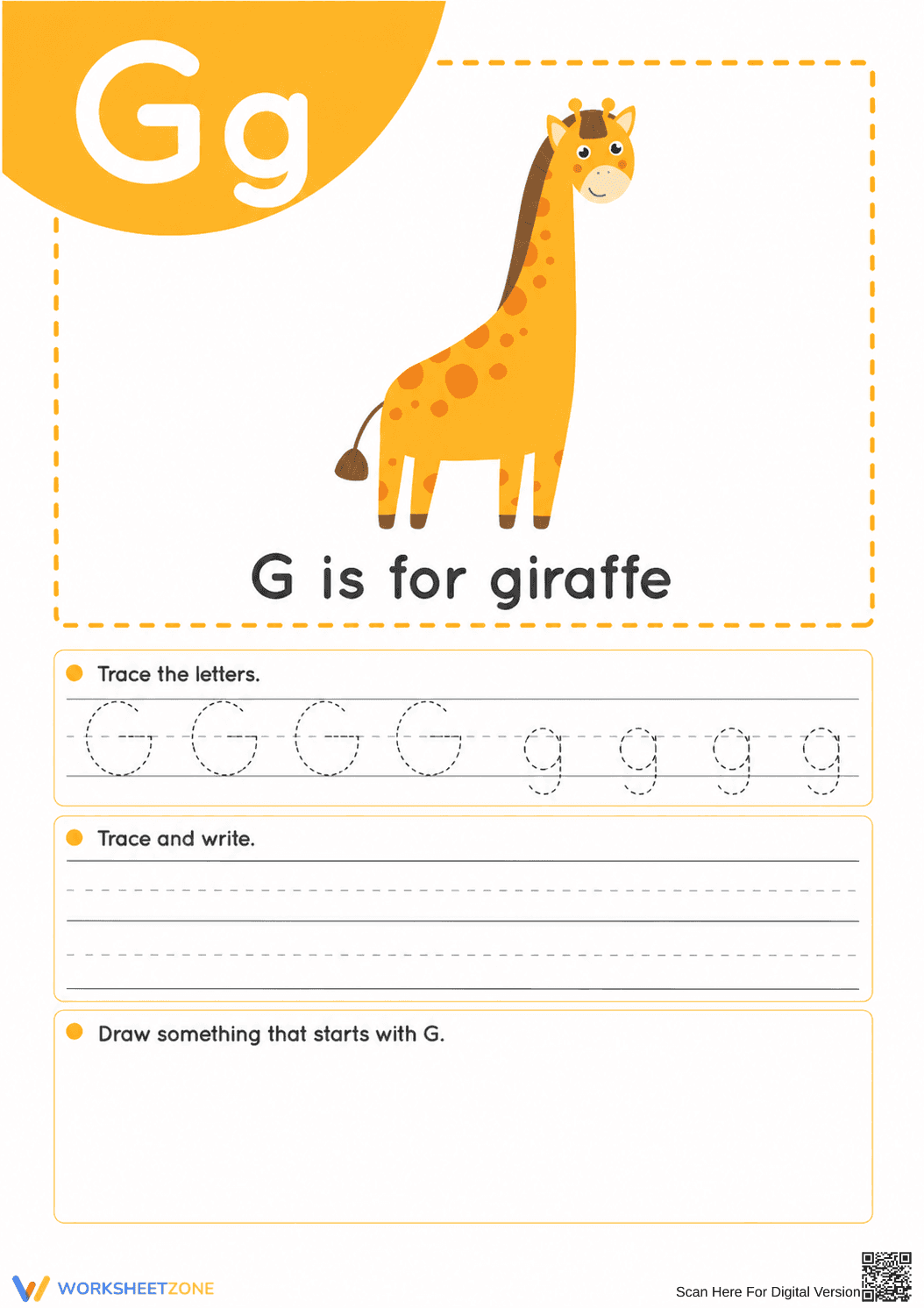

Letter G Beginning Sound Worksheet | Essential Grade K
Paste this activity's link or code into your existing LMS (Google Classroom, Canvas, Teams, Schoology, Moodle, etc.).
Students can open and work on the activity right away, with no student login required.
You'll still be able to track student progress and results from your teacher account.
This Kindergarten letter G worksheet provides a comprehensive introduction to alphabet mastery through tracing, writing, and phonemic association. Students will develop fine motor control while cementing the relationship between the letter G and its beginning sound. By the end of the activity, learners will demonstrate the ability to identify and produce both uppercase and lowercase G.
At a Glance
- Grade: Kindergarten · Subject: ELA
- Standard:
CCSS.ELA-LITERACY.RF.K.1.D— Recognize and name all upper- and lowercase letters of the alphabet- Skill Focus: Letter G formation and beginning sounds
- Format: 1 page · 3 tasks · Answer key included · PDF
- Best For: Morning work or literacy centers
- Time: 10–15 minutes
What's Inside
Inside this resource, you will find a structured single-page layout featuring three distinct learning zones. The first section provides dotted-line tracing for four uppercase and four lowercase letters to establish proper stroke order. The second section offers primary-ruled lines for independent writing practice. The final section includes a creative drawing box where students apply their phonics knowledge by illustrating an object starting with the letter G.
Zero-Prep Workflow
The zero-prep workflow for this resource is designed for maximum efficiency. First, print the single-page PDF (30 seconds). Second, distribute the sheets to students during your phonics block (1 minute). Finally, review the student drawings (30 seconds). Total teacher preparation time is under 2 minutes, making this an ideal solution for unexpected sub plans.
Standards Alignment
This resource is specifically aligned to `CCSS.ELA-LITERACY.RF.K.1.D`, which requires students to recognize and name all upper- and lowercase letters of the alphabet. It also supports `CCSS.ELA-LITERACY.L.K.1.A` by focusing on the physical printing of letters. Both standard codes can be copied directly into lesson plans, IEP goals, or district curriculum mapping tools.
How to Use It
Use this worksheet during the "You Do" phase of a direct instruction lesson on the letter G. It serves as an excellent formative assessment tool; teachers should observe students' grip and stroke direction as they trace. The expected completion time is 10 to 15 minutes, making it a perfect fit for independent literacy rotations or as a quiet morning work task.
Who It's For
This worksheet is designed for Kindergarten students, though it is also suitable for Grade 1 learners needing remedial support or English Language Learners (ELL) building basic vocabulary. It pairs naturally with an alphabet anchor chart or a read-aloud book featuring animals. The simple instructions allow students to work with minimal teacher intervention.
The mastery of letter-sound correspondence is a foundational pillar of early literacy development. This worksheet targets CCSS.ELA-LITERACY.RF.K.1.D by requiring students to recognize, trace, and produce the letter G in both its uppercase and lowercase forms. By connecting the visual symbol to the "giraffe" phoneme and encouraging a creative drawing task, the resource reinforces phonemic awareness through multi-sensory engagement. According to Fisher & Frey (2014), the gradual release of responsibility model—moving from guided tracing to independent writing—is essential for ensuring that students internalize correct stroke order and letter formation. Research indicates that early intervention in letter recognition is a strong predictor of future reading fluency. This printable resource provides the structured repetition necessary for Kindergarten students to achieve automaticity. Educators can utilize this tool to bridge the gap between simple recognition and active production, ensuring that every learner develops the fine motor skills and phonological knowledge required for Grade 1 success.


