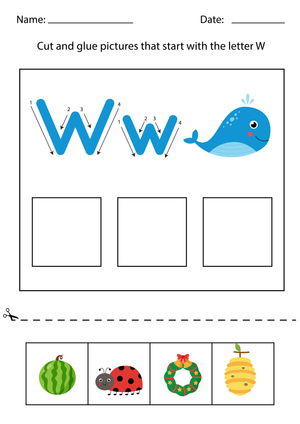
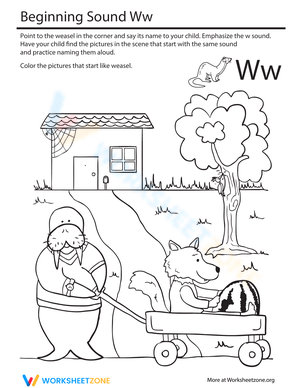
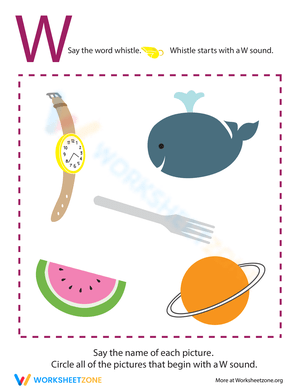
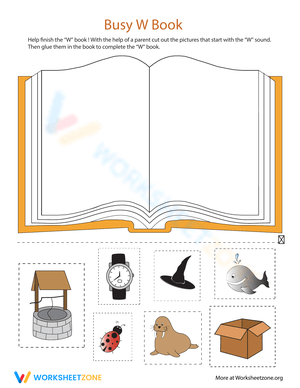
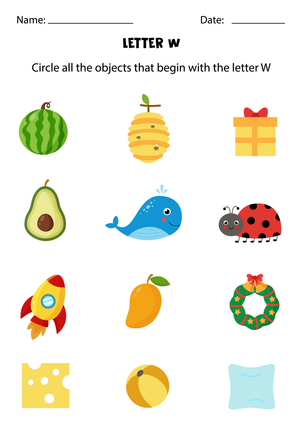
These letter w beginning sound printable worksheets for kindergarten cover the specific moment in early phonics when students move from hearing /w/ in isolation to recognizing it at the front of a printed word — exactly the gap that surfaces in phonics assessments during October and November of the kindergarten year. Each worksheet gives students a focused, repeatable task: tracing both forms of the letter, circling pictures whose names begin with /w/, and sorting W words against one contrasting beginning sound.
What Each Worksheet Targets
The /w/ sound is one of the glides in English — produced with rounded lips and no friction — and it appears in a cluster of early phonics words kindergartners encounter in read-alouds and decodable texts: web, wig, wax, wagon, wolf, and whale. Each worksheet builds recognition of that sound through a layered set of tasks.
- Letter tracing: Students trace uppercase W and lowercase w while saying the sound aloud, connecting hand movement to the phoneme.
- Picture identification: Students circle or color images whose names begin with /w/, choosing from three or four options that include one or two distractors.
- Sound sorting: Students sort a small set of pictures between /w/ and one other beginning consonant — a task that requires active listening rather than scanning for a familiar letter shape.
- Mixed review: A contrasting worksheet places /w/ among two or three other beginning sounds, building the flexible listening students need for actual reading.
Picture vocabulary is a hidden variable on every beginning sound worksheet. A student who doesn't know what a walrus is will hesitate or guess, and the wrong answer looks like a phonics error even when it is a vocabulary gap. The word choices in this set stay close to the everyday vocabulary of a five-year-old: animals, clothing items, and familiar household objects.
Mistakes Students Make That These Worksheets Help Surface
The letter name "double-u" is one of the stranger names in the alphabet — it doesn't front the phoneme /w/ the way "buh" does for B or "muh" does for M. Because of that, some kindergartners know the letter name perfectly and still struggle to isolate the sound. Watching where a student pauses on each worksheet tells you quickly whether the issue is letter recognition or phoneme isolation — two very different instructional problems.
A second common error is /w/–/v/ confusion. This shows up most often in students whose home language is Spanish, where a sound close to English /v/ serves in many /w/ contexts. A child might circle the picture of a vine when the target is wagon — not because they aren't trying, but because those two sounds feel nearly identical aurally. Naming the pictures aloud together before students start working almost always catches this before it becomes a pattern.
"Wh" words add another layer worth watching. Words like whale, wheel, and white appear on many beginning sound worksheets, and some students hear them as starting with an /h/-adjacent breath rather than a clean /w/. That's not wrong in every regional dialect, but it can muddle the phonics lesson. If you include "wh" pictures, name them explicitly during your warm-up and model the mouth position before students work independently.
Building These Worksheets Into Your Phonics Block
The most reliable routine is a two-minute oral warm-up before the worksheet goes out. Say four or five picture words aloud — some starting with /w/, some not — and have students show a thumbs-up or push a sound chip forward when they hear /w/. Then hold up both W and w before students begin. That sequence costs almost nothing in prep time and reduces guessing considerably.
In small group instruction, letter w beginning sound printable worksheets for kindergarten work well right after a shared oral sort. The teacher names each picture, the group decides together, and then each student marks the worksheet independently. The oral step functions as a model, so the written response actually tests what the student retained — not whether they understood the directions.
- Morning work: Familiar task formats let students settle in without waiting for teacher instructions. One worksheet carries five to seven minutes of independent practice without overloading a kindergartner at the start of the day.
- Centers: Pair each worksheet with a small set of letter cards or picture tiles. Students say each word aloud, hold up the W card, then mark their choice. That physical step reduces guessing based on proximity of images on the worksheet.
- Intervention block: Repeat the same worksheet across two or three short sessions before moving on. Repeated exposure to the same sound in the same format builds the automaticity that struggling readers need before transferring the skill to new words.
- Quick phonics check: Give the sorting worksheet cold — no warm-up, no teacher naming — to see who has genuinely internalized /w/ and who has been relying on context cues during group practice.
Adapting the Set for Different Learners
For students who are still building phonemic awareness and need more oral support before print: run through the entire worksheet aloud before students pick up pencils. Name each picture, ask the student to repeat it and stretch the first sound, and then let the student complete the worksheet. That oral-then-print sequence gives students the auditory input they need to respond accurately — it's a more direct form of support than simply re-explaining the directions.
Students who have already mastered /w/ sound isolation can move beyond circling and coloring. Ask them to write the letter beside each correct image, or for those ready for it, write the whole word beneath the picture. That extension shifts practice from recognition to production, which is where phonics instruction needs to go once the basic sound-symbol connection is secure.
When letter w beginning sound printable worksheets for kindergarten are used with English learners, previewing picture vocabulary before instruction is non-negotiable. Show the image, say the word, say it again slowly, and have the student repeat it. The phonics task should measure sound knowledge — not whether a student knows the English name for a spider's web or the difference between a wig and a hat.
Standard Alignment
These worksheets address CCSS.ELA-LITERACY.RF.K.3a, which calls for kindergartners to demonstrate one-to-one letter-sound correspondence by producing the primary sound for each consonant. In classroom terms, that standard shows up earliest in sound-isolation tasks — hearing /w/ at the start of a word — and then in the recognition work of matching that sound to the printed forms W and w. The sorting and picture-identification tasks in this set sit squarely in that instructional window, which most teachers hit between late September and December of the kindergarten year.
Frequently Asked Questions
Which picture words are most reliable for /w/ practice in kindergarten?
Short, familiar words with one clear image work best: web, wig, wagon, wolf, and worm. Words like walrus or wren are fine if you name them aloud during the warm-up, but they carry more vocabulary risk. When the picture is ambiguous or unfamiliar, the worksheet stops measuring what you think it's measuring.
Should I include "wh" words like "whale" and "wheel" alongside regular W words?
You can, but be deliberate about it. In most kindergarten classrooms, the instructional focus is /w/ as a single phoneme, and "wh" words produce /w/ in standard American English — so phonetically they belong. The complication is that some students hear the breath before the vowel in "wheel" and parse it as something closer to /h/. If you use "wh" words, make the oral model explicit: say each word slowly, show the mouth position, and confirm that both W and "wh" produce the /w/ sound at the start.
How do I tell the difference between a phonics gap and a vocabulary gap on these worksheets?
Name the pictures aloud yourself before the student works. If the student marks correctly after hearing the word, the issue was vocabulary, not phoneme isolation. If the student still misses it after hearing the word clearly, that points to the phonics skill. Keeping that distinction clear matters for planning what comes next: vocabulary gaps need word exposure, not more sound drills.
Where do these worksheets fit in a full kindergarten phonics sequence?
Letter w beginning sound printable worksheets for kindergarten belong in the first quarter of the year, after students have some phonemic awareness — clapping syllables, matching rhymes — but before they are asked to blend or segment whole words. W typically appears in the second or third wave of consonant instruction, after higher-frequency sounds like /s/, /m/, and /t/ have been introduced. Use this set once W has been introduced orally and students have seen both letter forms in shared reading or alphabet activities.