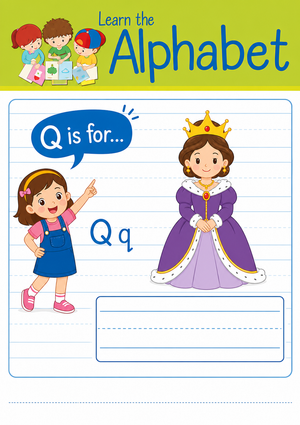
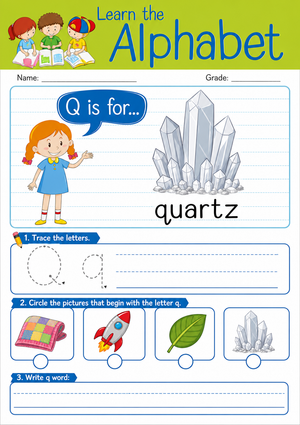
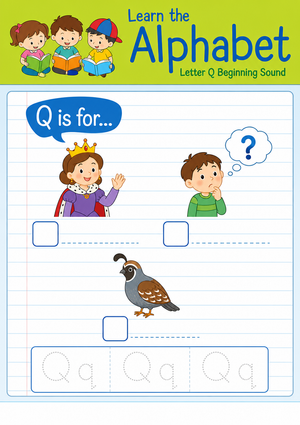
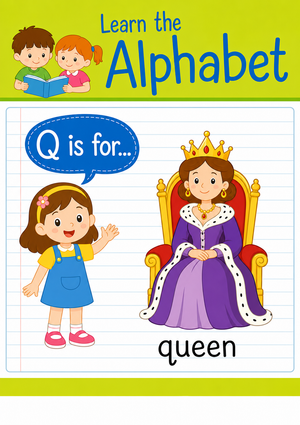
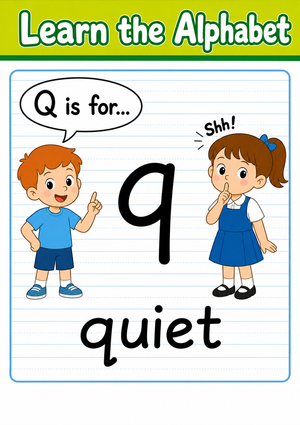
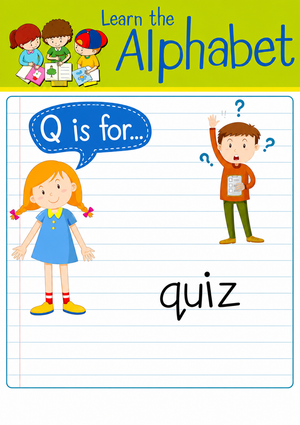
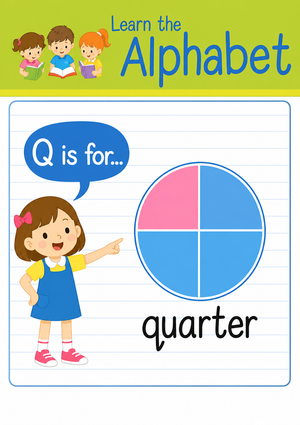
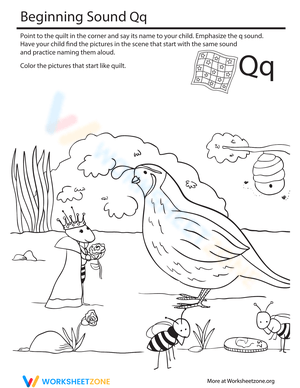
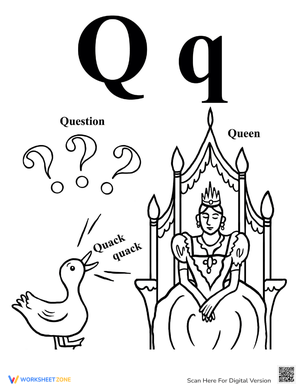
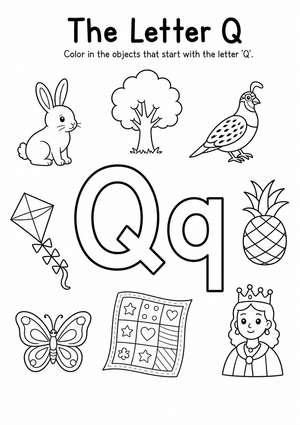
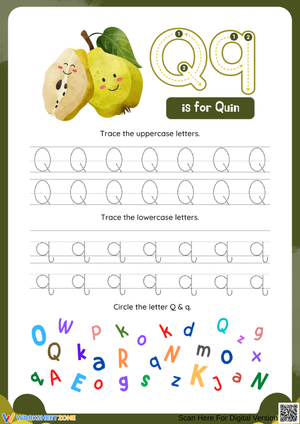
These letter q beginning sound worksheets for kindergarten give teachers a focused set of activities for one of the alphabet's genuinely unusual sound-spelling situations — the /kw/ phoneme that Q almost always produces alongside its partner U. Each worksheet in the set addresses a distinct skill, so teachers can pull individual activities where they fit rather than moving through the set in a fixed sequence.
What's Inside the Set
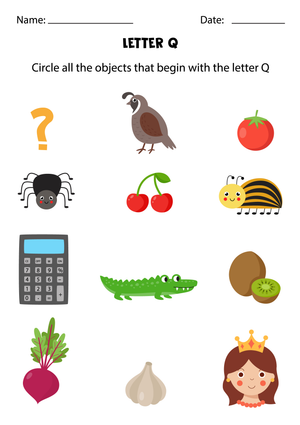
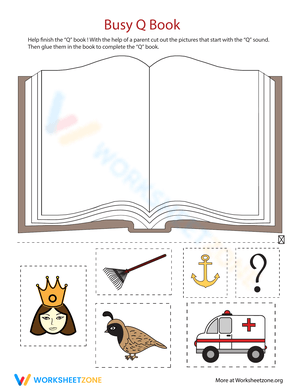
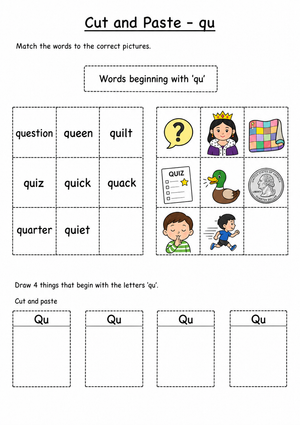
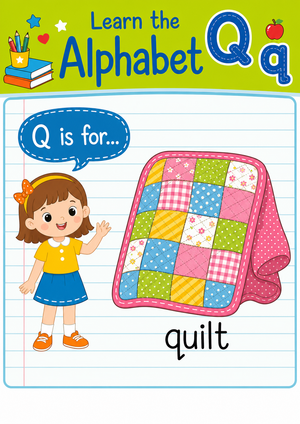
The worksheets break the Q unit into its component skills. Beginning-sound identification tasks present a group of pictures — a quilt, a cat, a duck, a queen — and ask students to mark only the ones whose names start with /kw/. Formation worksheets guide students through uppercase Q and lowercase q with explicit stroke-direction prompts. A sorting activity places /kw/ words alongside /k/ and /w/ distractors, which requires students to attend carefully to the full initial sound rather than making a visual guess. A QU-recognition task has students match pictures to the two-letter pair written together.
- Beginning-sound identification with illustrated picture sets
- Uppercase Q and lowercase q formation with directional cues
- Initial-sound sorting: /kw/ words alongside /k/ and /w/ distractors
- QU-pair recognition and picture matching
- Writing practice with words from the standard kindergarten Q vocabulary
Teaching Q and U as a Team From Day One
Unlike most consonants, Q in English almost never appears without U, and together they signal one consistent phoneme: /kw/. Teaching them as a pair from the first introduction prevents a specific spelling error that surfaces in first-grade independent writing — students who learned Q in isolation often spell "quick" as "kwik" because they never internalized that Q and U go together. Every worksheet in this set treats QU as a unit. Students do not see Q modeled without its partner, which builds the correct pattern at the point of first exposure instead of requiring a correction later.
Mistakes Students Make That These Worksheets Help Surface
The most consistent error is reversing lowercase q, writing a p instead. Both letters consist of a circle plus a vertical stroke — only the direction of the tail differs — and a student who writes "pueen" has the letter-sound connection intact but the visual form wrong. The formation worksheets use a deliberate stroke sequence: circle, downstroke, curl right. Watching students work through that sequence during small-group instruction surfaces reversals immediately rather than after the worksheet is complete and the teachable moment has passed.
A subtler problem appears in the auditory tasks. Students who know the letter name "Q" (pronounced "kyoo") sometimes fail to reliably identify /kw/ at the beginning of a word because they try to hear "kyoo" in "quiet" or "quilt" and the match feels uncertain. The sound-sorting tasks in this set ask students to respond to the phoneme /kw/ before they see any printed letter, which separates sound knowledge from letter-name recall and brings this confusion into view early enough to address.
Building These Worksheets Into Your Weekly Phonics Plans
The picture-sort worksheet fits naturally into the opening minutes of whole-group phonics — brief auditory practice before any pencils come out. The formation worksheet belongs in small-group rotation, where the teacher watches stroke direction in real time and redirects a reversal before it becomes a habit. The QU-recognition activity works as an independent center task after the sound has been introduced to the class; students who attended the lesson can practice matching on their own while the teacher pulls a smaller group for targeted formation or phoneme work.
Q tends to arrive late in the alphabet sequence — most programs place it in weeks seventeen through twenty — and that timing is worth accounting for. Students come to these letter q beginning sound worksheets for kindergarten with more developed phonemic awareness than they had in September, so the sound-identification tasks often move faster than equivalent activities did for earlier letters. The formation work still needs the same attention; q reversals are not correlated with phonemic awareness level. That faster pace on sound tasks frees up instructional time for what is genuinely new: the QU pairing and its consistent /kw/ pronunciation.
Matching the Set to Different Student Readiness Levels
Students still developing initial-sound awareness need the auditory tasks before they encounter any printed letters. Hear the word, decide if it starts with /kw/, respond with a gesture or signal — then move to the written worksheet. Going straight to writing before the phoneme is stable means the demands of letter formation compete with sound-processing work, and students end up forming letters without connecting them to sounds.
Students who have already internalized initial sounds and are beginning to blend simple words can extend any picture-identification or sorting worksheet by writing the words rather than circling or coloring. A student who independently writes "quack," "quilt," and "queen" without a model is operating well above the minimum standard for this unit. The blank lines beneath each picture prompt in the set accommodate that without requiring a separate activity.
Standard Alignment
The set addresses CCSS.ELA-LITERACY.RF.K.3.A, which asks kindergarteners to produce the primary sound or sounds for each consonant. In classroom terms, that means a student looks at the letter Q, produces /kw/ — not the letter name, not an approximation — and connects that phoneme to the beginning of recognizable words. The picture-sorting and beginning-sound tasks build exactly that sound-symbol connection. The QU-pair activities push further into early spelling knowledge, giving students a correct model for how /kw/ gets written before they attempt independent spelling in journals or dictation. The set also touches CCSS.ELA-LITERACY.RF.K.2.D through the auditory tasks that precede any written work — a useful alignment note when fitting these letter q beginning sound worksheets for kindergarten into a structured literacy scope and sequence.
Frequently Asked Questions
Why does Q almost always appear with U?
It is a pattern carried over from Latin and French borrowings in English — the spelling QU represented the /kw/ sound that Q originated with in those languages. For kindergarteners, the practical reason to teach it this way is that the pairing holds in nearly every word they will encounter through the end of elementary school. Teaching QU as a unit from day one means students do not have to revise an assumption later. The rare exceptions — words like "qi" or certain proper nouns — do not appear in early reading material and do not need to be addressed at this level.
My student keeps writing a backward lowercase q. What should I do?
Lowercase q and p are near-mirror images, and reversals between them rank among the most common letter-formation errors in kindergarten alongside b and d. Two approaches work reliably: a consistent verbal prompt during writing ("circle, down, curl right") that the student says aloud while forming the letter, and tracing with a finger before picking up a pencil. Students who reverse q often also reverse b and d; tracking which reversals persist past mid-year, and which self-correct as reading exposure increases, helps identify who may need a more structured response in first grade.
How many Q words does a kindergartener need to know?
A working vocabulary of five to seven words covers the kindergarten year: queen, quilt, quiet, question, quarter, quack, quick. These are visually concrete enough to appear in picture-sorting tasks and common enough to surface naturally in early classroom conversation. Students do not need an extensive Q word bank at this stage — the goal is for the /kw/ phoneme to be automatic so they can decode unfamiliar words when they encounter them in first-grade texts. Using the same core words consistently across these letter q beginning sound worksheets for kindergarten builds the sound through repetition without overwhelming students with unfamiliar vocabulary.