


























Views
Downloads
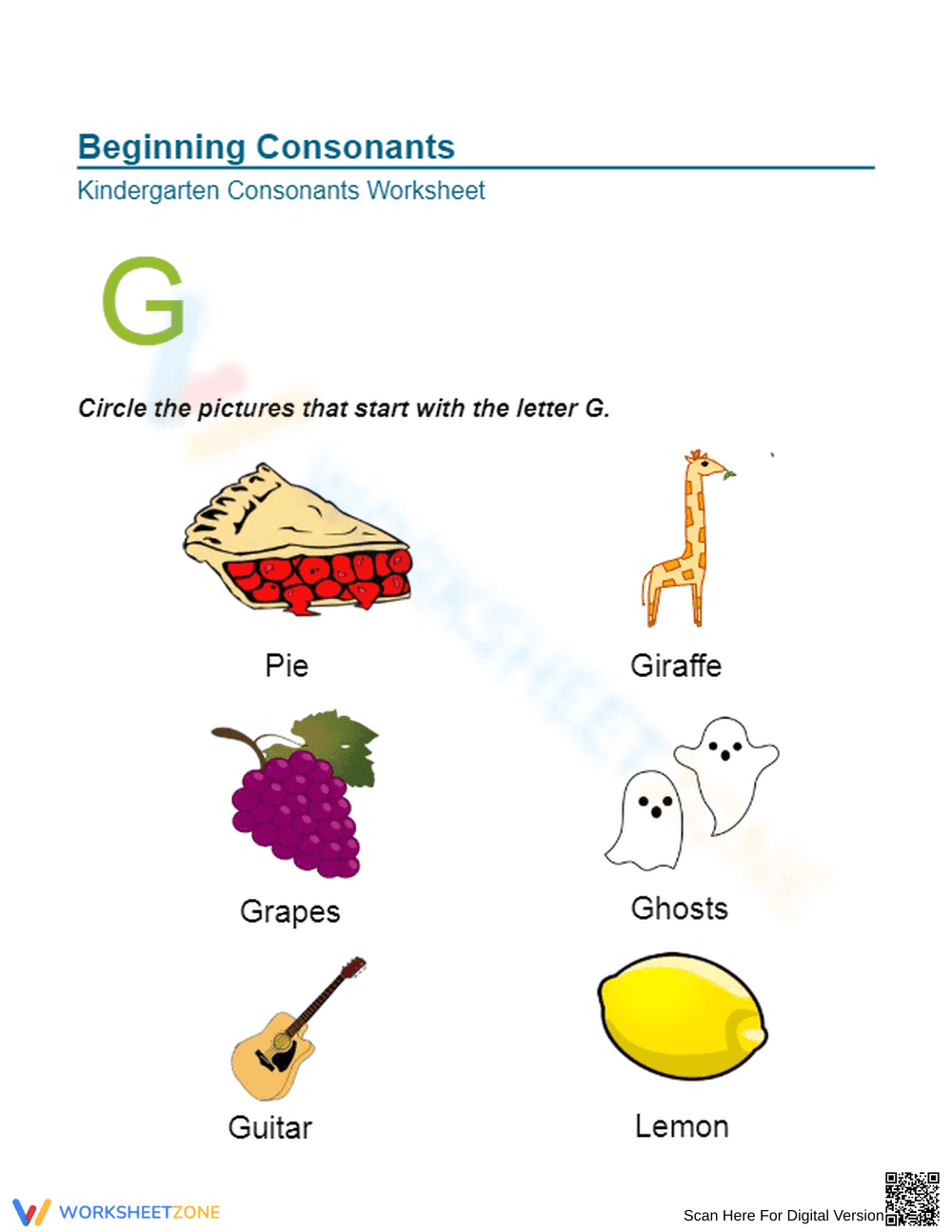

Essential Letter G Beginning Consonants Worksheet | Pre-K
Paste this activity's link or code into your existing LMS (Google Classroom, Canvas, Teams, Schoology, Moodle, etc.).
Students can open and work on the activity right away, with no student login required.
You'll still be able to track student progress and results from your teacher account.
This Preschool phonics worksheet helps early learners master the initial "g" sound through visual identification. Students examine six distinct illustrations to determine which objects begin with the letter G, reinforcing the connection between written symbols and spoken phonemes. It provides a clear, focused environment for developing foundational literacy skills.
At a Glance
- Grade: Preschool · Subject: ELA
- Standard:
CCSS.ELA-LITERACY.RF.K.3.A— Demonstrate basic knowledge of one-to-one letter-sound correspondences for consonants- Skill Focus: Initial consonant sound /g/
- Format: 1 page · 6 problems · Answer key included · PDF
- Best For: Morning work or phonics centers
- Time: 5–10 minutes
The worksheet features a clean layout with six high-quality illustrations including a giraffe, grapes, and a guitar. Each image is paired with its printed name to support word recognition. The single-page PDF format includes a clear instructional prompt and a large "G" header to keep students focused on the target letter.
The zero-prep workflow is designed for maximum efficiency. Teachers can print the single-sheet PDF in under 30 seconds. Distribution takes less than a minute, and because the task is intuitive, students can begin immediately. Reviewing the six items as a whole class takes approximately 2 minutes, making this an ideal resource for busy transition periods or unexpected sub plans.
This resource aligns with `CCSS.ELA-LITERACY.RF.K.3.A`, which requires students to demonstrate basic knowledge of one-to-one letter-sound correspondences by producing the primary sound for each consonant. It also supports phonological awareness by asking students to isolate the initial sound in spoken words. Both standard codes can be copied directly into lesson plans, IEP goals, or district curriculum mapping tools.
Use this worksheet during the guided practice portion of a phonics lesson after introducing the letter G. It serves as an excellent formative assessment; observe if students can distinguish between the hard "g" in "grapes" and the soft "g" in "giraffe," or if they correctly exclude "lemon." Expected completion typically takes 5 to 10 minutes.
This is designed for preschool and early kindergarten students who are beginning their phonics journey. It is particularly helpful for English Language Learners (ELLs) who benefit from the visual cues paired with vocabulary words. Pair this with a letter G anchor chart or a tactile sand-tracing activity for a multi-sensory learning experience.
According to the RAND AIRS 2024 report, early exposure to systematic phonics instruction, specifically letter-sound correspondence, is a significant predictor of later reading fluency. This worksheet addresses the critical need for isolated practice with the letter G, helping students build the phonemic awareness necessary to decode more complex words. By focusing on 6 specific tasks, the resource avoids cognitive overload while providing enough repetition to solidify the /g/ sound. The inclusion of both hard and soft "g" sounds (grapes vs. giraffe) offers a subtle opportunity for teachers to discuss phonetic variations. Research from Fisher & Frey (2014) emphasizes that visual supports in early literacy worksheets help bridge the gap between oral language and written text. This resource provides that bridge through clear imagery and direct task alignment to CCSS.ELA-LITERACY.RF.K.3.A, ensuring students meet foundational benchmarks.


