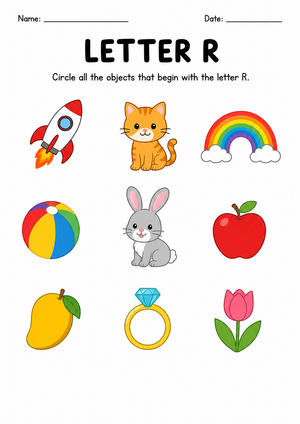
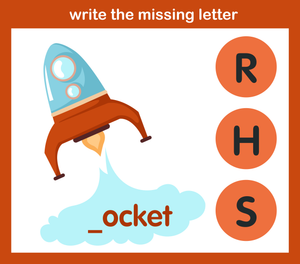
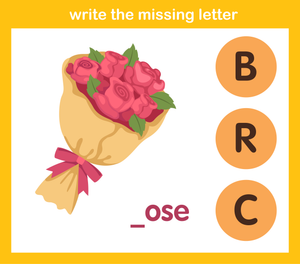
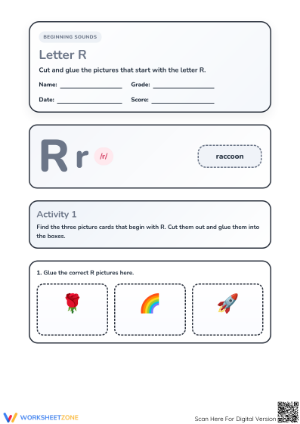
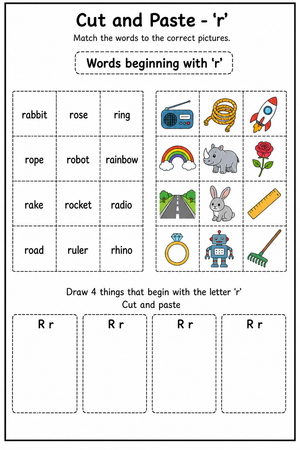
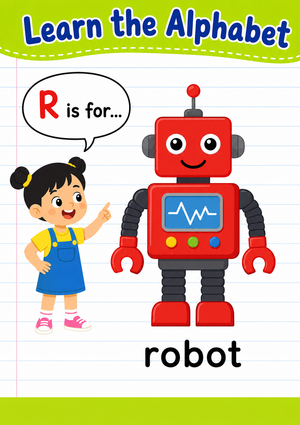
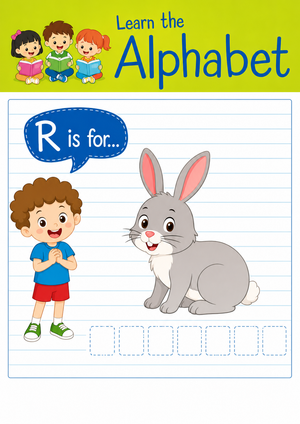
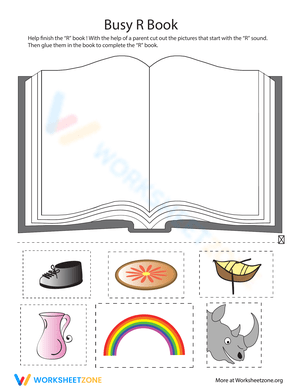
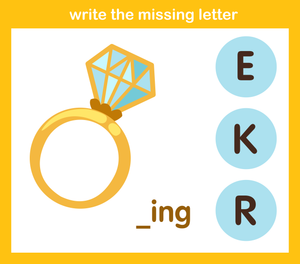
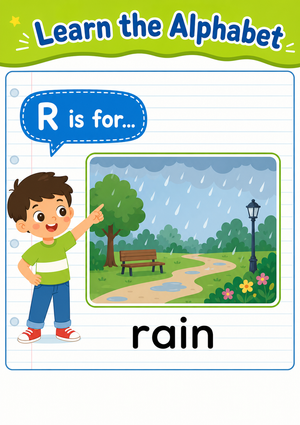
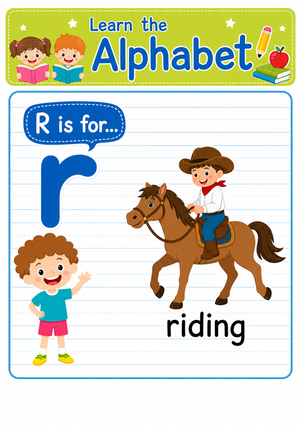
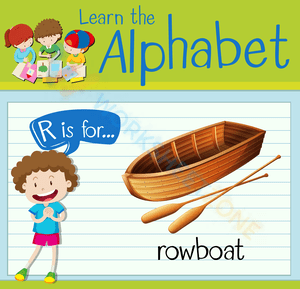
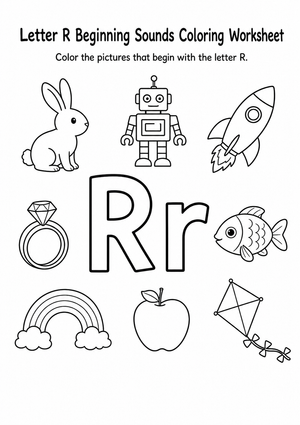
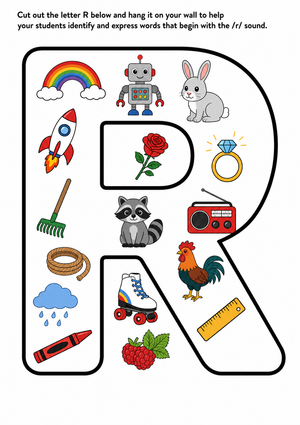
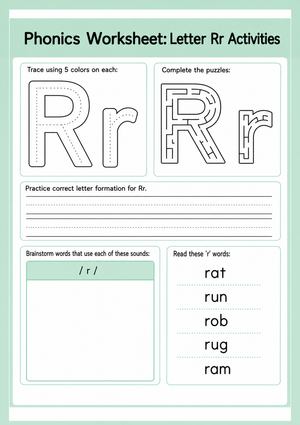
These letter r beginning sound worksheets for kindergarten give teachers a targeted, print-ready set of phonics activities built around one of the harder sounds for five-year-olds to produce and identify accurately. The set covers letter formation, phoneme isolation, and sound discrimination through four distinct formats — tracing, sound sorting, cut-and-paste, and color-by-sound — so teachers can match the right activity to the right lesson moment rather than working through materials in sequence.
Skills These Worksheets Build
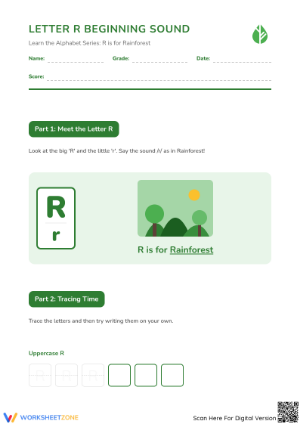
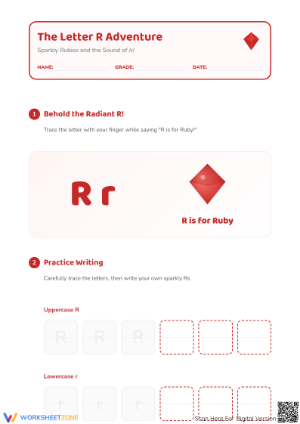
Each worksheet targets one or more of three interlocking areas: letter recognition, sound-symbol correspondence, and phoneme isolation. Tracing worksheets ask students to form uppercase and lowercase R with attention to stroke order, then immediately identify pictures beginning with /r/. That paired structure — physical formation followed by phonemic identification — keeps the letter-sound connection active within the same short task, rather than treating handwriting and phonics as separate exercises.
Sound sorting worksheets place /r/ pictures alongside distractors beginning with /l/ and /w/ — the two phonemes most commonly confused with /r/ at this stage. Students mark or cut pictures into labeled columns, which forces them to listen past the general sonorant quality those sounds share and attend to the specific initial phoneme. Several worksheets also build visual discrimination work into the task: students identify the printed letter R among similar-looking letters, with particular attention to distinguishing R from P and B. All three share a vertical stroke and curved bowl, but only R carries the diagnostic diagonal leg — and that leg is what these activities train students to see.
- Letter tracing — uppercase and lowercase R with stroke-order guidance
- Beginning sound identification — circling or marking pictures that start with /r/
- Sound sorting — categorizing /r/ words against /l/ and /w/ distractors
- Cut-and-paste activities — sorting and gluing pictures into labeled columns
- Color-by-sound — completing a picture using a phoneme-based color key
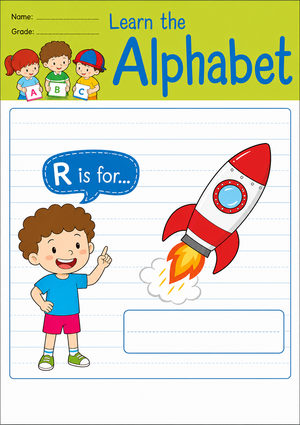
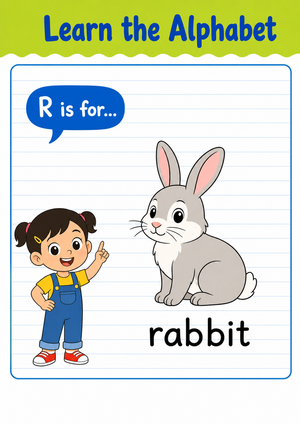
Anchor images across the set draw on words kindergartners already know well: rabbit, rain, ring, robot, and red. Using familiar vocabulary in the pictures keeps the cognitive demand where it belongs — on the phoneme, not on word retrieval.
The /r/-for-/w/ Substitution and What Else to Anticipate
The most common and persistent error in this unit is the /w/ substitution — "wabbit" for "rabbit," "wed" for "red," "wing" for "ring." It happens because producing /r/ requires the tongue to arch toward the alveolar ridge while the lips stay open and relatively flat, a configuration that most five-year-olds cannot control reliably. The /w/ sound uses rounded, slightly pursed lips, which is physically easier to produce, so it gets recruited as a substitute. When students say "wabbit," they are not guessing carelessly — they are using the closest sound their mouths make comfortably.
Before students begin any worksheet in this unit, the mirror technique addresses this gap directly. Give each student a small hand-held mirror and have them alternate between /w/ and /r/. For /w/, the lips visibly round into a tight circle; for /r/, the mouth stays more open and the lip movement is minimal. Children who can see their own lip position make the correction faster than those who only hear the teacher model the sound. Once students can reliably produce /r/ in isolation, the sound sorting and categorization worksheets become meaningful phonics practice rather than a visual guessing game.
A second error worth watching: students who correctly sort "robot" as an R word will sometimes also place "leaf" in the R column. The /r/ and /l/ phonemes are both liquid consonants, and early phonological processing often treats them as near-equivalents before finer auditory discrimination develops. Sound sorting worksheets in the set include /l/ distractors specifically to surface that confusion while there is still instructional time to address it.
Working These Worksheets Into Your Literacy Block
These letter r beginning sound worksheets for kindergarten fit most naturally at three points in a structured literacy block: immediately following whole-group phonics instruction as a quick-apply task, during center rotations as independent practice, and as morning work during the transitional minutes before the school day formally begins. Color-by-sound and tracing worksheets hold up well as independent tasks because the format is self-evident after one teacher model — students do not need proximity to the teacher to stay on track.
Cut-and-paste worksheets work better in a supervised center, especially during the first week of the /r/ unit. The scissor work pulls attention away from the phonics task for some students, and a brief model — "I cut, I say the word slowly, I decide which column" — before center time prevents the activity from turning into a crafting exercise. Sound sorting worksheets tend to generate the most independently productive center work: students can return to the anchor words posted in the room if they get stuck, which makes the task self-correcting without requiring teacher input.
Completed worksheets also function as immediate formative information. A color-by-sound worksheet where a student consistently colors /l/ pictures with the /r/ color tells you something a running record will not — that the gap is phoneme discrimination, not letter-sound knowledge in isolation. That distinction changes the next instructional step.
Standard Alignment
These worksheets address CCSS.ELA-LITERACY.RF.K.2, specifically the phonological awareness expectation that kindergarten students isolate and pronounce the initial sounds in spoken single-syllable words. They also support CCSS.ELA-LITERACY.RF.K.3, which covers basic letter-sound correspondences — demonstrating knowledge of the primary sound associated with each consonant letter.
Most kindergarten pacing guides place the /r/ phoneme in the second semester, often between January and March, after students have gained confidence with higher-frequency consonants like /m/, /s/, /t/, and /b/. That sequence reflects the developmental reality that /r/ demands more precise articulatory control than most other consonant phonemes. These worksheets are timed for that second-semester window, though they also serve students who are ready for /r/ before the whole-class unit begins.
Adjusting the Set for Different Learners in the Same Room
The letter r beginning sound worksheets for kindergarten in this set offer enough format variety that tiering the work rarely requires creating additional materials. The adjustment happens at the selection level — which worksheet goes to which student — rather than modifying the same worksheet for everyone.
Students still working on letter recognition use the tracing worksheets with the phoneme identification component held back temporarily. Keeping the task to one demand — forming the letter correctly — reduces cognitive load while letter formation is still effortful. Once letter recognition is automatic, those students move into picture sorting. For students who have already mastered the /r/ sound and are ready to push further, the sorting worksheets extend naturally: after completing the printed task, those students write or dictate two or three additional /r/ words at the bottom of the worksheet, moving from recognition into word production without needing separate materials.
English learners whose home language does not include the English /r/ phoneme — which applies to many speakers of Japanese, Korean, and some Spanish dialects — often benefit from extended oral production practice before the written worksheets are useful. Pairing two or three minutes of mirror-based sound modeling with the tracing activity first gives those students a functional entry point without requiring a completely separate lesson.
Frequently Asked Questions
My students keep placing /l/ words in the R column during sorting. How do I address that?
That error is common and genuinely informative. The /r/ and /l/ phonemes are both liquids, and young children's auditory processing often treats them as members of the same category before finer phoneme discrimination develops. Pull those students into a brief small-group session using minimal pairs — "road" versus "load," "rip" versus "lip" — before sending them back to the sorting worksheet. Oral production practice with those pairs, using the mirror technique, accelerates the discrimination faster than additional worksheet repetitions alone.
Are these worksheets appropriate for independent literacy centers?
Yes, with one qualification: the format needs to be modeled at least once in whole-group before students work independently. Color-by-sound, tracing, and basic picture identification worksheets are self-sufficient once students understand what the task asks. Cut-and-paste worksheets benefit from a second brief model early in center time because the physical manipulation can override the phonics focus if students have not internalized the sorting procedure.
How do these fit alongside a published phonics program?
These letter r beginning sound worksheets for kindergarten work as supplemental reinforcement alongside structured phonics programs — Fundations, CKLA, or a basal series. Each worksheet stands alone, so teachers pull individual ones when the core program has moved past /r/ but specific students need more repetitions before that phoneme is secure. That kind of targeted extension usually takes one to three additional worksheets, not a full re-teach.
What should I do if a student consistently substitutes /w/ for /r/ even after mirror practice?
Some students need speech-language support that goes beyond what phonics worksheets can provide. If a student cannot produce /r/ in isolation after several sessions with the mirror and explicit lip-position modeling, flag it for your school's speech-language pathologist. Persistent /r/ articulation difficulty past age five falls within the range of typical development, but it is worth documenting so that referral decisions are made with a record of which instructional strategies were already attempted.