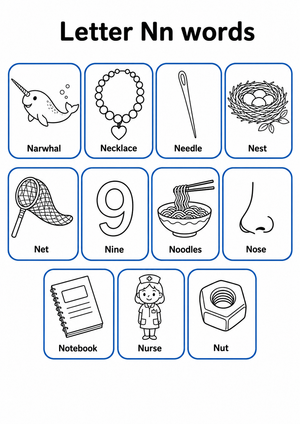
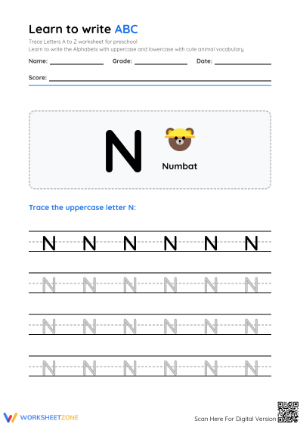
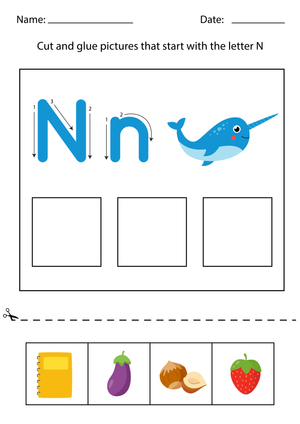
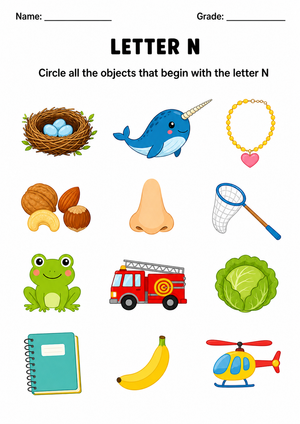
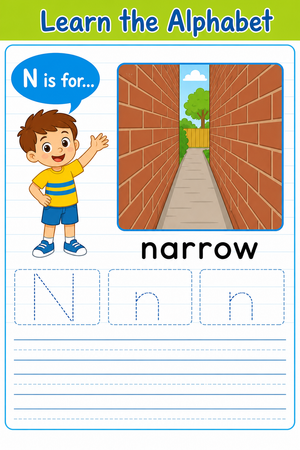
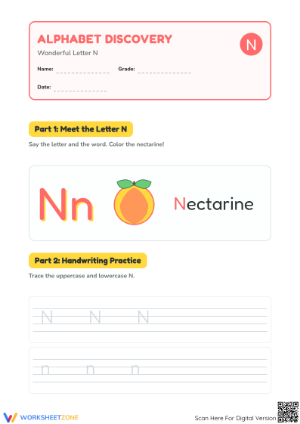
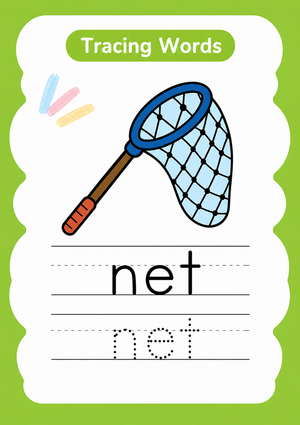
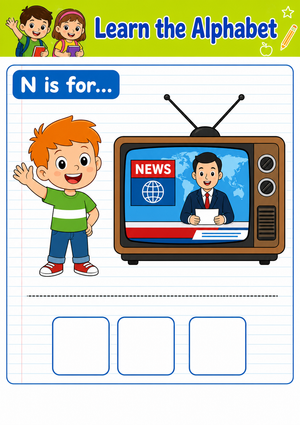
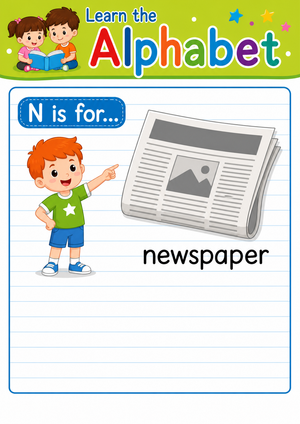
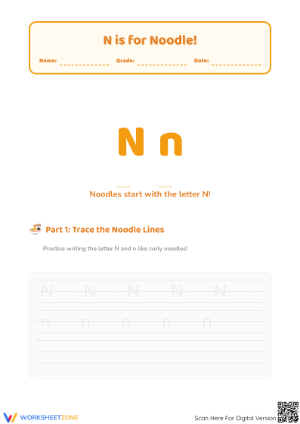
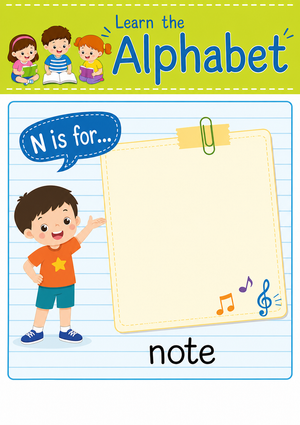
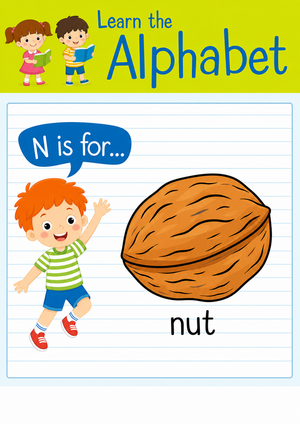
These letter n beginning sound worksheets for kindergarten give teachers a focused phonics resource for one of the earliest consonants in a systematic reading sequence. The /n/ sound gets introduced well before more complex letters partly because five-year-olds can feel it — the vibration moves into the nose in a way kids notice when you ask them to rest two fingers lightly against their nostrils and hum. Each worksheet in the set targets initial-sound recognition through formats students can handle independently once you've done a brief whole-group warm-up.
The Specific Skills Targeted
The set works through four task types that build on each other across the week:
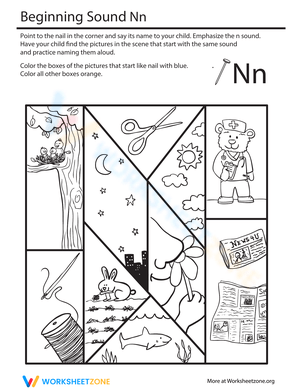
- Picture sorts: Students look at a row of illustrated objects, name each one silently, and circle or color only those that start with the /n/ sound.
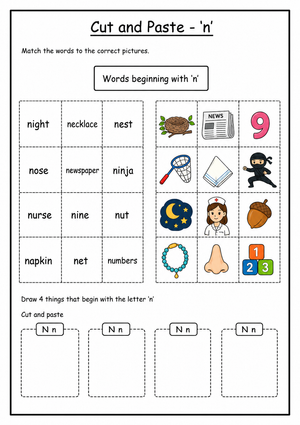
- Cut-and-paste: Students cut along dotted lines and glue N-initial images into a labeled box — slowing them down enough to process each picture before committing.
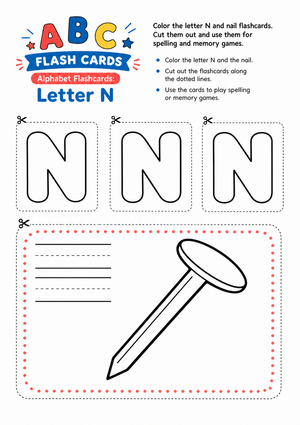
- Letter tracing: Uppercase and lowercase N formation practice paired with an /n/-word image bank that students color as they go.
- Line matching: The letter N sits alongside four or five images; students draw a line to each one that begins with the correct sound, with distractors included.
The vocabulary used across these letter n beginning sound worksheets for kindergarten sticks to concrete, easily pictured nouns: nest, net, nut, nose, nail, nine. Words where the N is silent or embedded in a blend — "knight," "know," "snap" — don't appear at this level. Kindergartners need unambiguous examples before exceptions have any meaning.
Frequent Student Errors Worth Anticipating
The most consistent error in initial N work is /n/ and /m/ confusion. Both are nasal consonants — air routes through the nose rather than the mouth — so students who haven't yet learned to track tongue placement hear them as variations of the same humming sensation. A child who correctly identifies "nest" will sometimes also circle "milk" or "moon," not because they're guessing but because the low, resonant quality of M words feels familiar after practicing N. Calling this out directly — "these both hum in your nose, but watch what your lips do" — and then having students compare "noon" and "moon" in a hand mirror addresses it before it compounds further down the alphabet sequence.
A second pattern worth knowing: students who produce /n/ perfectly in isolation but still sort pictures incorrectly because a pictured word is unfamiliar. A worksheet that includes "newt" as a distractor can stump a student who knows what one looks like in a book but can't retrieve the English label fast enough. A quick verbal preview of all illustrated words before students begin removes vocabulary uncertainty as the variable — important especially for English learners.
Fitting These Worksheets Into Your Phonics Week
Most teachers running a letter-of-the-week structure find that letter n beginning sound worksheets for kindergarten slot cleanly into Tuesday through Thursday, after Monday's whole-group introduction. Day one is for songs, a shared read-aloud with N words flagged, and a listening game — students stand when they hear a word that starts with /n/ and stay seated for everything else. Day two: the tracing worksheet, which also doubles as a fine motor checkpoint. Days three and four are for picture sorting and cut-and-paste, which are more cognitively demanding and land better once the sound is already anchored. The cut-and-paste worksheet works well at a literacy center on Friday too — students who finish early can flip it over and try writing their own N words from memory.
If you're not running letter-of-the-week, the sorting and line-matching worksheets work as a five-minute warm-up at the start of the phonics block, or as the last quiet task before a transition. The picture sort takes most kindergartners around eight minutes and is calm enough for those fractured minutes before specials without needing teacher management.
Standard Alignment
These letter n beginning sound worksheets for kindergarten map directly to RF.K.2.D, which requires kindergartners to isolate and pronounce the initial, medial vowel, and final sounds in three-phoneme (CVC) words. Initial-sound identification with N is an entry point into that standard — students have to isolate the first phoneme before they can do full word analysis. The tracing worksheet also touches RF.K.1.D, which covers recognizing and naming all upper- and lowercase letters, and L.K.1.A, which addresses printing those letters. If your pacing guide places N alongside early CVC words, the picture sort can preview net, nap, and nod as early decoding examples once students can reliably hear the initial sound.
Adjusting the Worksheets for a Range of Learners
For students who haven't stabilized letter-sound correspondence for any consonant yet, reduce the field size on the picture sort. Instead of eight images to evaluate, give them four — two clear N starters and two non-N items with very different beginning sounds, like "sun" or "dog." That narrower field lowers cognitive load without changing what the task is asking them to do. A verbal preview of all pictured words before students begin also helps, especially when vocabulary — not phoneme recognition — is what's producing the errors.
Students who are ahead of this skill can use the reverse side of any worksheet to generate their own N words, draw and label classroom objects that begin with the sound, or write a two-word phrase — "nine nails," "neat nest" — that uses the phoneme twice. One honest tradeoff: students who freeze when facing unfamiliar pictured vocabulary sometimes find the line-matching format discouraging, because drawing a line to the wrong image feels more final than circling. The cut-and-paste worksheet is more forgiving for those students — pieces can be repositioned before the glue sets.
Frequently Asked Questions
Is it normal for kindergartners to still confuse /n/ and /m/ after several practice sessions?
Yes, and it's not a red flag on its own. Both sounds are nasals produced with similar resonance, so some confusion persists into mid-kindergarten even for students who are on track. The distinction clicks faster when you address both sounds in the same lesson rather than in separate weeks — side-by-side mirror work showing the lip difference (pressed together for /m/, slightly open with the tongue tip behind the upper teeth for /n/) speeds up the separation more than additional solo N practice alone.
What vocabulary works best for initial N practice at the kindergarten level?
Concrete nouns that children can picture without context work best: nest, net, nut, nose, nail, nine, nap, nod. Short CVC words are especially useful because they keep the initial sound clean and unblended. Words where the N is silent or part of a consonant cluster belong in a later unit once students have the basic phoneme stable.
Can I use these worksheets for progress monitoring?
The picture sort and line-matching worksheets work well as informal documentation — you can note accuracy, hesitation patterns, and whether a student self-corrects. They aren't normed assessments and won't replace a formal phonemic awareness screener, but they give you a quick snapshot before pulling a small group. Date each worksheet and file it; a side-by-side comparison of a September and a November sort is often the clearest early-phonics growth evidence you can show a parent at a conference.