


























Views
Downloads

Letter G Beginning Sound Worksheet | Essential Phonics
Paste this activity's link or code into your existing LMS (Google Classroom, Canvas, Teams, Schoology, Moodle, etc.).
Students can open and work on the activity right away, with no student login required.
You'll still be able to track student progress and results from your teacher account.
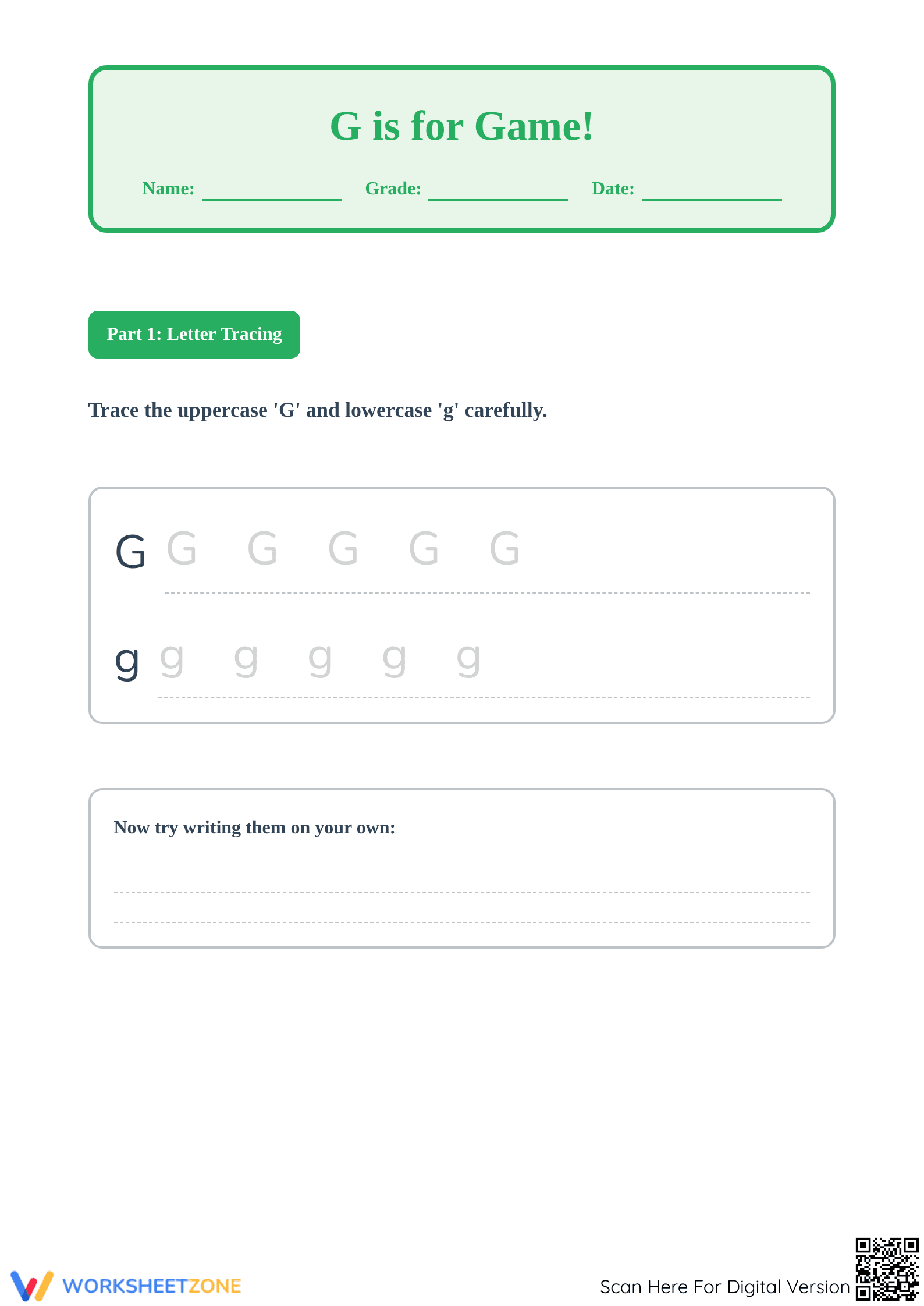
This Kindergarten and Grade 1 phonics worksheet provides a comprehensive approach to mastering the letter G. Students engage in multi-sensory learning by tracing, writing, and identifying beginning sounds through visual cues. By the end of these two pages, learners will demonstrate proficiency in recognizing both uppercase and lowercase forms while connecting the letter to its phonetic sound.
At a Glance
- Grade: Kindergarten · Subject: ELA Phonics
- Standard:
CCSS.ELA-LITERACY.RF.K.3.A— Demonstrate basic knowledge of one-to-one letter-sound correspondences by producing the primary sound- Skill Focus: Letter G recognition and beginning sounds
- Format: 2 pages · 12 tasks · Answer key included · PDF
- Best For: Independent literacy centers or morning work
- Time: 15–20 minutes
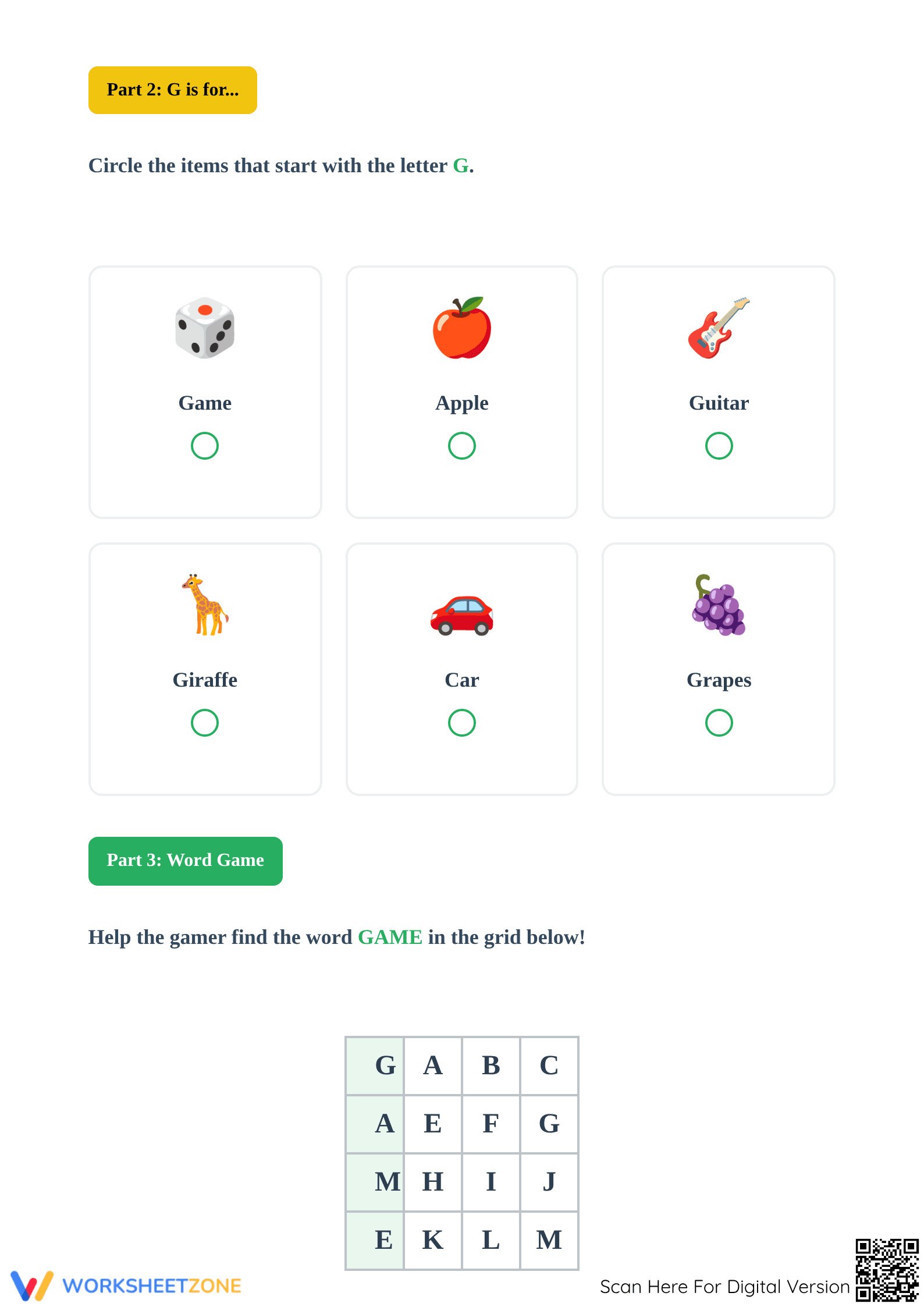
The resource is divided into three distinct parts across two pages. Part 1 focuses on fine motor development through uppercase and lowercase letter tracing, followed by a blank line for independent practice. Part 2 presents six high-quality illustrations where students must discriminate between "G" sounds (like Guitar and Grapes) and non-examples (like Apple and Car). Part 3 concludes with a 4x4 letter grid word search to reinforce word-level recognition of the word "GAME."
This worksheet is designed for a zero-prep workflow to maximize instructional time. Step 1: Print the two-page PDF (30 seconds). Step 2: Distribute to students during your phonics block or as a transition activity (1 minute). Step 3: Use the included answer key for rapid visual grading or peer-review (1 minute). The layout is intuitive for young learners, requiring minimal teacher intervention once the initial instructions are given.
Aligned primarily to `CCSS.ELA-LITERACY.RF.K.3.A`, this worksheet requires students to produce the primary sound for the letter G. It also supports `CCSS.ELA-LITERACY.RF.K.1.D` by requiring the recognition and naming of all upper- and lowercase letters of the alphabet. Both standard codes can be copied directly into lesson plans, IEP goals, or district curriculum mapping tools.
Use this worksheet during the "You Do" phase of a gradual release model. After introducing the letter G with an anchor chart, assign the tracing section to solidify letter formation. For a formative assessment, observe students during Part 2; if a student circles the "Giraffe" (soft G) versus "Guitar" (hard G), it provides a perfect opening to discuss different phonetic sounds. Expect completion in 15 to 20 minutes.
This resource is tailored for Kindergarten students beginning their phonics journey, but it serves as excellent remedial practice for Grade 1 or Grade 2 students needing extra support with letter-sound correspondence. It pairs naturally with a "Letter of the Week" curriculum or a specific phonemic awareness lesson focusing on velar stops.
Research by Fisher & Frey (2014) emphasizes the importance of the gradual release of responsibility, moving from guided tracing to independent identification. This worksheet follows that pedagogical structure by scaffolding the student's experience from motor-skill tracing to cognitive sound discrimination. According to the NAEP, early mastery of letter-sound correspondence is one of the strongest predictors of later reading success. By providing 12 targeted tasks, this resource ensures students receive the repetitive exposure necessary for long-term retention of the CCSS.ELA-LITERACY.RF.K.3.A standard. Educators can utilize this structured approach to build the foundational phonological awareness required for decoding more complex texts in later primary grades.


