


























Views
Downloads

Letter G Tracing Worksheet | Essential Phonics Guide
Paste this activity's link or code into your existing LMS (Google Classroom, Canvas, Teams, Schoology, Moodle, etc.).
Students can open and work on the activity right away, with no student login required.
You'll still be able to track student progress and results from your teacher account.
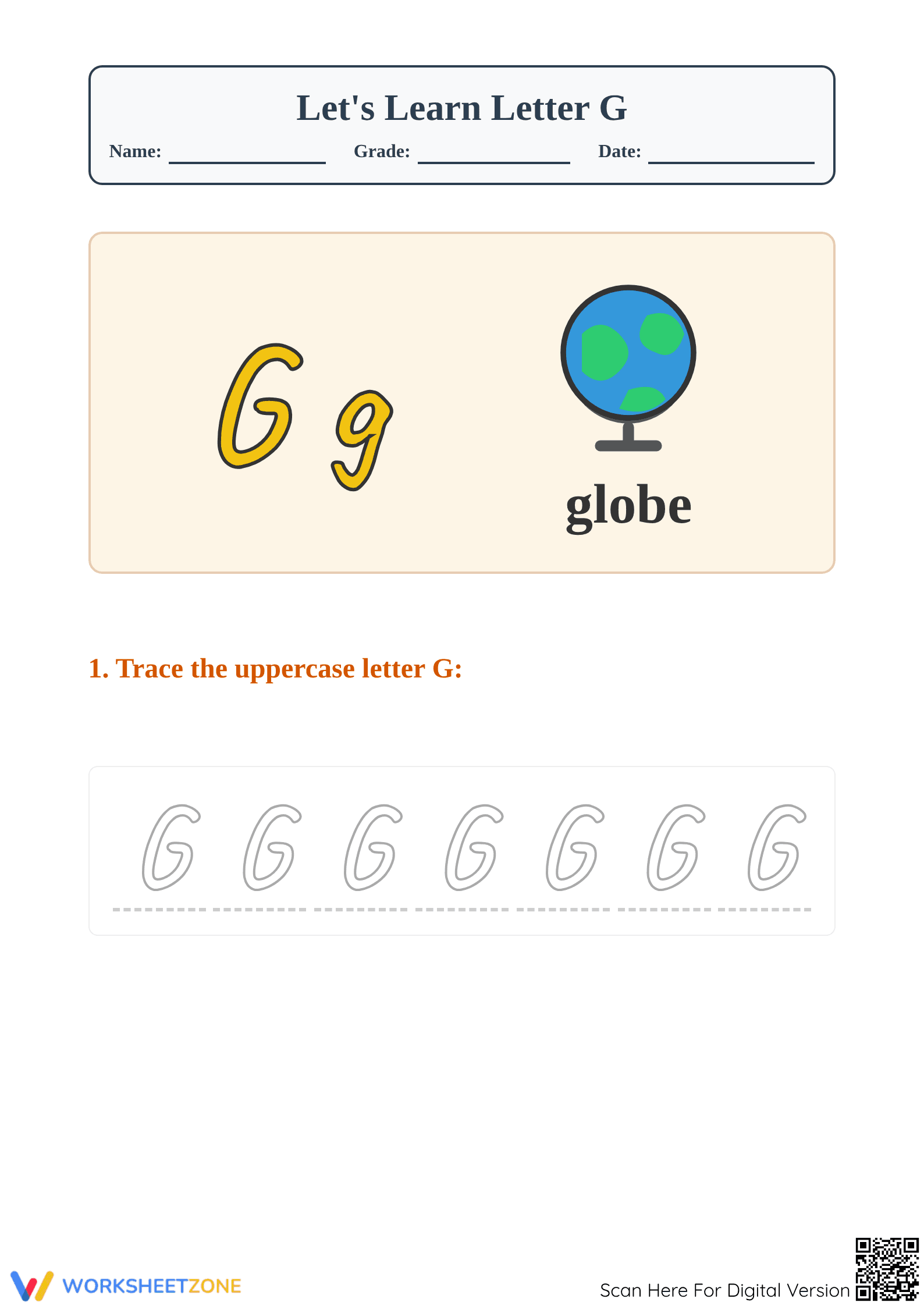
This Kindergarten Letter G worksheet provides foundational practice in letter formation and beginning sound recognition. Students develop fine motor control while connecting the letter "G" to the "globe" anchor image. By focusing on both uppercase and lowercase variants, the resource ensures comprehensive alphabet mastery for early readers.
At a Glance
- Grade: Kindergarten · Subject: ELA Phonics
- Standard:
CCSS.ELA-LITERACY.L.K.1.A— Print many upper- and lowercase letters of the alphabet- Skill Focus: Letter G formation and identification
- Format: 2 pages · 14 problems · Answer key included · PDF
- Best For: Early literacy centers and morning work
- Time: 10–15 minutes
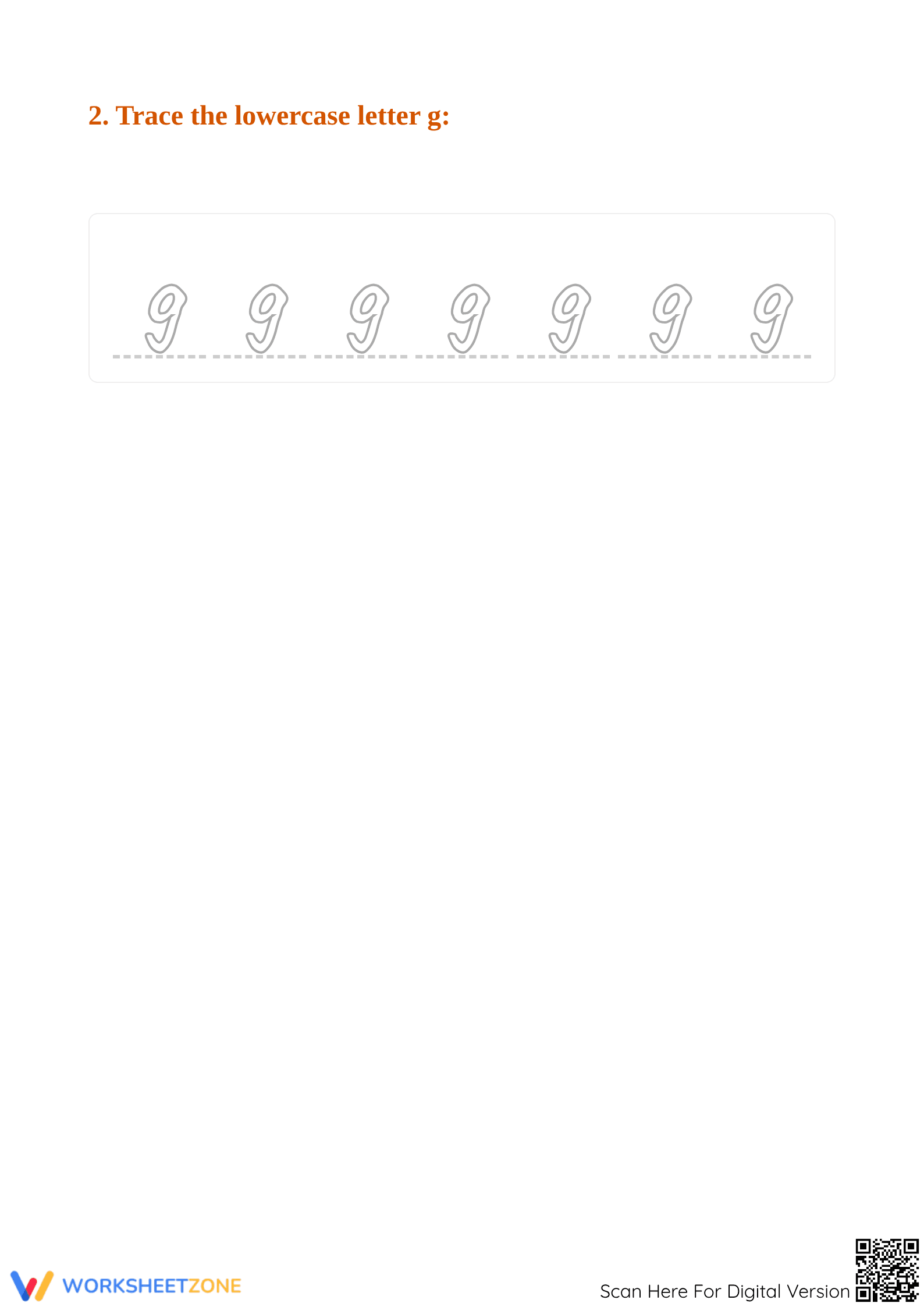
The resource contains two dedicated pages for handwriting practice. Page one introduces the uppercase "G" with a large visual of a globe to reinforce phonemic awareness. Page two transitions to lowercase "g" practice. Each page features seven tracing prompts set on primary dashed lines to guide proper stroke order and height.
The worksheet follows a structured progression. First, students engage in guided practice by observing the large model letters. Next, they move to supported practice using the light-gray tracing guides for seven repetitions. Finally, the ample white space allows for independent practice as students attempt to replicate the letter forms without assistance. This gradual-release model builds muscle memory effectively.
This resource is aligned with CCSS.ELA-LITERACY.L.K.1.A, which requires students to print many upper- and lowercase letters. It also supports CCSS.ELA-LITERACY.RF.K.1.D by helping students recognize and name all letters of the alphabet. Both standard codes can be copied directly into lesson plans, IEP goals, or district curriculum mapping tools.
Use this worksheet during the "You Do" phase of a phonics lesson after demonstrating the "around and across" motion for uppercase G. It serves as an excellent formative assessment; observe students' pencil grip and stroke direction as they work. Expected completion time is 10 to 15 minutes depending on fine motor development.
This is designed for Kindergarten students, though it is highly effective for Grade 1 students needing intervention or ESL learners building basic English literacy. Pair this with a physical globe or a "G" themed anchor chart to provide a multi-sensory learning experience for your students.
According to research by Fisher & Frey (2014), the gradual release of responsibility is vital for early literacy skills like letter formation. This worksheet utilizes that framework by providing clear models before asking for student output. Mastery of the standard CCSS.ELA-LITERACY.L.K.1.A is a significant predictor of later writing fluency and reading speed. By isolating the letter G, students can focus on the specific motor patterns required for "G" and "g" without the cognitive load of multiple characters. This targeted approach aligns with the Science of Reading, which emphasizes explicit, systematic instruction in phonics and handwriting. Providing 14 specific tracing opportunities ensures that students move from initial exposure to the early stages of automaticity. This resource serves as a reliable tool for educators seeking to bridge the gap between letter recognition and active production in early childhood classrooms.


