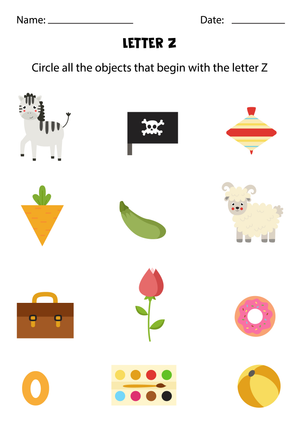
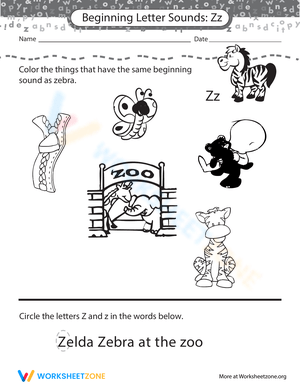
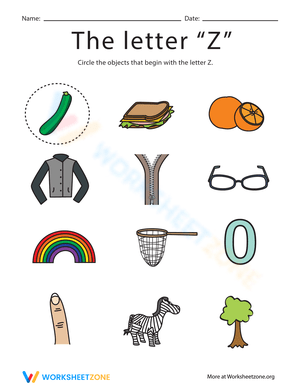
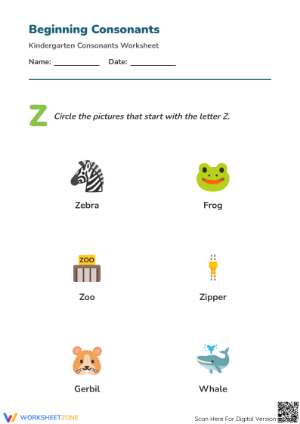
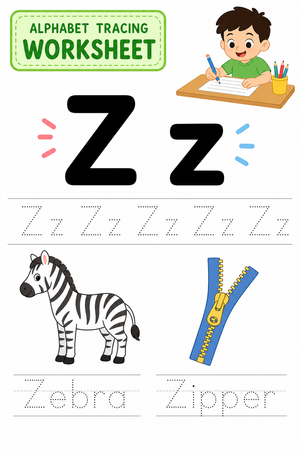
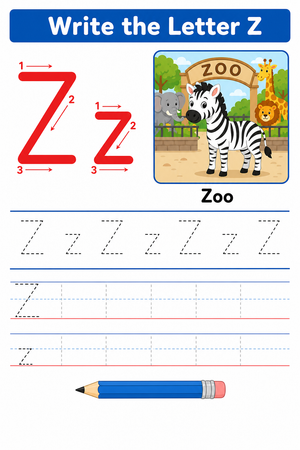
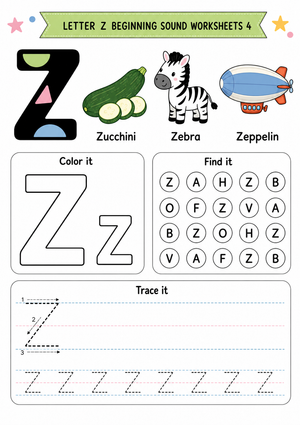
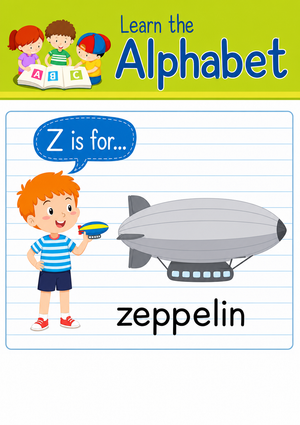
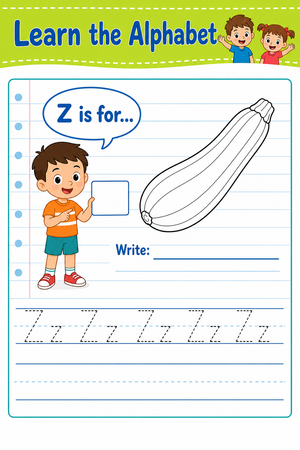
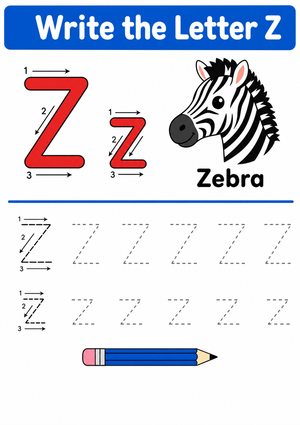
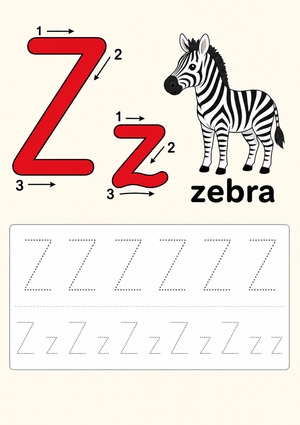
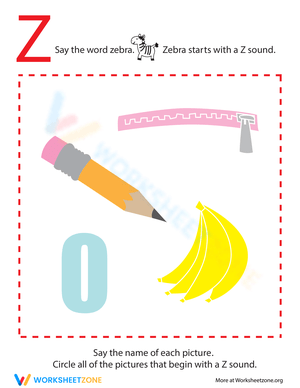
These kindergarten letter z beginning sound pdf worksheets give teachers a focused set of printables for one of the phonics year's more challenging milestones. Z sits near the bottom of English letter-frequency charts, which means students arrive at it with far less ambient exposure than they've had for letters like S, T, or M. The resources in this set address that gap directly, pairing letter recognition with sound production across a deliberately narrow vocabulary.
The Specific Skills Each Worksheet Targets
The anchor vocabulary — zebra, zoo, zero, zipper, zigzag — is narrow by design. When students already know a word, the phonics task stays in focus rather than spilling into vocabulary guesswork. Across the set, students:
- Sort pictures by beginning sound, marking images that start with /z/ while working through S-initial distractors — which is where the real instructional challenge lives.
- Identify the initial sound in picture-prompted words, training the ear to isolate the first phoneme before connecting it to print.
- Trace and form the letter Z, a stroke sequence — two horizontals connected by a diagonal — that is genuinely harder than it looks for five-year-olds who have spent most of the year practicing curves and straight verticals.
- Match pictures to the letter, drawing lines from the letter Z to corresponding images to build rapid letter-sound association.
- Color beginning-sound pictures, combining fine motor work with phonemic focus in a format that keeps young learners engaged without demanding extensive written output.
Fitting These Worksheets Into Your Literacy Block
Project a picture-sorting worksheet for a whole-group launch. Before students mark anything, have them place two fingers lightly on the side of their throat and say zebra — they will feel the buzz that separates /z/ from /s/. Then say sun and notice the absence of vibration. That 90-second check is worth doing as a class at least twice, because it gives students a self-correction strategy they can use independently at a center without raising a hand.
The letter-formation worksheets belong in teacher-led small groups, at least the first time through. Students who start the Z from the bottom-left horizontal instead of the top-right develop a reversal habit that hardens fast at this age. Catching stroke order errors in the moment takes about 10 seconds; correcting an ingrained reversal takes much longer.
Matching and coloring worksheets are lower-stakes tasks that fit naturally in the 8-10 minutes before specials or at the close of morning meeting. They require little facilitation, which makes them genuine candidates for independent center rotations once the class has practiced the /z/ sound together.
Student Errors That Surface in Z Phonics Work
The most common error that emerges when students work through the kindergarten letter z beginning sound pdf worksheets is misclassifying /z/ pictures as /s/ pictures. This is not a careless mistake. Both sounds are produced with the mouth in exactly the same position — the only difference is voicing. A student who marks zipper under the S column is making a phonetically logical error: they hear the same oral configuration and default to the more familiar letter.
A subtler pattern shows up specifically with zipper: students who correctly identify zebra will sometimes hesitate on or miss zipper entirely. The short /i/ vowel that follows the /z/ in zipper seems to interfere — students anchor the /z/ sound to the "zee" vowel sequence in zebra and fail to recognize the same sound in a new phonetic context. When this pattern shows up in student work, the fix is minimal-pair practice, not more worksheets.
Students from Spanish-speaking households may face an additional layer: in many Spanish dialects, the letter Z maps to a sound much closer to /s/ than to /z/. Knowing that context helps you respond to errors as a language background issue rather than a phonemic-awareness gap — two different problems that look identical on a completed sort.
Differentiating the Set Across Readiness Levels
When adapting the kindergarten letter z beginning sound pdf worksheets for a mixed-readiness room, the picture sorts offer the most flexibility. For students still building phonemic awareness, reduce the image set to three or four choices per sort. Fewer items lower the working memory demand without changing the target skill. A small reference strip showing zebra and zoo alongside the letter Z gives these students a comparison point at the moment of decision — not a crutch, just a reduction in load where it matters most.
Students who move quickly through the initial-sound sorts are ready to find /z/ in medial and final positions. Words like puzzle, fizz, and buzz don't announce themselves as Z words the way zebra does. Write one of those words on the back of a completed worksheet and ask the student to circle where they hear the Z — it's a genuine stretch that requires no extra materials and takes about three minutes.
For students developing English alongside the phonics curriculum, the concrete picture prompts — particularly the clear illustrations of a zebra and a zipper — reduce the language-processing barrier so the phonics skill stays in focus. Matching and coloring tasks tend to be the most accessible entry points because they require less verbal production than sorting activities that involve discussion.
Standard Alignment
The set aligns with CCSS.ELA-LITERACY.RF.K.3.A, which requires kindergarteners to demonstrate one-to-one letter-sound correspondence by producing the primary sound for each consonant. Letter Z typically lands late in the pacing calendar — most kindergarten programs reach it between late February and April. By that point, students have roughly 20 consonants behind them, which makes the /z/ versus /s/ comparison genuinely productive: students know S well enough that the contrast becomes an instructional tool rather than an added burden. The tracing and formation activities also address the fine motor and foundational writing strand present in most state standards built on the Common Core progression.
Frequently Asked Questions
How can I tell whether a student is truly hearing the /z/ sound or just guessing on the picture sorts?
Ask the student to say the word aloud before marking the worksheet. If they produce a clear /z/ onset but still mark the picture in the S column, the issue is letter-sound mapping — they hear the right sound but connect it to the wrong symbol. If they say the word with a /s/ onset, the issue is phonemic — the voicing distinction hasn't clicked yet. These two errors look identical on a finished worksheet but call for completely different follow-up.
Are there enough Z words to fill a complete phonics lesson?
For a 20-25 minute kindergarten lesson, yes. The core anchor set — zebra, zoo, zero, zipper, zigzag — carries sorting, matching, and tracing activities without pushing into obscure vocabulary. The small word pool is actually an advantage at this level: repeated encounters with the same words across different task types build faster, more durable letter-sound recall than a broad survey of unfamiliar terms would.
When is the right time to use these as review rather than initial instruction?
The kindergarten letter z beginning sound pdf worksheets hold up well as end-of-year review because the anchor words are fully familiar by then, letting students focus entirely on the sound rather than working out what the picture shows. Two worksheets in April or May — one sort, one tracing activity — work as a quick formative check before the first-grade transition and give teachers a concrete data point on which students still confuse /z/ and /s/ heading into summer.