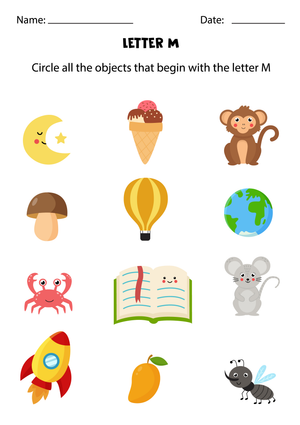
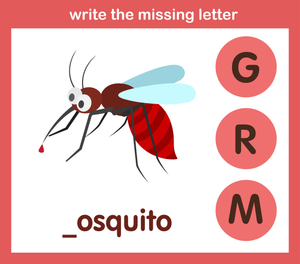
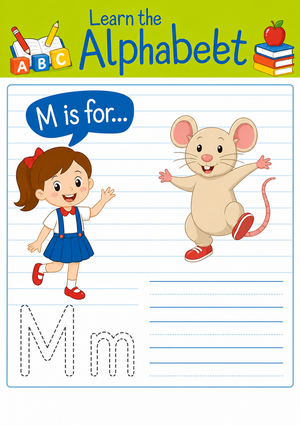
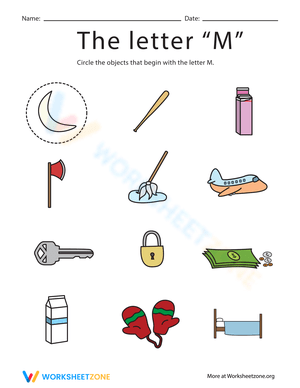
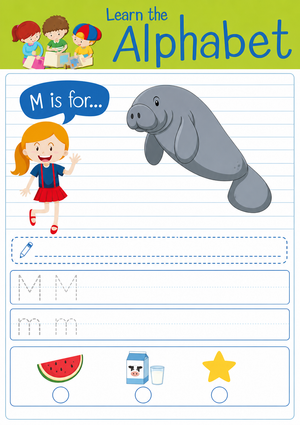
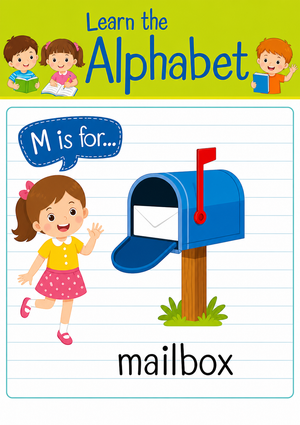
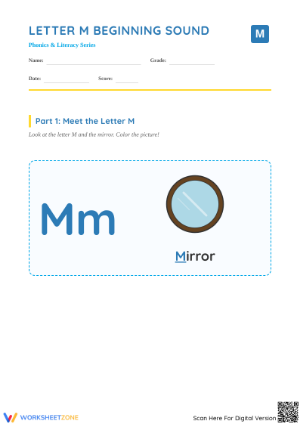
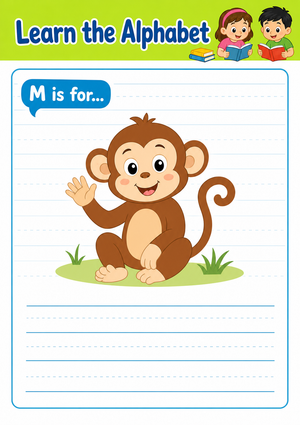
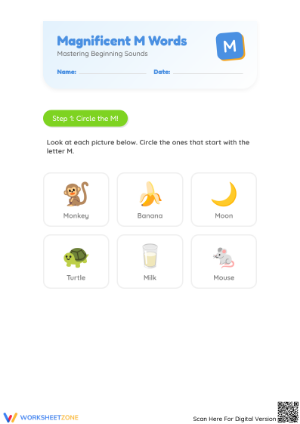
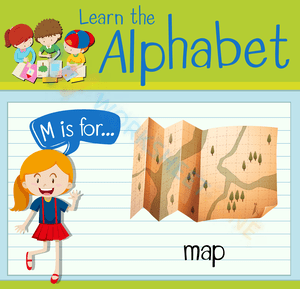
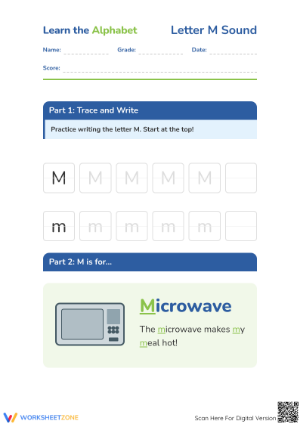
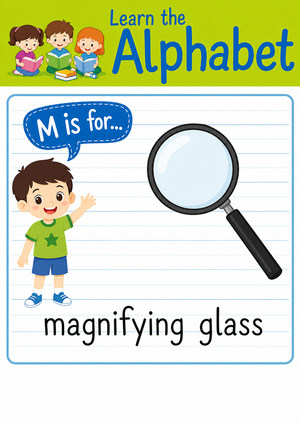
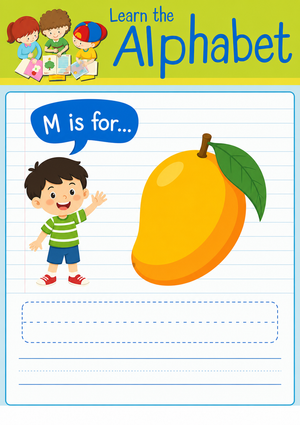
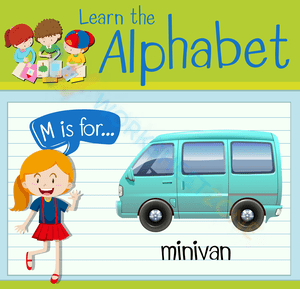
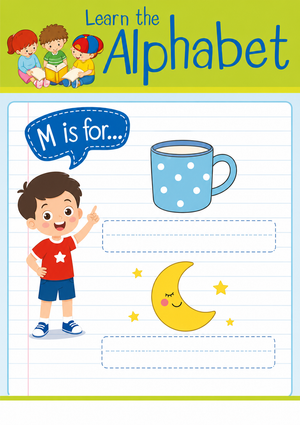
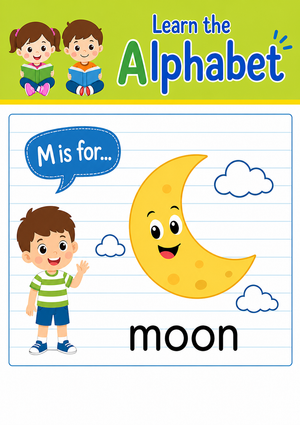
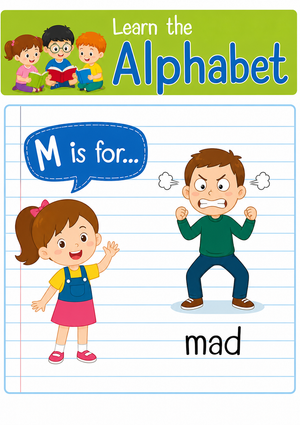
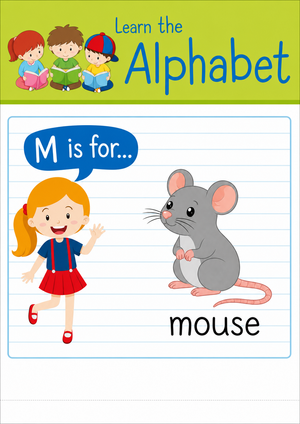
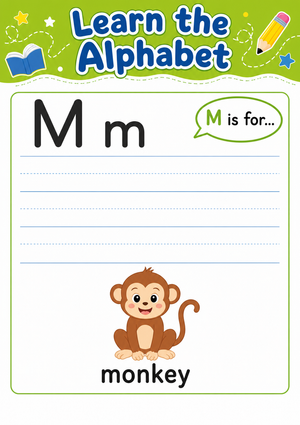
These letter m beginning sound pdf worksheets for kindergarten give teachers a focused set of phonics resources for one of the first consonants most programs formally introduce. The activities center on words kindergartners already know — moon, milk, monkey, mitten, mouse — and that familiarity is deliberate. When a child can picture the object clearly, isolating the first sound becomes one cognitive job instead of two.
What Students Practice in Each Worksheet
Each worksheet targets a specific skill within a tight instructional window — initial /m/ sound recognition, letter formation, and visual discrimination of the letter shape — rather than bundling multiple concepts into a single activity. The skills across the set include:
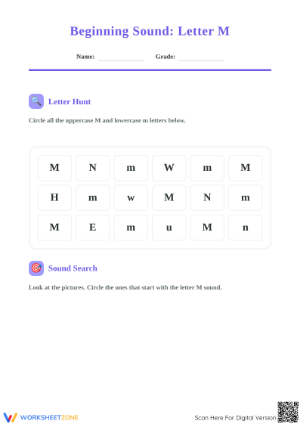
- Picture-sound matching: students mark or circle illustrated words that begin with /m/
- Cut-and-paste sorting: students sort M-initial pictures from non-M pictures and glue the correct ones onto a large printed letter
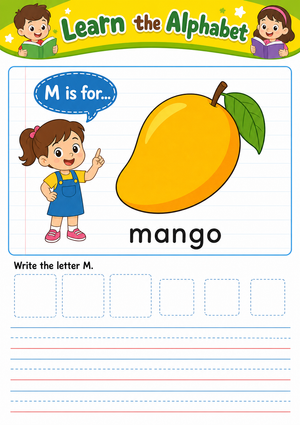
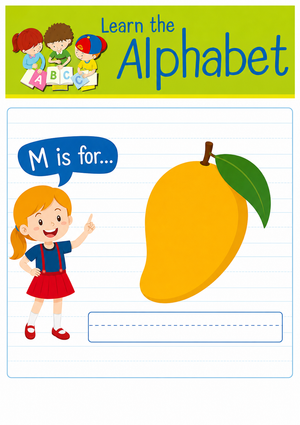
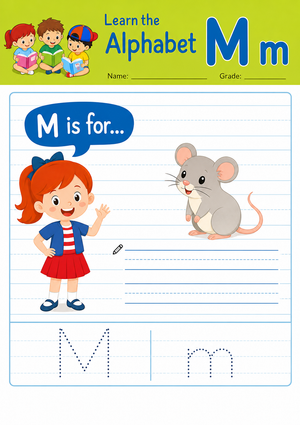
- Letter formation: tracing uppercase and lowercase M while saying the /m/ sound aloud, usually paired with coloring an anchor image like a mouse or mitten
- Visual discrimination: identifying M among similar-looking letters such as N and W before any sound work begins on that worksheet
- Beginning sound mazes: students trace a path through M-initial pictures to help a character reach a destination, layering problem-solving onto phoneme identification
Frequent Student Errors Worth Watching For
The /m/ and /n/ confusion is more persistent than most teachers expect before they've taught this unit a few times. Both are nasal consonants — students feel a similar hum resonating when they produce either sound — which means a child can know that lips pressed together signals /m/ and still mark "net" or "nail" as an M word because the nasal quality registers first. Any sorting worksheet that presents /m/ and /n/ pictures together functions as an immediate diagnostic. If a student circles "nest" alongside "moon," they're cueing on nasal resonance rather than place of articulation, and they need mouth-shape work before more written practice will move them.
A separate issue shows up in the formation worksheets. Students with good sound awareness will sometimes hesitate or erase on the tracing line because their traced M looks too much like an N to them. The visual discrimination activities address this directly, but the pattern is worth noting in student work: a correctly identified sound paired with a shaky or reversed letter form tells you the phonics knowledge is in place and the formation practice needs more time.
Fitting These Worksheets Into Your Week
The letter m beginning sound pdf worksheets for kindergarten slot into several different points in the school day without requiring re-teaching each time you use them. The tracing and coloring worksheet is low-stakes enough for morning arrival — students settle in and start independently while you're taking attendance. The cut-and-paste sorting worksheet runs cleanly as a literacy center once you've modeled it in whole-group; after the first rotation, most five-year-olds run it without prompting.
For any worksheet that contrasts /m/ and /n/ pictures, hold it until mid-unit rather than introducing it alongside the first /m/ activities. Give students two or three sessions with the target sound on its own first. Adding a contrasting sound too early splits attention before the /m/-to-letter association has consolidated — students who seem confident during whole-group practice will start second-guessing their answers on paper when /n/ pictures appear before they're ready for that comparison.
The maze and visual search worksheets hold up well in dry-erase sleeves. Slip them into plastic sheet protectors, hand out whiteboard markers, and one copy cycles through an entire center rotation. This matters most the week you introduce /m/, when printing volume is already high and your copy budget is always closer to gone than you'd like.
Adapting the Worksheets for Different Student Levels
Students still building fine motor control do better starting with the tracing and maze worksheets before attempting the cut-and-paste sort, which demands more precise snipping and placement. Printing the sorting worksheet at 120 percent gives students more room to work without distorting the images. The pictures read clearly at a larger size, and the extra margin reduces the frustration of gluing tiny cutouts in the wrong column.
For students who have /m/ solid after the first session, flip the worksheet over and ask them to draw two objects that start with M and label them using their best phonetic spelling. "Mn" for moon and "mk" for milk are completely reasonable outputs at this point in kindergarten — both tell you the child has internalized the sound-to-letter connection and is ready to move toward blending. The letter m beginning sound pdf worksheets for kindergarten also give you a natural conversation starter with your speech-language pathologist if you have students receiving services targeting bilabial sounds — a quick check before the unit tells you whether the mirror articulation activity belongs in their practice or not.
Standard Alignment
These worksheets address CCSS.ELA-Literacy.RF.K.3.a, which asks kindergartners to demonstrate basic knowledge of one-to-one letter-sound correspondences by producing the primary sound for each consonant. The /m/ sound appears early in most phonics sequences under this standard because it's phonetically stable — M represents /m/ in virtually every common kindergarten word, with no variant pronunciations to introduce alongside it. The worksheets address both the receptive side of the standard (identifying M-initial pictures) and the productive side (tracing the letter while saying the sound aloud), which matches the instructional sequence most programs follow before moving on to blending work later in the kindergarten year.
Frequently Asked Questions
My students keep confusing /m/ and /n/ even after several practice sessions. What's the most targeted next step?
The clearest intervention is a direct comparison of mouth position. Have students place two fingers lightly on their lips: for /m/, they'll feel the lips press together and close; for /n/, the lips stay open and the tongue moves behind the teeth. A sorting worksheet that mixes M-initial and N-initial pictures in the same activity makes the contrast concrete on paper. Students who are still marking N-initial words as M words after that kind of targeted work may benefit from a session with your speech-language pathologist to rule out a perceptual or articulation issue that worksheet practice alone won't resolve.
Can these worksheets run in a literacy center without teacher supervision?
Yes — with one condition: model the task explicitly before students work independently. The picture-sound matching and maze worksheets are the most center-ready after a whole-group walkthrough. The cut-and-paste sorting worksheet needs an introduction that includes the gluing step specifically; students who skip the model tend to paste everything on the worksheet regardless of beginning sound. Once the routine is established, most kindergartners run these activities without needing adult redirection during the center block.
Which anchor words hold up best when introducing /m/ to five-year-olds?
The most reliable choices are concrete, easily pictured words where the initial sound is unmistakable: moon, milk, mouse, monkey, mitten, and map. Avoid words like "magic" or "merry" at this stage — the initial sound is technically the same, but the pictures are abstract enough that vocabulary load gets in the way of the phonics task. Single-syllable and simple two-syllable words where nothing complicated follows the /m/ keep students' attention on the right feature.
How do these worksheets pair with the mirror articulation activity?
The letter m beginning sound pdf worksheets for kindergarten work naturally alongside hand-held mirrors during instruction. After students look at a picture on the worksheet — a mouse, a mitten — ask them to produce the /m/ sound while watching their lips in the mirror. Seeing lip closure happen in real time creates a proprioceptive anchor: students feel and see the bilabial contact at the same moment they hear the sound. This is especially useful for students who confuse /m/ and /n/, because the mirror makes the physical distinction visible in a way that verbal explanation alone rarely does.