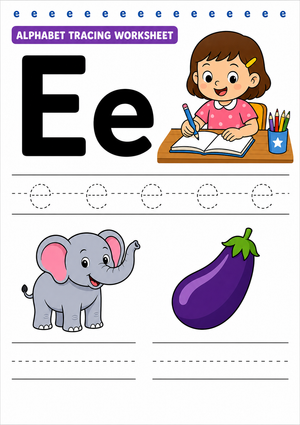
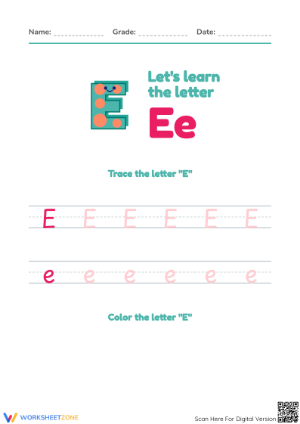
These kindergarten letter e beginning sound worksheets give teachers targeted phonics practice for one of the vowels kindergarteners most commonly struggle to isolate at the start of a word. The short /e/ shows up constantly in medial position — pet, bed, hen — so students hear it often but get far less practice recognizing it as a word opener. Each worksheet in the set pulls that initial position into focus through picture-based tasks that ask students to listen, decide, and mark before moving on.
The Specific Skills Each Worksheet Builds
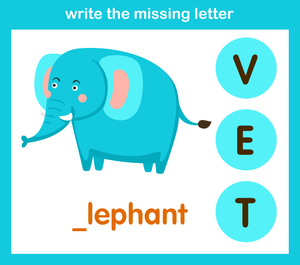
The tasks across this set center on phonemic isolation at the onset — that moment when a student hears elephant and separates the /e/ from everything that follows before thinking about letters at all. Worksheets vary across five task formats so the skill gets practiced from multiple angles:
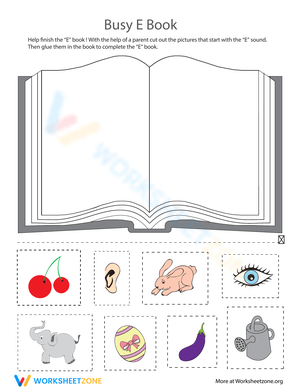
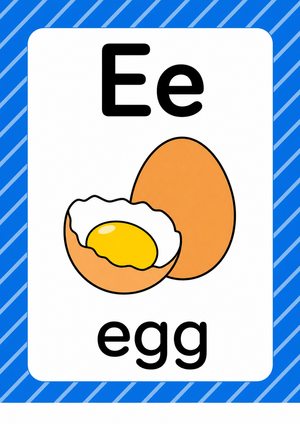
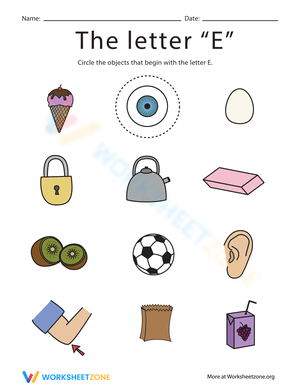
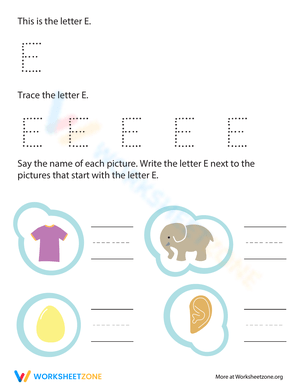
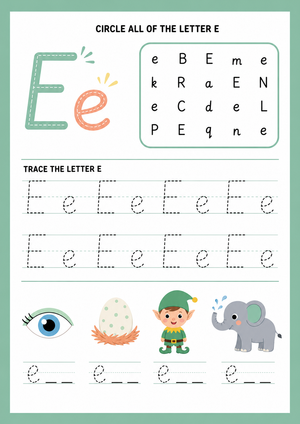
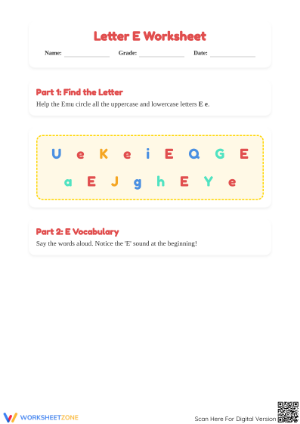
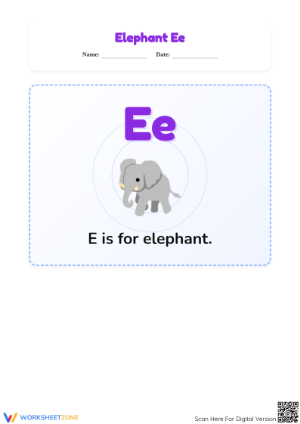
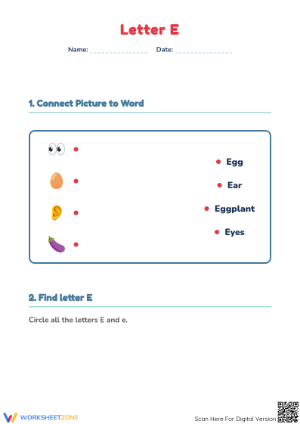
- Picture identification: Students look at a row of images and circle or color only those that begin with the /e/ sound. Anchor pictures — egg, elbow, elf, envelope — are words most kindergarteners can name after one or two read-alouds.
- Sound sorting: Students sort drawn images into two columns — /e/ starters and non-/e/ starters. Some worksheets add a second vowel column, typically /i/, to push students toward sharper discrimination between closely related sounds.
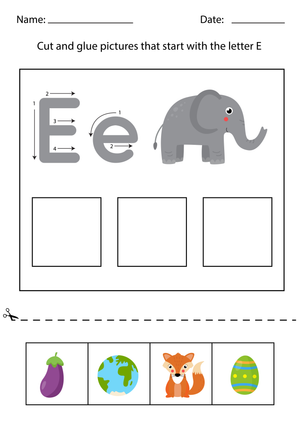
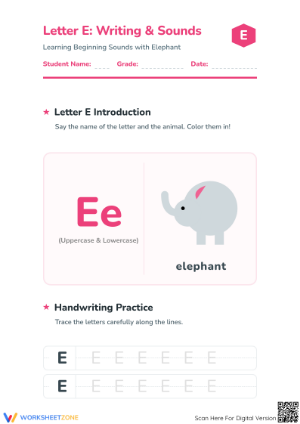
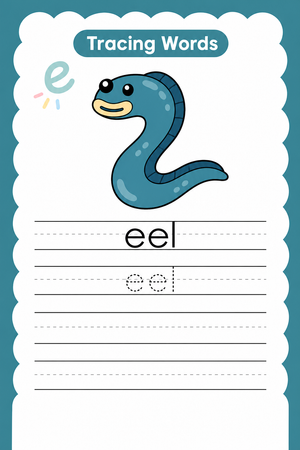
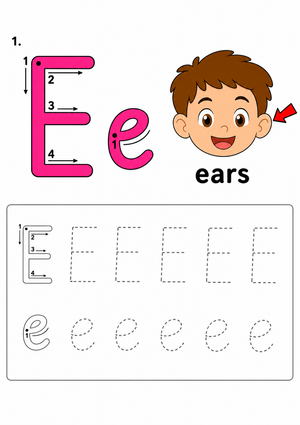
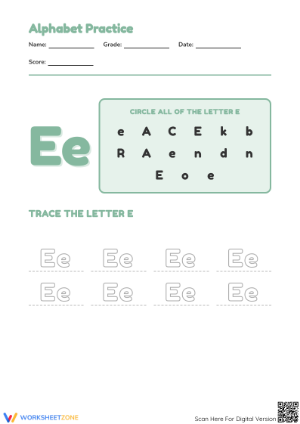
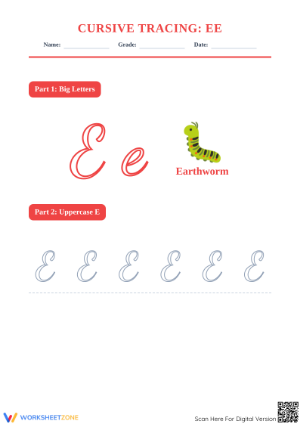
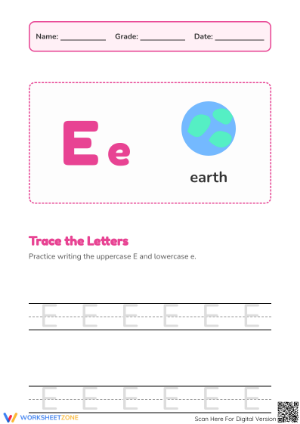
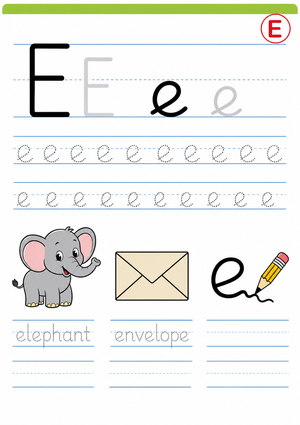
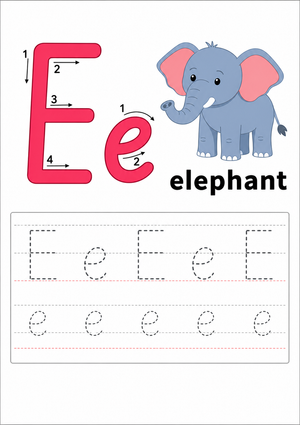
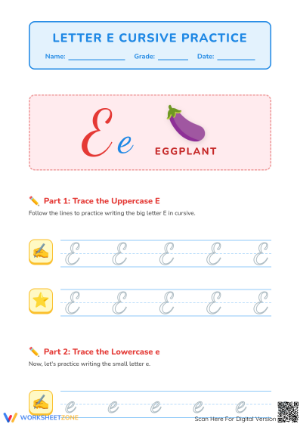
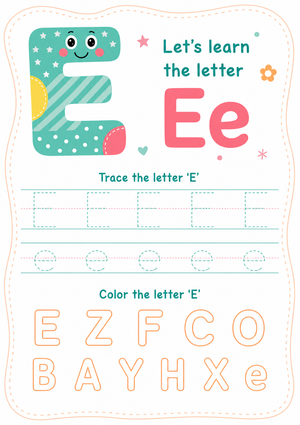
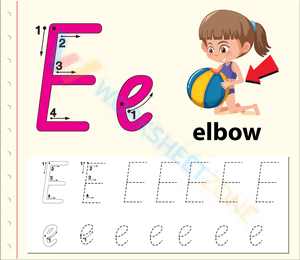
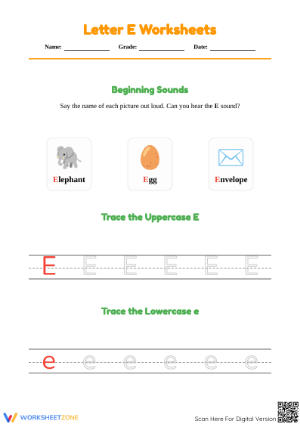
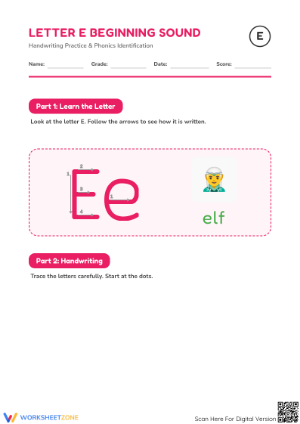
- Trace and identify: Students trace uppercase and lowercase E, then mark pictures with the matching beginning sound. The handwriting task and the phonics task run together without either one overtaking the other.
- Cut-and-paste sorts: Students cut pictures from the bottom of each worksheet and paste them under the correct letter header. Fine motor practice comes along for free.
- Color-by-code: A picture grid reveals a hidden image when students color only the sections labeled with the /e/ beginning sound. These hold attention through the last rotation of a literacy block better than a simple circling task does.
The /e/ Sound Errors Teachers Encounter Most Often
The most consistent error is conflation with the short /i/ sound. When a student hears exit, they sometimes mark it as starting with /i/ — not from inattention, but because the jaw and tongue positions for these two vowels sit close enough that the distinction requires deliberate practice. The same confusion surfaces with pairs like inch versus edge. What this looks like in actual student work is a completed worksheet where egg is correctly circled and eraser is skipped, while itch and igloo are also circled. The student isn't guessing — they're applying a phonemic category that's just a bit too wide.
A second pattern involves vocabulary, not phonics. Before students attempt kindergarten letter e beginning sound worksheets independently, name every picture aloud and have students repeat it. A student who doesn't know the English word for elf cannot sort it by beginning sound — that's a language gap, and on a completed worksheet it looks identical to a phonics gap. Naming the pictures takes less than two minutes and eliminates most of this category of error before it starts.
Fitting These Worksheets Into Your Phonics Routine
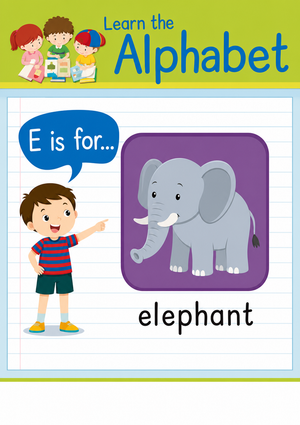
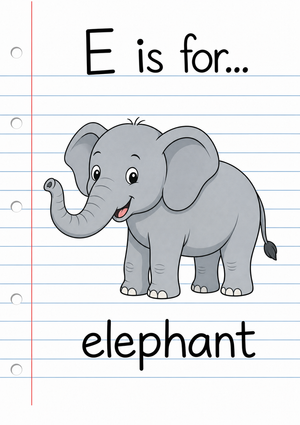
Most teachers introduce the /e/ beginning sound during a whole-group phonics lesson — an anchor chart with a large letter E surrounded by pictures of eggs, elephants, and an envelope. After that 8-to-10-minute introduction, the corresponding worksheet works well as the immediate independent practice that closes the lesson. Students arrive at the paper primed from four or five modeled examples, and the task reinforces what just happened rather than requiring them to do something new.
Kindergarten letter e beginning sound worksheets also fit naturally into literacy center rotations. While the teacher runs a guided reading group, a small cluster of students works through a picture sort or cut-and-paste activity on their own. Because the tasks rely on images rather than print, students manage them without adult support — which is exactly what a center rotation requires. Worksheets that include cutting or coloring tend to sustain attention through a full 12-to-15-minute rotation without behavioral redirects.
One move worth building in before distributing any worksheet: run a quick oral "say-and-sort" with five words — two /e/ starters, two non-/e/ starters, and one tricky /i/ word. Students give a thumbs up or thumbs down. That 90-second check tells you who is ready to work independently and who needs to stay closer during tomorrow's lesson.
How to Modify These Worksheets for Your Range of Learners
For students still developing basic auditory discrimination, narrow the field on a picture-identification worksheet by placing sticky notes over two or three images so they work with a smaller set. The task stays the same — find the /e/ words — but the reduced number of choices lowers the cognitive load enough for genuine success before they tackle the full version.
Students who have the short /e/ sound secure can push further by writing the letter E next to each circled picture, or by using one anchor word in an oral sentence before moving on. On a cut-and-paste worksheet, those students sort into three columns — /e/, /i/, and "other" — instead of two. Kindergarten letter e beginning sound worksheets used this way stop functioning purely as reinforcement and start working as informal diagnostics: how a student handles the E-versus-I column tells you more about phonemic awareness than a circling task alone.
Standard Alignment
These worksheets address CCSS.ELA-LITERACY.RF.K.2d, which asks kindergarteners to isolate and pronounce the initial, medial, and final phonemes in spoken words. Identifying the /e/ sound at the front of a spoken word is a direct application of that standard at the onset position — the phoneme location most kindergarteners master first, and the right place to build the skill before moving to medial vowels in CVC words. The worksheets also connect to RF.K.3a, covering one-to-one letter-sound correspondence, because students match what they hear to the printed letter E. In most scope-and-sequence maps, /e/ beginning sound work lands in the first quarter of kindergarten, after initial work with /a/ and before CVC blending practice begins.
Frequently Asked Questions
Should I introduce the short E or long E beginning sound first?
Short E first, without exception. The short /e/ is the vowel students use immediately when they begin blending CVC words like bed and pet. Long E — the letter saying its own name, as in eagle — is easier to hear but far less immediately useful in early decodable texts. Introduce the long E sound after the short /e/ is secure, and frame it simply as "the letter's name sound."
Which anchor words work best for /e/ beginning sound instruction?
Egg, elephant, elbow, elf, and envelope are the most reliable choices. Each has a clear, unambiguous short /e/ at the onset, and most kindergarteners recognize them from prior read-alouds or classroom objects. Avoid using each or eat as anchor words early in instruction — both carry the long E sound, and mixing them in before the short /e/ is grounded creates confusion that lingers into CVC blending work.
How do I support English Language Learners with these worksheets?
The picture-based format works well for ELL students because it separates phonics practice from reading ability. The critical adjustment is pre-teaching vocabulary: name each picture explicitly, have students repeat the word, and confirm they can retrieve it before independent work begins. An ELL student who doesn't have the English word for envelope cannot sort it by beginning sound — addressing that before the worksheet goes out is the teacher's move, not a problem to leave to the student.
How long should a worksheet-based /e/ beginning sound lesson run?
Budget 15 to 20 minutes for the full lesson: 8 to 10 minutes of whole-group instruction with an anchor chart and sound examples, then 8 to 10 minutes of independent worksheet time. Kindergarteners lose focus on phonics tasks after roughly 10 minutes of paper-and-pencil work, so keeping the independent portion tight produces cleaner results than stretching it through the full block.