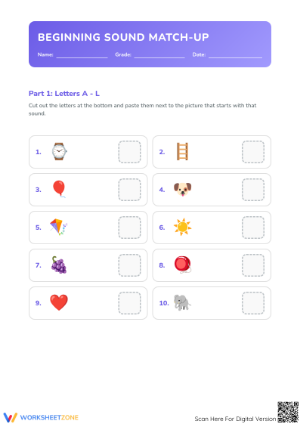
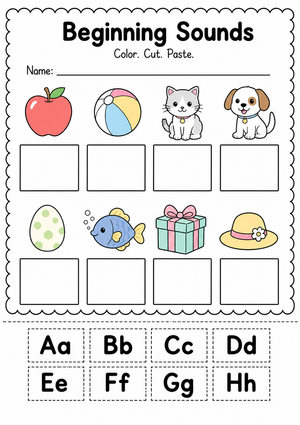
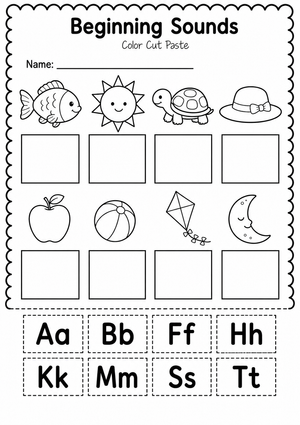
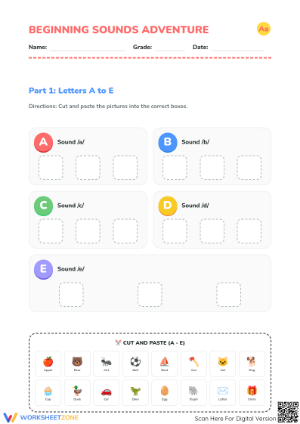
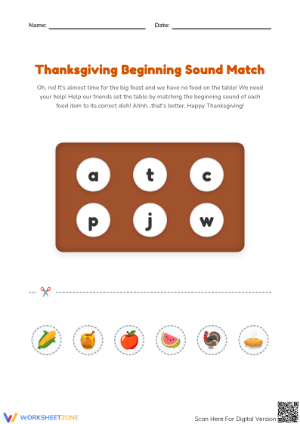
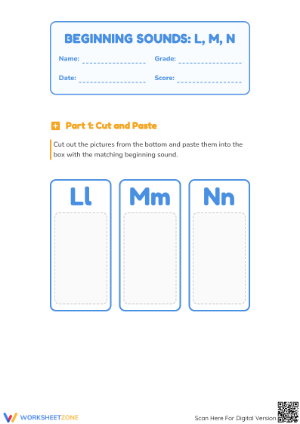
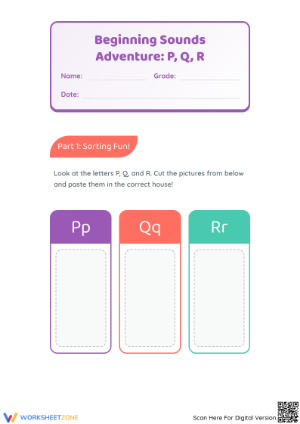
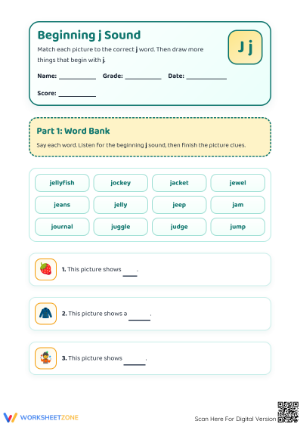
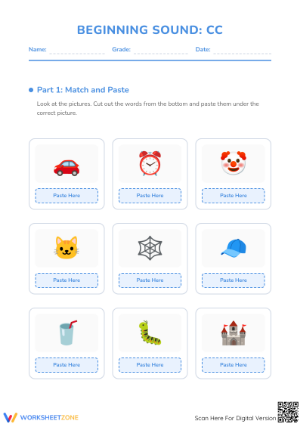
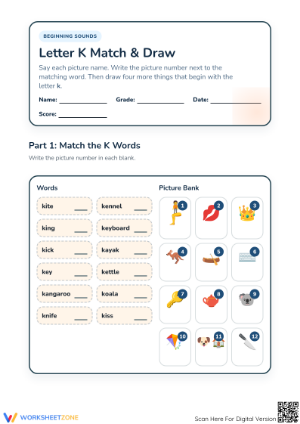
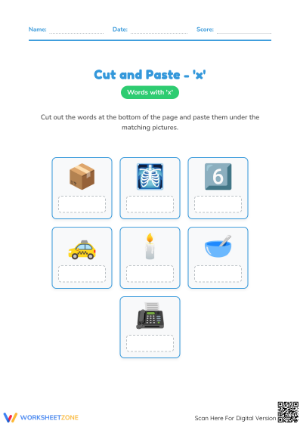
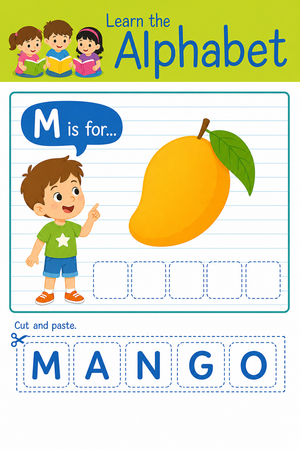
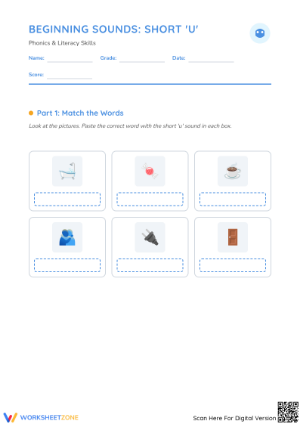
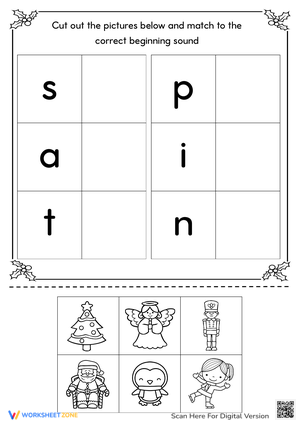
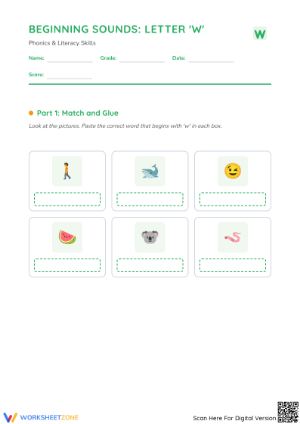
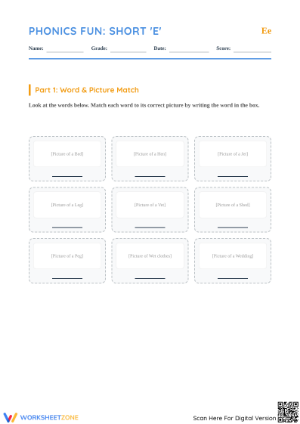
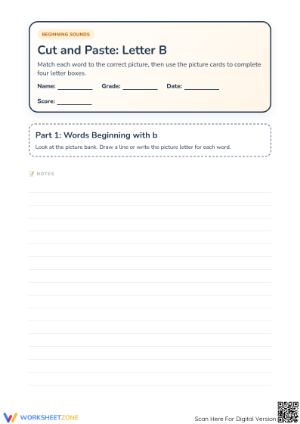
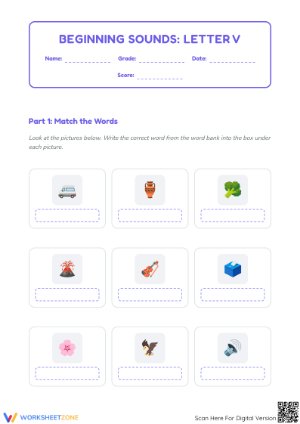
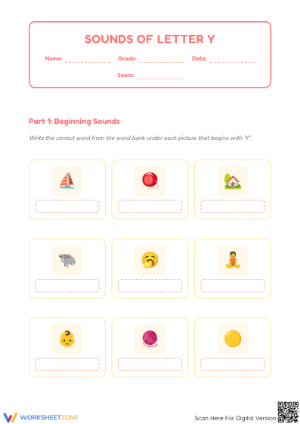
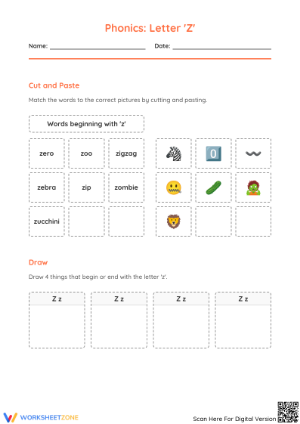
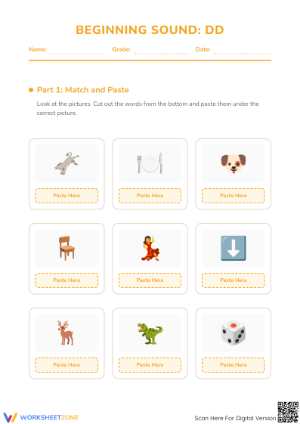
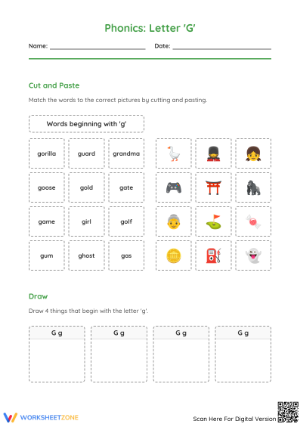
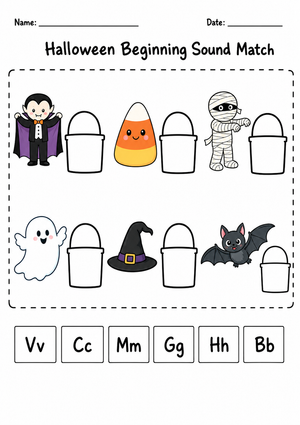
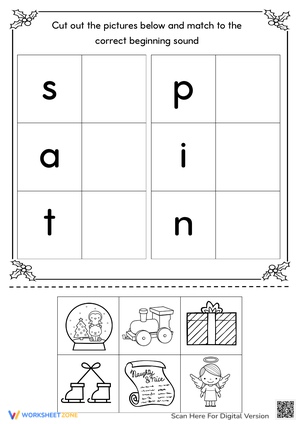
Cut and paste beginning sounds pdf worksheets for kindergarten put the motor and phonemic work side by side: students say a picture name, isolate the first sound, find the matching letter among several choices, cut it out, and glue it down. That physical sequence — naming, listening, deciding, placing — slows the task down in exactly the right way for five-year-olds who are still learning to hold a sound in memory long enough to connect it to a letter. Teachers get a format that runs in centers, small groups, and morning work without requiring constant adult check-ins once students learn the routine.
What Each Worksheet Targets
The skills on these worksheets cluster around three areas kindergarten teachers work on simultaneously: phonological awareness, letter-sound knowledge, and early written response. Each one matters for a different reason, and this format asks students to use all three in sequence rather than in isolation.
- Initial sound isolation: Students hear a word and identify the very first phoneme — /s/ in sun, /m/ in map — before touching any answer choices.
- Letter-sound correspondence: Students match that isolated sound to a printed letter, the phonics connection that carries directly into decoding work later in the year.
- Picture naming accuracy: Students must say the picture name correctly before the task can work at all. A student who calls a drawing of a web a spider will isolate /sp/ rather than /w/ — and mark the wrong answer despite working phonics knowledge.
- Visual discrimination: Choosing among two or four letter options requires careful comparison, especially when answer choices include look-alikes such as b and d.
- Fine-motor coordination: Cutting small answer pieces and placing them over a labeled box takes the grip control and spatial accuracy that many kindergartners are still actively building.
The vocabulary picture names carry real weight here. Worksheets built around words like hat, dog, cup, pig, and fan let students spend attention on sounds rather than figuring out what an image depicts. When every student knows the word being pictured, the task measures phonics — not background vocabulary.
Mistakes Students Make That These Worksheets Surface Early
The most common error pattern is not guessing — it is mislabeling the picture. A student who sees a cartoon rabbit and says bunny will listen for /b/ and choose the wrong letter, even though the phonemic awareness is working correctly. The error lives in the word, not the phonics knowledge. This happens most in the first few weeks of center use, before students have internalized which name the teacher expects for each image. A quick whole-group model — holding up each picture, naming it together, stretching the first sound aloud — catches this before copies are wasted and before the student develops a habit of choosing /b/ for every rabbit picture they see.
A second pattern appears with letters that share similar sounds. Students early in the year who are still cementing the difference between /v/ and /f/, or between /b/ and /p/, will choose incorrectly not because they cannot hear the first sound, but because voiced and voiceless consonant pairs have not fully separated in their auditory processing yet. Mark those not as phonics failures but as a signal to return to auditory discrimination before asking for letter matching on paper. The cut-and-paste format helps here in a small way: when a student sets a piece down and then looks at the answer again while reaching for glue, there is a natural pause that sometimes produces a self-correction.
How to Build These Worksheets Into Your Literacy Block
The most useful adjustment is to run a quick oral round before anyone touches scissors. Call out each picture name, ask students to stretch the first sound — "sssun," "mmmop" — and show fingers or letter cards to signal their choice. Then students cut, sort their pieces by setting them on top of the correct letter boxes, and check with a partner before glue comes out. This adds maybe ninety seconds and separates students who genuinely know the sound from those who are watching neighbors. It also saves copies, because errors caught before gluing are easy to move.
In literacy centers, a stable routine matters more than novelty. Teach the center procedure in whole group, run two or three guided rounds, then release students to the rotation. Once they know what to do with the scissors, the small answer pieces, and the letter boxes, you can pull a small group at the back table while the center runs without interruption. Cut and paste beginning sounds pdf worksheets for kindergarten work well here because the visual format is self-directing — students can look at each worksheet to know what step comes next, without reading a set of written instructions they may not yet decode.
For intervention, say each picture name aloud and ask the student to repeat it before they cut anything. This oral-first step separates language confusion from phonics confusion. A student who can produce /s/-/s/-/s/ when you stretch sock together but still glues the wrong letter likely needs more explicit letter-sound review, not more picture naming work.
Adjusting the Set for Different Student Levels
Differentiation for beginning sounds work comes down to two levers: field size and task sequence. Adjusting either one changes the difficulty without requiring separate materials.
- Reduce the answer field: Cover two of four answer choices with a sticky note, leaving only the target letter and one clear distractor. This halves the decision load without changing the phonics task itself.
- Add an oral picture sort first: Before letter matching, have students group picture cards by initial sound. Hearing /d/ across three different words primes the connection before a printed letter appears.
- Pre-name pictures: For students with limited English vocabulary or articulation differences, name each picture together before the student begins cutting, so the word label is secure.
- Extend for confident students: After gluing, ask them to write the beginning letter independently on the back, or generate a second word that starts with the same sound.
- Limit visible rows: Fold the bottom portion of the worksheet under so only one row shows at a time, for students who lose focus when a full layout is in front of them.
One honest limitation: this format frustrates students who are strong in oral phonics but whose cutting and gluing is labored. A child who can orally segment every word you offer but whose scissors work is slow may spend all available attention on the fine-motor task with little left for the sound decision. For those students, pre-cut answer pieces set in a small tray — or a partner who handles the cutting while they identify the sound — keeps the phonics goal intact without the format becoming an obstacle.
Standard Alignment
These worksheets align with CCSS.ELA-LITERACY.RF.K.3.A, which asks kindergartners to demonstrate basic knowledge of one-to-one letter-sound correspondences by producing the primary sound for each consonant. In classroom terms, that standard shows up in early fall as teachers introduce consonant sounds one by one, and beginning sounds work is the main vehicle for checking whether students can connect a printed letter to the sound they hear at the start of a spoken word. Many teams also connect this work to RF.K.2.D, which calls for students to isolate and pronounce the initial sounds in single-syllable words — the phonological awareness side of the same skill. Cut and paste beginning sounds pdf worksheets for kindergarten address both standards within a single task: oral naming and sound isolation targets RF.K.2.D, while the letter matching targets RF.K.3.A.
Frequently Asked Questions
Do students need to know letter names before using these worksheets?
Not fully, but some familiarity with letter shapes helps. Students who recognize a handful of consonants by sight can compare the letter in the answer box to their choices without needing to read the letter name aloud. For students who are very early in letter recognition, start with picture-to-picture sorts — matching images that begin with the same sound — before transitioning to these letter-matching worksheets once a core set of consonants feel familiar.
How many answer choices work best at the beginning of the year?
Two or three choices outperform four in August and September. The goal in those first weeks is building the sorting routine and giving students early accuracy before field size increases. More choices can be introduced once students demonstrate they can isolate initial sounds reliably and move through the cutting task without visible frustration. Adding a distractor that shares a visual similarity with the target letter — like p alongside b — raises difficulty without expanding the field.
Can these worksheets be used with English language learners?
Yes, with a vocabulary preview step. Before the worksheet enters a center, show each image to the student in a small group, say the English word clearly, ask them to repeat it, and confirm they are using the intended word — not a translation that begins with a different sound. A student who knows the picture as perro rather than dog will hear /p/ and choose incorrectly, through no fault of their phonics knowledge. When picture names are secured ahead of time, the letter-matching task works the same way it does for native English speakers.
What is the most efficient way to check student work in a center?
Make sort-before-glue the non-negotiable center rule. Students place every cut piece on top of its answer box, review the row, then check with a center partner before glue comes out. Cut and paste beginning sounds pdf worksheets for kindergarten structured around clear letter boxes make this two-step routine easy to enforce because the target location is visually obvious. Errors caught during the sort take three seconds to fix. Errors found after gluing usually cost a new copy and a student's confidence.