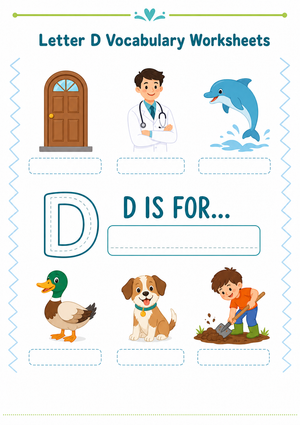
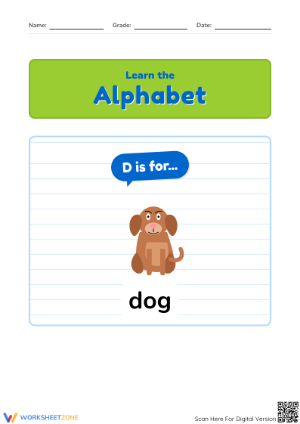
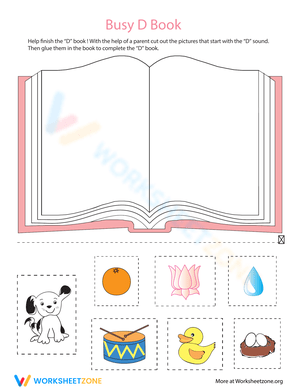
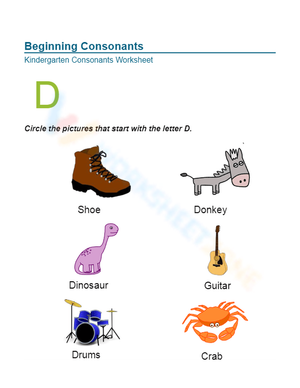
These letter d beginning sound pdf worksheets for kindergarten give teachers ready-to-print phonics practice built around picture-based sound identification — no prep beyond pulling the PDF from a folder. The set targets a single phoneme goal: connecting the spoken /d/ sound to its printed letter, both uppercase and lowercase. Each worksheet fits into a literacy block, a center rotation, or a take-home review folder.
What Each Worksheet Asks Students to Do
The tasks move across several response modes, which matters because hearing a sound and forming a letter are different cognitive actions that need separate practice. Students who can circle a picture of a duck correctly often stumble when sorting a drum against a door without any visual anchor group nearby — the task looks similar but demands more precise sound discrimination.
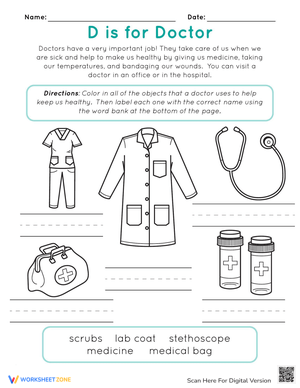
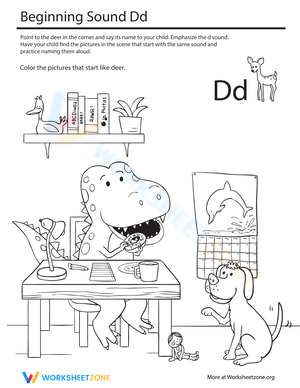
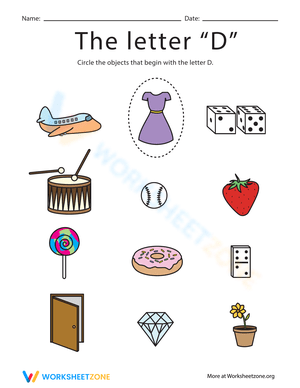
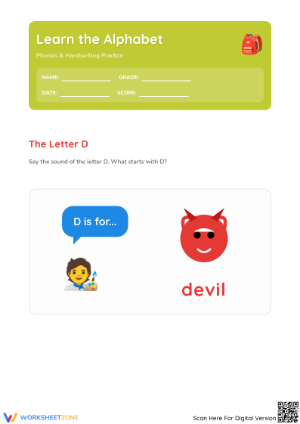
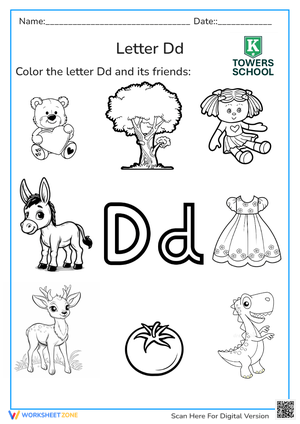
- Picture identification: Students look at a group of images and circle or color those that begin with /d/.
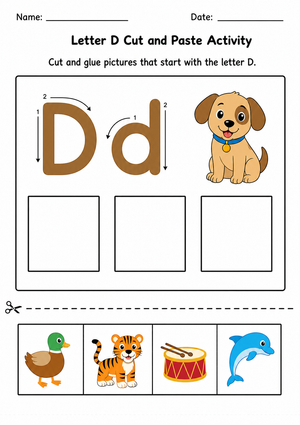
- Sound sorting: Students place pictures into two groups — starts with D, or does not.
- Cut-and-paste activities: Students physically move images into a D column, which adds a kinesthetic element to the sorting decision.
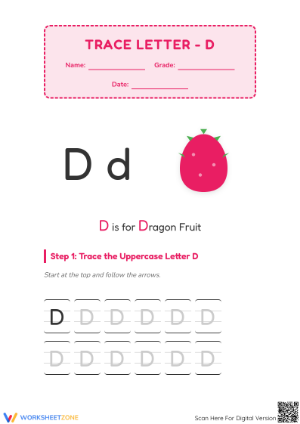
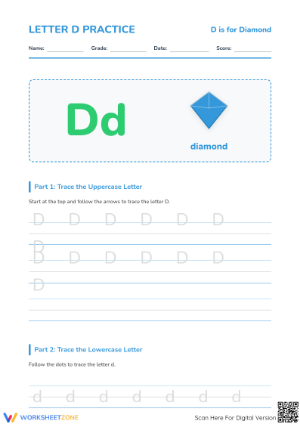
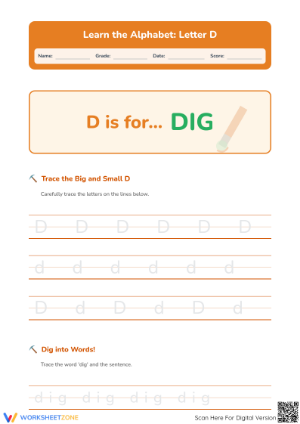
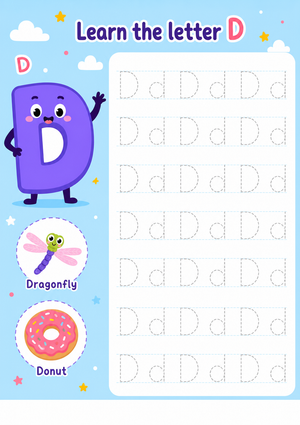
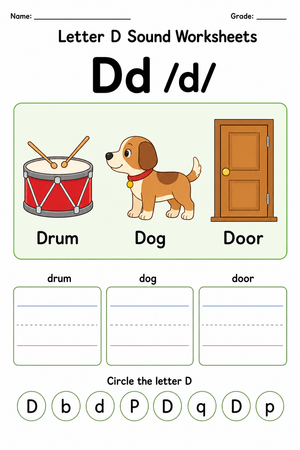
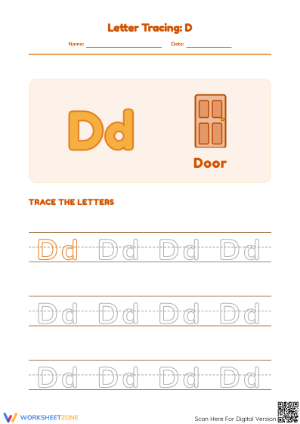
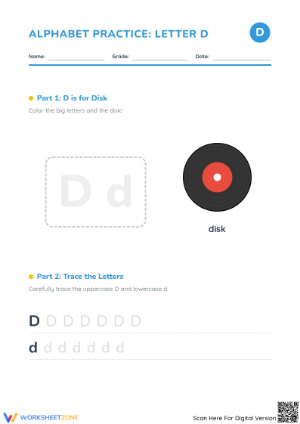
- Letter tracing: Students trace uppercase D and lowercase d, saying the letter name and sound while they write.
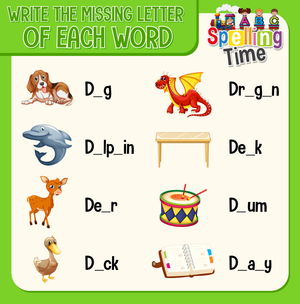
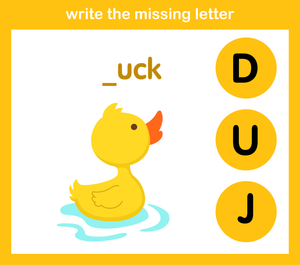
- Labeling: On select worksheets, students write or trace D beside pictures that match the target sound.
This range keeps the /d/ practice from becoming a single repeated routine. Students who breeze through the circling task often need several passes at the cut-and-paste sort before the sound-letter link is genuinely solid.
Fitting These Worksheets Into Your Literacy Block
Start with a short oral warm-up before students touch the worksheet. Hold up three to five picture cards, say each word at a natural pace, and ask students to give a thumbs up when they hear /d/ at the start. That two-minute exchange primes the auditory pathway before students encounter the written task. Without it, students who are uncertain about the sound tend to choose pictures by visual pattern — they pick images that look like they could start with D based on the letter shape, not on phoneme recognition.
When letter d beginning sound pdf worksheets for kindergarten are paired with this brief oral warm-up, the worksheet becomes a confirmation of what students already demonstrated verbally rather than a first encounter with the sound. That shift in function matters. The task moves from guessing activity to retrieval check.
During small-group instruction, ask students to say each picture name aloud before marking anything. The oral-first habit separates students who genuinely hear /d/ from those who are pattern-matching on visual cues. During center rotations, post a simple direction card showing a dog and the notation "/d/ — /d/ — dog" so students can self-cue without waiting for redirection. For intervention, cut one worksheet apart into individual picture cards, run an oral sort first, and then return to the written sorting task as a second pass.
Student Mistakes That Surface Quickly With This Letter
Two error patterns show up reliably. The first is the b/d reversal — the most well-documented letter confusion in Kindergarten. Students who swap b and d on the page are often not confused about the sound at all; they know /d/ when they hear it. The trouble is that b and d are mirror images of each other, and until students build a stable visual anchor for each form, they reverse them in writing. A worksheet that displays clear, consistent letter models at the top gives students a reference point to check against while they work, which cuts down on careless reversals without requiring extra instruction time.
The second error is sound-level confusion between /d/ and /b/. Both are voiced stop consonants — the mouth position is nearly identical, with the main difference being where the tongue contacts the palate. When picture vocabulary is unfamiliar, students sometimes categorize "ball" or "bus" as beginning with /d/ because the articulatory feel is so close. Sticking to high-frequency, concrete words — dog, duck, door, drum, doll — removes that ambiguity. When a student marks the wrong picture using familiar vocabulary, the error is clearly phonemic, and the next instructional step becomes easy to identify.
Meeting Students at Different Points in Phonics Development
Students who are still building general phonemic awareness — learning to isolate sounds before connecting them to letters — need the oral work extended before the written task. Pair each worksheet with a verbal naming routine: say the word, tap the first sound, repeat. Do not move to the written response until a student can reliably isolate /d/ by ear during that oral portion.
Students who have the /d/ sound secured and are ready for more challenge can turn any sorting worksheet into a production task. After identifying D pictures, have them write the letter D independently beside each matching image — or write the full word if their writing development is on pace. That converts a recognition activity into a retrieval and production task without requiring a different set of materials.
For English learners who may not recognize the picture vocabulary immediately, a brief preview of image names before the worksheet session removes the vocabulary barrier without changing the phonics goal. The sound-matching work stays intact; students just need the word labels cleared first so the phoneme-matching task is not blocked by unfamiliar words.
Standard Alignment
These worksheets address CCSS.ELA-LITERACY.RF.K.3.A, which requires Kindergarteners to demonstrate basic knowledge of one-to-one letter-sound correspondences by producing the primary sound for each consonant. Beginning sound identification with the letter D sits directly at the center of that standard. RF.K.3a appears in the first half of the Kindergarten phonics sequence because consonant-sound correspondences must be in place before students attempt CVC decoding or consonant blends. The picture-identification and sorting tasks in this set translate well to formative check-ins for individual RF.K.3a progress — more directly than the tracing tasks, which address letter formation rather than phoneme-grapheme knowledge.
Frequently Asked Questions
Can these worksheets serve as an assessment tool?
Yes, with a useful distinction. The picture-identification and sorting tasks give a readable snapshot of whether a student can match /d/ to its printed letter, which maps to RF.K.3a and works as formative data. The tracing tasks show letter formation, not phonics knowledge. Use the sorting worksheets to check sound recognition; treat tracing as practice evidence rather than assessment documentation.
What should I do when a student finishes quickly but marks answers carelessly?
The most effective fix is a touch-and-say routine: students touch each picture, say the name quietly, then mark. Posting a three-step direction card — touch, say, mark — gives early finishers a visible procedure to follow rather than leaving them to rush through the task. On the next check-in, ask the student to name one D picture and explain why it starts with /d/. That brief oral response catches errors a circled answer alone would hide.
Are these worksheets still useful for students who already know the /d/ sound?
Letter d beginning sound pdf worksheets for kindergarten still serve a productive role for students who have secured the phoneme — but shift the task. Have those students write the letter D independently beside each matching picture rather than just circling it, or use the images as prompts for writing full words. The visual material remains useful even when the target recognition skill is already in place.
How many worksheets from the set should I use in a single week?
One or two worksheets per week keeps the practice purposeful without overloading a single phoneme. Return to letter d beginning sound pdf worksheets for kindergarten across several days — morning warm-up one day, center rotation the next, take-home on Friday — rather than completing the full set in one sitting. Distributing the practice across a week gives the /d/ sound multiple retrieval opportunities, which builds more durable phoneme-grapheme knowledge than running through every worksheet in a single block.