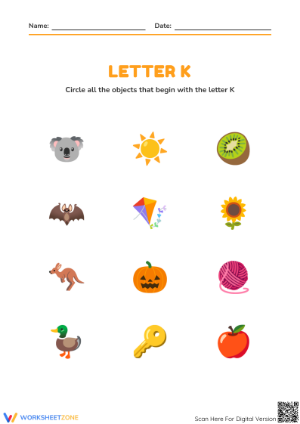
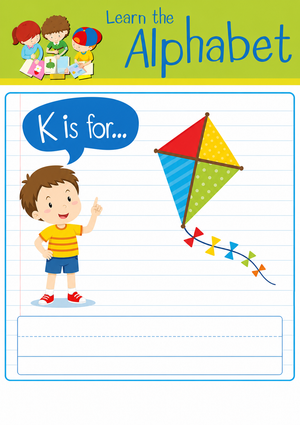
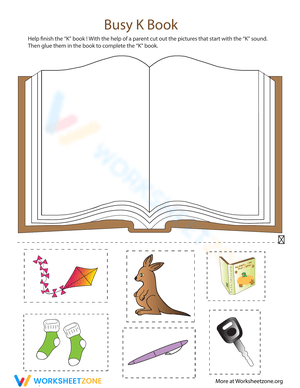
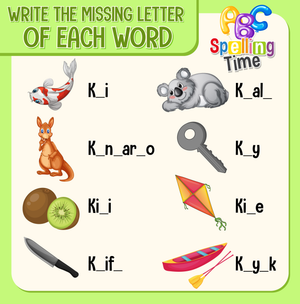
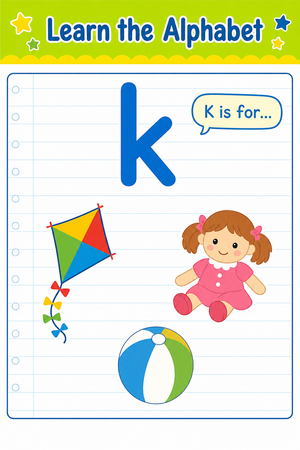
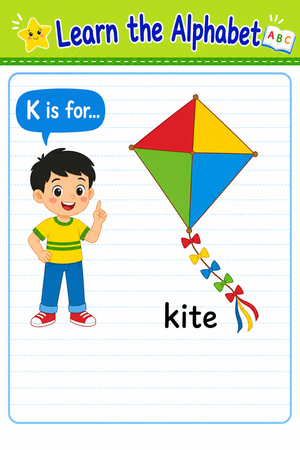
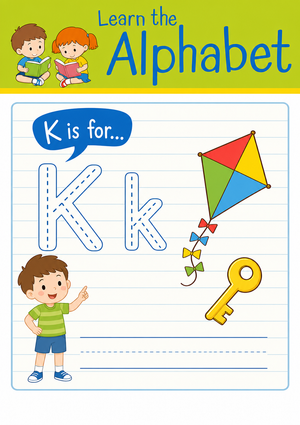
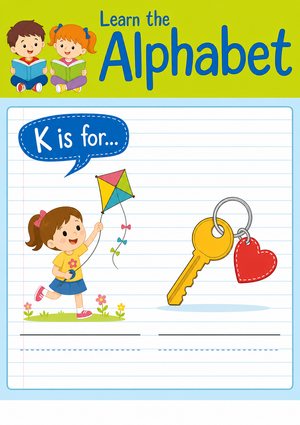
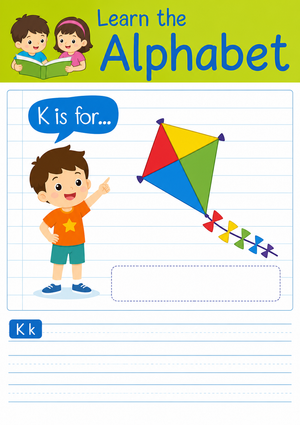
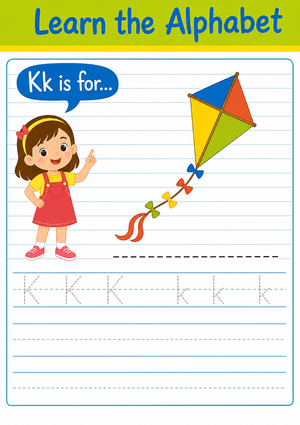
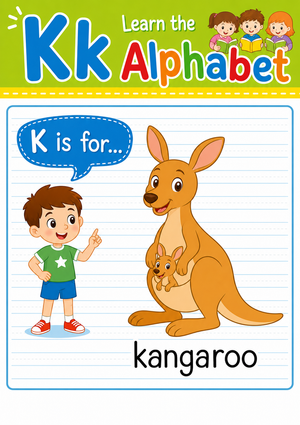
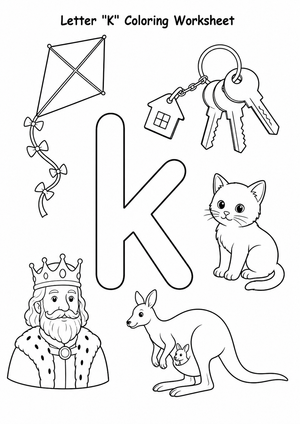
These kindergarten letter k beginning sound printable worksheets give teachers a focused tool for one of the trickier early phonics moments — helping five-year-olds hear the /k/ sound at the start of a spoken word and connect it to the printed letter K. Each worksheet keeps the work narrow on purpose: trace Kk, name the pictures, identify which ones start with /k/, then mark or sort. That tight scope is exactly what most Kindergartners need before they can apply beginning-sound knowledge independently.
The Specific Skills Each Worksheet Targets
The /k/ sound is one of the first consonants Kindergartners encounter, and K is a natural early choice because the sound is easy to isolate and the picture vocabulary is strong: kite, key, king, kangaroo. These words carry the /k/ sound cleanly at the front with nothing blended before it, which gives students the clearest possible opportunity to hear the target.
Each worksheet in the set builds on a cluster of connected skills:
- Sound isolation: Students say a picture name aloud and pull off the first sound — hearing /k/ in kite before they look at any letter.
- Letter recognition: Both uppercase K and lowercase k appear so students see the full symbol pair, not just one form.
- Letter formation: Tracing Kk ties the sound-to-symbol work to muscle memory and connects the phonics lesson to early handwriting in the same task.
- Visual discrimination: Circling or sorting K pictures against non-K pictures asks students to compare, not just recall.
- Decision-making under limited text: Because the directions rely on pictures rather than written instructions, students can work with minimal adult support once the routine is established.
The Vocabulary Confusion Teachers Need to Anticipate
The most common source of wrong answers on beginning-sound work in Kindergarten is not weak phonics — it is vocabulary mismatch. A student who sees a picture of a kettle and calls it a "pot" will hear /p/ at the start and mark the wrong answer. That child may actually know the /k/ sound well; they simply did not have the word kettle in their spoken vocabulary. This pattern shows up regularly with less familiar K words: kayak, koala, and koi are all clean examples of the sound, but any of them can trip up a student who names the picture something else entirely.
The fix is a 30-second picture preview before pencils touch the paper. Point to each image and say its name aloud. That move separates vocabulary knowledge from phonics knowledge and gives teachers much cleaner data on whether students can actually hear the beginning sound. It also prevents the frustration of a child who genuinely knows /k/ marking a "wrong" answer because they called the picture "cat" when the worksheet expected "kitten."
How to Work These Worksheets Into Your Lesson Sequence
These worksheets do their best work as the practice step in a lesson, not the opening move. A short teacher-led warm-up with picture cards, a few spoken examples, and a clear demonstration of "we're listening for the very first sound" sets students up to use each worksheet successfully. In whole group, project the first row, name the images together, and think aloud before releasing students. The actual worksheet time is quiet and brief — most Kindergartners complete one in eight to twelve minutes, which makes these a natural fit for the independent work block that follows phonics instruction.
For literacy centers, keep the routine consistent across the week. Students trace, say each picture name to a partner, then mark the K words. Adding that oral step — "say the picture name before you circle it" — turns a quiet paper task into active phonemic awareness practice. In small groups, slow the pace and cover parts of each worksheet so students work through one section at a time. That structure lets teachers hear individual students producing the /k/ sound and catch confusion before it calcifies.
These kindergarten letter k beginning sound printable worksheets also travel well in take-home folders. Because the task is visual and the directions are short, families can support the practice without needing a phonics background. A brief note — "Say each picture name out loud before your child circles or colors" — extends the oral component into the home without adding complexity for parents.
Standard Alignment
These worksheets address CCSS.ELA-LITERACY.RF.K.3a, which requires Kindergartners to demonstrate basic knowledge of one-to-one letter-sound correspondences by producing the primary sounds for each consonant. The /k/ sound work here — isolating, hearing, and connecting that sound to the letter K — sits directly within that standard's scope. RF.K.3a is typically taught in the first half of Kindergarten, so these resources are most useful from September through January for most published pacing guides. Teachers in states with equivalent letter-sound correspondence standards at the Kindergarten level will find the skill alignment holds regardless of the specific code their state uses.
Adjusting These Worksheets for Different Readiness Levels
Kindergarten phonics readiness can span two to three years of developmental range in one classroom. Students who are still working on sound isolation — just learning that a distinct sound exists at the start of a word — need the oral rehearsal step extended before they write anything. Say the picture name, stretch the first sound, ask the student to repeat just that sound, then point to the letter K. For these learners, completing half of each worksheet with guided support is more useful than rushing through independently.
Students who already hear /k/ reliably and connect it to the letter can extend the task: draw one additional K word in a blank box, generate a short oral list of K words, or sort the worksheet pictures into two labeled columns on a separate sheet. These additions stay inside the beginning-sound skill rather than jumping ahead to unrelated phonics work. For students somewhere in between, pairing each worksheet with small picture cards they can physically move around before writing often reduces errors and builds confidence before pencil work begins.
Frequently Asked Questions
Why does teaching K sometimes feel harder than other consonants?
Partly because of the C/K overlap. Both letters make the /k/ sound in English, and students who notice this — often after seeing cat and kite side by side — will ask which letter is "right." In Kindergarten, the practical move is to keep C words and K words in separate lessons so students can focus on sound-to-symbol connection without the spelling rule entering the picture. The rule for when English uses K versus C comes later, in first and second grade. Introducing it during Kindergarten phonics instruction creates more confusion than it resolves.
How many picture choices should appear on a Kindergarten beginning-sound worksheet?
Four to six images per task row is the right range for most Kindergartners. Fewer than four gives students so few options that the task loses its discrimination value; more than six begins to tax working memory. Every worksheet should include at least two clear nonexamples — pictures that do not begin with /k/ — so students have to actually decide, not simply circle everything on the row.
Can these be used during reading intervention?
Yes, and the single-sound focus makes them a natural fit. Intervention blocks typically follow a one-target-at-a-time structure, and these worksheets match that approach. In an intervention session, kindergarten letter k beginning sound printable worksheets work best when the teacher previews all pictures first, takes two or three oral repetitions of /k/ before any writing begins, and uses the completed worksheet as a brief exit check rather than a formal grade. That sequence makes the worksheet a diagnostic tool as much as a practice task.
What should I do when a student keeps marking the wrong pictures?
Check vocabulary before assuming a phonics gap. Ask the student to name each picture aloud before marking anything. If they label a picture with a word that starts with a different sound, the issue is vocabulary, not the letter K. If they name the picture correctly but still mark it wrong, the gap is in sound isolation, and the next instructional move is more oral work with picture cards — no paper at all. The kindergarten letter k beginning sound printable worksheets return as meaningful practice once the student can pull /k/ off the front of a spoken word without support.