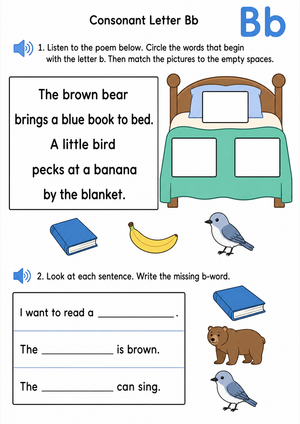
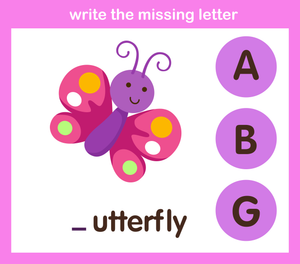
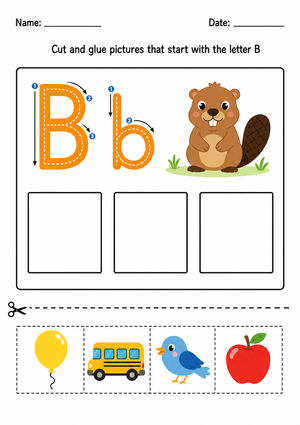
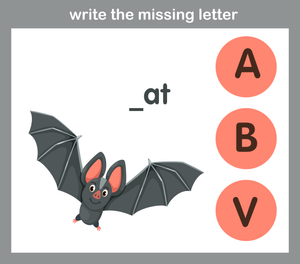
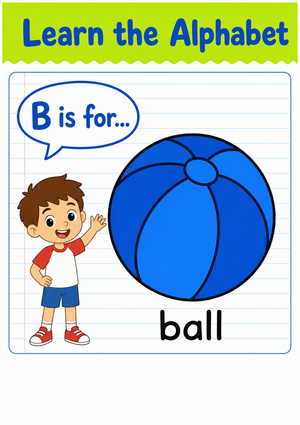
These kindergarten letter b beginning sound printable worksheets give teachers a set of phonics tasks built around the initial /b/ sound — a voiced bilabial stop that most five-year-olds can already produce in speech long before they recognize the letter that represents it. Children who say "ball" and "bus" all day have the sound; the worksheets close the gap between that spoken familiarity and the printed symbol. Each worksheet focuses on one aspect of that connection — sound isolation, letter-symbol matching, or both — so teachers can pull individual worksheets as warm-ups, center activities, or small-group tools without re-explaining the task each time.
What's Inside the Set
The worksheets cover a range of phonics tasks, all anchored to the beginning /b/ sound:
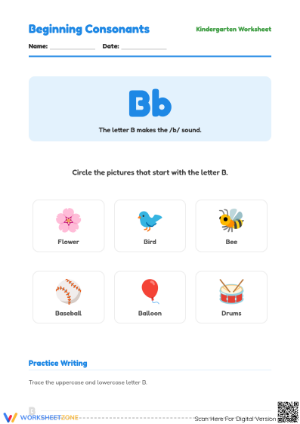
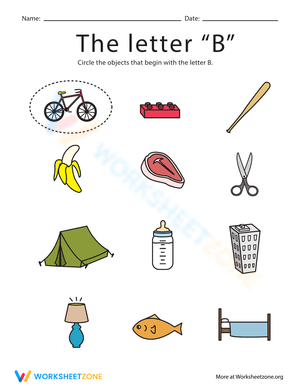
- Initial sound isolation: Students say each pictured word aloud, then mark or circle pictures whose names begin with /b/. This is the foundational skill the set builds.
- Picture-to-letter matching: Students draw a line from an image — a boat, a bee, a basket — to the letter B, reinforcing the sound-symbol pairing directly.
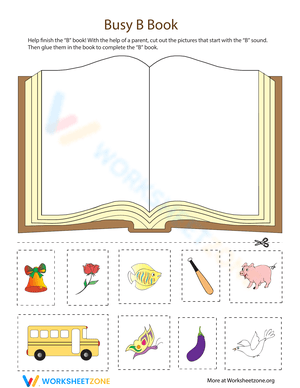
- Cut-and-paste sorting: Students sort picture cards into two columns: /b/ words and non-/b/ words. This format makes a child's internal speech process visible — you can watch them mouth the word before deciding where to place the card.
- Letter tracing and formation: Each worksheet that includes tracing pairs the motor task with the sound, so students say /b/ as the pencil follows the letter shape. The repetition builds letter-form memory alongside phoneme memory.
- Search-and-find: Students scan a busy illustration for objects beginning with B — a bird, a book, a button — which builds vocabulary and visual attention at the same time.
The mix of auditory, visual, and motor tasks matters because five- and six-year-olds are still developing phonological processing. A single-mode task loses students faster than one that asks them to see, say, and mark. These worksheets combine those modes within each activity rather than isolating them.
Where Students Go Wrong When Learning the /b/ Sound
The most predictable error is the b/d reversal, and it shows up early. Because lowercase b and d are mirror images, many students who can produce the /b/ sound correctly still reach for the wrong letter. This is a visual processing issue, not a phonemic one — the child knows the sound but retrieves the wrong symbol. The "bat and ball" anchor is reliable when used consistently: the vertical stroke is the bat, the round bump is the ball, and since you grip the bat before swinging at the ball, the line comes first. The key is committing to a single mnemonic and making sure it appears on any desk strip or reference card students have while working. Switching between different anchors undermines the automaticity you're building.
A less-discussed error involves /p/. Both /b/ and /p/ are bilabial stops — the mouth does exactly the same thing for both sounds. The only difference is voicing: /b/ vibrates the vocal cords, /p/ does not. Students who are still building phonemic awareness sometimes collapse these into one category. When you see a student place a picture of a pear in the B column on a sorting worksheet, that is a phonemic confusion, not a letter confusion. Having students press two fingers lightly against their throat while alternating "ball — pan, ball — pan" lets them feel the distinction rather than just hear it, which resolves the error faster than verbal explanation alone.
Working These Worksheets Into Your Phonics Routine
Most teachers introduce the letter B during whole-group instruction first — a shared read-aloud heavy with /b/ vocabulary, a quick sound-production demonstration where students feel their lips press together, a few practice words as a class. After that anchor, the worksheets move into literacy centers where students work independently. The cut-and-paste sort is the strongest center activity because it produces a visible, checkable product without requiring teacher presence. A student who places a picture of a pig in the B column has made a phonemic error you can address during the debrief — not mid-activity, when you are likely occupied with a small group elsewhere.
The kindergarten letter b beginning sound printable worksheets work especially well in the first 8–10 minutes of a literacy block as a retrieval warm-up. Students complete a tracing or circle-the-picture task while the teacher handles attendance or morning check-in, and the format is simple enough that no verbal re-explanation is needed each day. Rotate the worksheet type every few sessions rather than repeating the same format back-to-back — students who sorted pictures on Tuesday are ready for a search-and-find on Thursday. The target skill stays constant; the task structure stays fresh.
For small-group phonics sessions, pair a worksheet with a physical object when you can. A brief "mystery bag" moment — each student pulls out a toy bear, a button, or a small ball — gives them a tactile anchor that transfers directly to the 2D pictures on the page. Students who held the ball and said "/b/ — ball" retrieve that phoneme faster when they see a drawn ball on the worksheet two minutes later. It takes about 90 seconds and measurably reduces hesitation on the first few items.
Standard Alignment
These resources address CCSS.ELA-Literacy.RF.K.3, the kindergarten foundational skills standard covering phonics and word analysis. The specific cluster is RF.K.3.a: demonstrating knowledge of one-to-one letter-sound correspondences by producing the primary sound for each consonant. Isolating the initial /b/ sound and connecting it to the printed letter B is a direct, measurable application of that requirement. Teachers using standards-based reporting can use the cut-and-paste sort and circle-the-picture tasks as formative evidence of RF.K.3.a — the student's finished product shows exactly which words they identified correctly and which they did not, giving you item-level data without additional assessment prep.
Tailoring the Worksheets for Students at Different Phonics Stages
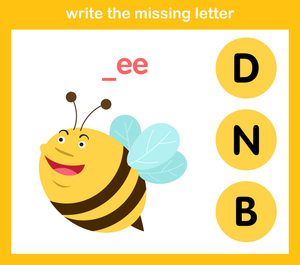
For students who already isolate beginning sounds reliably, the worksheets still hold value — but the task shifts. Ask those students to write the pictured word (or attempt it phonetically) rather than circling the letter. A student who writes "brd" for bird or "bk" for book is demonstrating initial sound knowledge and applying phonemic segmentation, which moves them toward more explicit CVC work ahead of pacing-guide expectations. You can extend further by leaving a blank cell on the worksheet where students generate and draw their own /b/ word — this requires retrieval rather than recognition.
For students still building phonemic awareness — particularly English language learners who may not have English labels for the pictured objects — the illustration quality on each worksheet matters more than the task complexity. Before asking an ELL student to work independently, walk through the pictures together and name each one in English: "This is a bear. Bear. /b/ — bear." That 60-second preview prevents the situation where a student skips an item entirely because they do not know what it is called, which looks like a phonics error but is actually a vocabulary gap. For kindergarten letter b beginning sound printable worksheets to function as phonics practice for ELL students, the vocabulary check has to happen first — otherwise you are measuring English word knowledge, not sound isolation.
Frequently Asked Questions
How do I handle students who keep reversing b and d even after we've practiced the anchor?
Give the student a physical desk reference — a strip or card with the bat-and-ball image for b and a comparable anchor for d — and require them to consult it before writing the letter during any worksheet activity. The goal is to make the external reference automatic before the internal one is reliable. Most students outgrow b/d reversals as their visual processing matures; the desk strip prevents the reversal from being reinforced through repeated incorrect practice while that development is still underway. Consistent, low-stakes correction during center time matters more than any single direct-instruction moment.
How many worksheets should I use per week during a letter B unit?
Two or three per week is sufficient if each one uses a different format. One sort, one tracing or formation task, and one search-and-find gives students varied practice without turning phonics into extended seat work. A kindergarten letter b beginning sound printable worksheets session should run 10–15 minutes; beyond that, engagement drops sharply for students who are still building stamina for pencil-and-paper tasks. Shorter sessions repeated across several days produce stronger retention than one long block of phonics work.
Can I use these worksheets with students who are not yet reading?
Yes — the tasks rely on picture identification and oral production, not reading. Students listen to themselves say a word, isolate the first sound, and respond by marking, cutting, or tracing. No decoding is required. The one preparation step is confirming that students know the English name for each pictured object, particularly in classrooms with a mix of language backgrounds. A quick picture walk before center time takes under two minutes and prevents incorrect responses that stem from vocabulary gaps rather than phonics gaps.
What do I do when a student finishes a worksheet quickly and correctly?
Have a standard extension task ready at the center — typically a blank box where students draw and label two more objects beginning with B. This keeps finishers engaged without requiring you to leave a small group. The student writing "br" for brush or "bt" for boat is giving you informal phonemic segmentation data. Students generating their own /b/ examples independently are ready for more explicit sound-blending work sooner than the pacing calendar may indicate, and that self-generated work is a cleaner signal than performance on a multiple-choice phonics task.