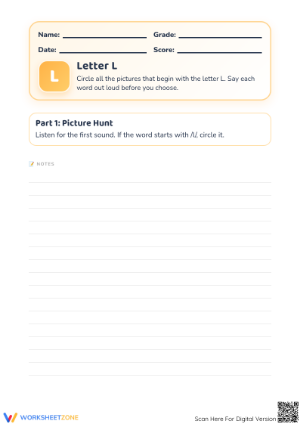
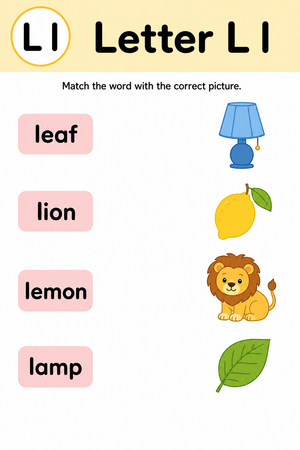
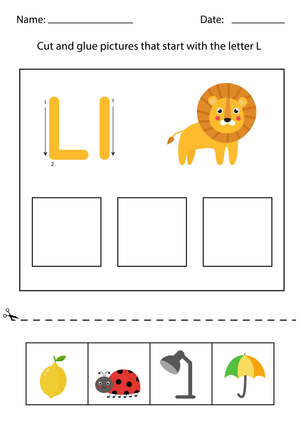
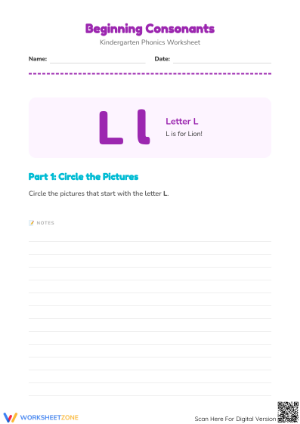
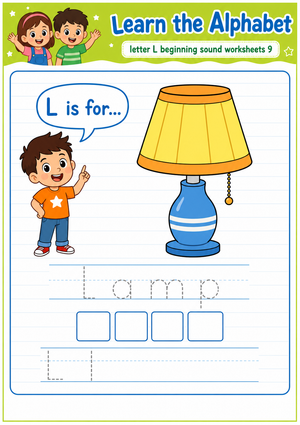
These kindergarten letter l beginning sound printable worksheets give teachers a targeted set of picture-based phonics exercises for the specific moment in early literacy when students first learn to pull a beginning sound away from the rest of a spoken word. Each worksheet zeros in on the /l/ sound through naming, sorting, tracing, and marking tasks. Together, the set builds the phoneme isolation fluency that makes early decoding start to click.
The Skills Each Worksheet Targets
The /l/ sound is a continuous consonant—students can stretch it out without stopping their breath, which makes it more audible and easier to isolate than stop sounds like /p/ or /t/. That property makes it a strong entry point for phoneme isolation work, and the worksheets take advantage of it by asking students to say a picture's name aloud, hold the first sound, and decide whether they're hearing /l/ before marking anything on the page.
Across the set, students practice several distinct task types:
- Identifying beginning /l/ pictures in a mixed field—leaf, lamp, and lion alongside unrelated images like dog or sun—so students discriminate rather than simply confirm a sound they're already expecting
- Sorting pictures into "starts with L" and "does not start with L" columns, which requires holding two categories in working memory at once
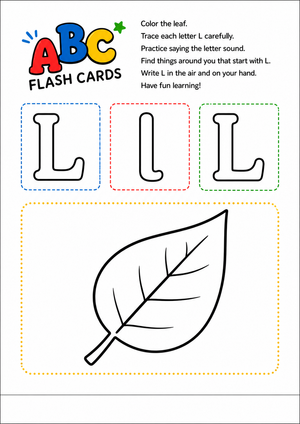
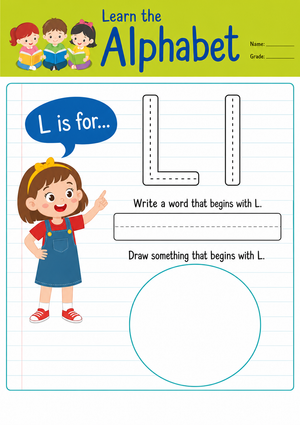
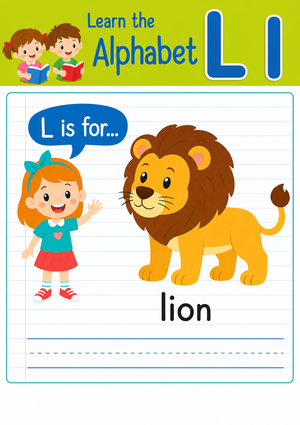
- Tracing uppercase L and lowercase l while naming a corresponding picture, pairing motor rehearsal of the letter form with auditory rehearsal of the sound
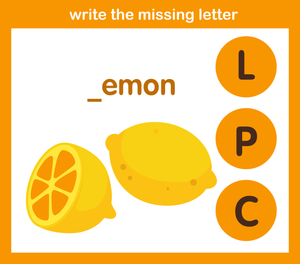
- Coloring or circling correct pictures using anchor vocabulary—lion, leaf, log, lemon, lock—that most kindergarteners recognize on sight
- A few exercises that introduce slightly less familiar /l/ words such as lantern and lizard, pushing vocabulary range without abandoning the phonics task
What to Watch in Student Work Before You Collect the Papers
The most common error on these worksheets is picture-naming confusion, not a phonics gap. A student who calls the "log" picture "wood" will mark it wrong—not because they don't know the /l/ sound, but because they didn't know the vocabulary. Taking two minutes to name every picture together on the projector before seatwork begins prevents that entire category of errors. Catching problems early—before you collect and score a kindergarten letter l beginning sound printable worksheets—keeps your assessment data from being skewed by vocabulary gaps that have nothing to do with phonics knowledge.
The second pattern worth flagging: students who conflate /l/ with /w/ or /r/. These are all voiced, continuous sounds, and some five-year-olds haven't fully separated them in their own articulation. A quick whole-group mouth-placement check before students start—tongue tip touching the ridge just behind the upper front teeth for /l/, lips rounded for /w/, tongue pulled back for /r/—sharpens accuracy considerably. Handing each student a small mirror so they can watch their own mouth as they say the sounds makes the contrast concrete in a way that verbal explanation alone doesn't.
Where These Worksheets Fit Into Your Phonics Block
Literacy centers are the natural home for these resources, but the sequence matters. A kindergarten letter l beginning sound printable worksheets works best as the independent follow-up to a whole-group lesson, not as the introduction to the sound. When students sit down at a center, they should already have the anchor words loaded from the read-aloud or phonics board activity that came before it. Instruction first, guided practice next, then independent worksheet work—that order is how the sound actually moves from class knowledge to individual student fluency.
For center logistics, laminate a set and store it in dry-erase pockets. Students mark answers with an expo marker, you do a quick check, and you wipe it clean for the next rotation. With four rotations through a typical center block, one laminated worksheet can serve an entire class before it needs reprinting. Morning warm-up is another reliable slot—a short sorting task in the eight or nine minutes before the literacy block formally opens activates phonological memory from the previous lesson without eating into instruction time.
Standard Alignment
These worksheets address RF.K.2d, which requires students to isolate and pronounce the initial, medial vowel, and final sounds in three-phoneme CVC words. In classroom terms, that standard describes exactly what happens on each worksheet: the student says "leaf," isolates /l/ as the first phoneme, and records that judgment by sorting, circling, or marking. Every completed worksheet produces direct evidence of RF.K.2d, which makes the set straightforwardly useful for progress monitoring conversations and phonics portfolio documentation at the end of a unit.
Adjusting the Work for Students at Different Points in the Sequence
Students who are still building basic letter recognition belong on the tracing and coloring worksheets before they attempt the sorting tasks. Sorting asks a child to evaluate two categories simultaneously while also processing phoneme identity—that combination can overwhelm students who haven't consolidated the letter form yet. Running the tracing worksheets first gives those students more exposures to L before the task demands increase.
Students who already isolate /l/ reliably can begin with the vocabulary-extension worksheets and then generate their own /l/ word lists on the back of a completed sheet—an extension that moves from recognition into production without requiring a separate handout. For a kindergarten letter l beginning sound printable worksheets to work across a mixed classroom, the simplest approach is assigning the tracing-heavy worksheets to students who need more letter exposure and the sorting and vocabulary worksheets to students who are ready to work at a higher discrimination level.
Frequently Asked Questions
Which vocabulary works best as anchor words for introducing the /l/ sound?
Stay with words that are visually distinct and unlikely to be mislabeled: lion, leaf, lamp, lock, ladybug, lemon, and log are reliable choices. Hold off on consonant blends—block, clock, sled—until students are consistently isolating the single initial phoneme. Blends obscure the task for students who are still developing phoneme discrimination, and a blend-heavy picture set will generate errors that look like phonics confusion but are actually about auditory complexity.
How long should one worksheet take during center time?
Ten to fifteen minutes is the right window for a single picture-sort or tracing task. If a student is spending more than that, the task is likely above their current level or the anchor vocabulary wasn't previewed before they sat down. Short, focused practice sessions distributed over several days build more retention than one extended /l/ sound session—and they're a better match for a five-year-old's attention span.
Can these worksheets work for students who haven't yet learned all their letters?
Yes, with some adjustment. The picture-identification and sorting tasks don't require students to know the letter name or form—they only require the child to hear the beginning sound and make a judgment. Students who are pre-alphabetic can still do meaningful phonemic awareness work using the picture-sort tasks, even if they skip the tracing component. The tracing worksheet makes more sense once a student is in the partial alphabetic phase and actively connecting sounds to letter forms.