These kindergarten letter u beginning sound printable worksheets give teachers four distinct activity formats—coloring-and-tracing, cut-and-paste picture sorts, identify-and-circle checks, and guided mazes—each targeting the short /ʌ/ sound that five- and six-year-olds need to anchor before they can reliably blend simple CVC words. Short /u/ typically arrives last among the five short vowels in a kindergarten phonics sequence, landing at the point in the year when students are ready to apply it directly to decoding and invented spelling.
What's Inside the Set
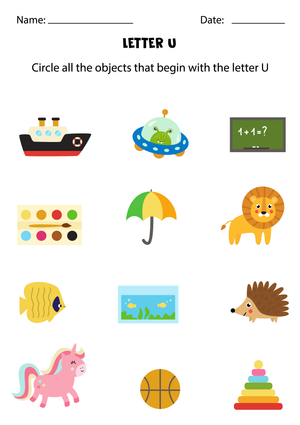
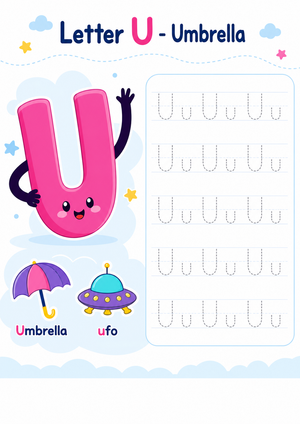
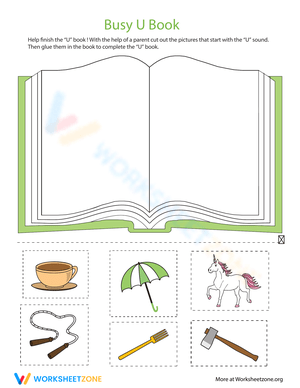
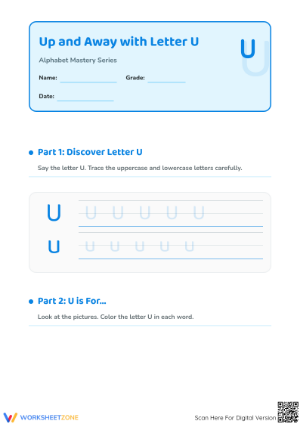
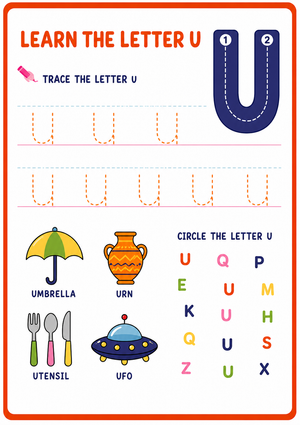
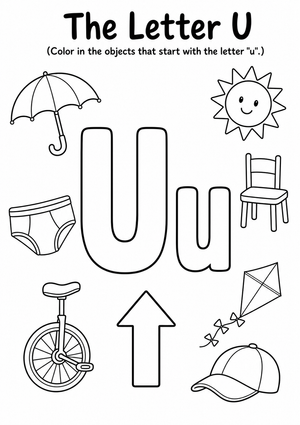
Each worksheet in the set covers a specific skill within the same phoneme. The coloring-and-tracing worksheet pairs letter formation with sound recognition: students trace uppercase and lowercase U, then color only the pictures whose names begin with /u/. The cut-and-paste sort develops auditory discrimination — students say each picture name aloud, isolate the initial sound, and glue the image into a "starts with /u/" column or set it aside. The identify-and-circle format functions as a fast formative check; a teacher can scan a class set in under three minutes, which makes it practical as an exit ticket on day two of the unit. The maze worksheet threads a path through /u/ images, and its game-like structure keeps reluctant phonics workers moving through the activity without stalling.
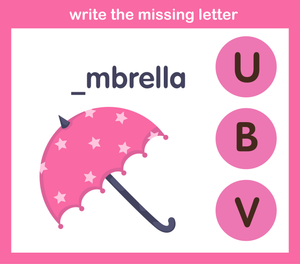
The anchor vocabulary across the set — umbrella, up, under, uncle, and umpire — consists of words kindergarteners already recognize. That matters because picture-recognition uncertainty adds cognitive load; using familiar images keeps the phonics task front and center.
Error Patterns Worth Knowing Before You Distribute These Worksheets
The most consistent error on beginning /u/ work is confusion with short /o/. A student who correctly sorts umbrella into the /u/ column will often sort olive or octopus there too — the mouth position feels similar enough at five years old that the sounds blur. A mirror placed at the phonics center addresses this directly: when students watch themselves say up and then on in sequence, they can see that /o/ drops the jaw noticeably further. Running that comparison before students touch the cut-and-paste sort gives the auditory task a physical reference point.
A second issue involves unicorn and uniform. Both words begin with the long /u/ sound — /juː/ — but students who encounter those pictures on any worksheet will confidently place them in the /u/ column, which is wrong at the sound level when short /u/ is the target. Preview the picture set before distributing and pull or flag any long-/u/ images that would muddy the lesson's focus.
How to Work These Worksheets Into Your Phonics Block
The coloring-and-tracing worksheet fits naturally at the start of a letter U unit — project it during whole-group and model saying each picture name while stretching the first sound before the class decides together whether it matches /u/. The next day, the identify-and-circle worksheet works as a warm-up retrieval prompt before moving into new instruction. Mid-unit, place the cut-and-paste sort at a literacy center alongside a small basket of physical objects — a toy umbrella, a plastic cup — so students can handle the objects, say their names, and complete the worksheet independently or with a partner. The maze makes a natural Friday station or take-home activity once the sound is largely secured.
The kindergarten letter u beginning sound printable worksheets also handle those eight minutes at the end of the day when something structured but low-demand keeps things orderly. The identify-and-circle format requires no teacher explanation — students recognize the routine from earlier letters and can work independently while the teacher manages dismissal prep.
Standard Alignment
These worksheets address RF.K.3.a, the kindergarten Reading Foundational Skills standard that calls for students to demonstrate basic knowledge of one-to-one letter-sound correspondences by producing the primary sound for each consonant and each vowel. For the letter U, RF.K.3.a focuses on the short /ʌ/ sound — the phoneme that drives decoding in words like bug, run, and cut and appears at the start of high-frequency words like up and under. The kindergarten letter u beginning sound printable worksheets in this set target that specific phoneme rather than general letter introduction, which places them squarely within the RF.K.3.a benchmark rather than the pre-K letter-naming work that precedes it.
Adjusting the Set for Different Learners in the Same Room
For students who are still connecting letters to sounds inconsistently, pre-sort the cut-and-paste pictures before the lesson — /u/ images in one pile, everything else in another — and ask the student to say each picture name aloud and confirm the sound before gluing. The two-step check (say it, confirm it) slows the task in a useful way. The coloring-and-tracing worksheet also works well for this group because the motor task gives students something to hold onto even when the auditory piece is shaky.
Students who have short /u/ secured can use an extended identify-and-circle worksheet that mixes in long /u/ images — unicorn, uniform — alongside the short /u/ set. Asking them to sort short versus long /u/ beginnings turns the kindergarten letter u beginning sound printable worksheets into a contrast exercise rather than a simple recognition drill, and it gives teachers a natural bridge toward vowel team and long vowel instruction later in the year.
Frequently Asked Questions
Should I introduce the short /u/ sound or the long /u/ sound first?
Short /u/ first, consistently. The short sound appears in the simple CVC words — bug, cup, run — that early readers decode in their first guided reading texts. The long /u/ sound, including the initial /juː/ in words like unicorn, shows up in more complex spelling patterns and is better introduced once students have short /u/ automatic.
What do I do when a student can name the letter U but can't isolate the beginning sound?
Letter naming and sound production are different skills, and kindergarteners often master naming first. Keep the focus on the auditory task: say a word, stretch the first sound, and ask whether it matches /u/ — before showing any written letter at all. Once the student can sort by sound alone, reintroduce the printed letter as the symbol for that sound.
How many practice sessions does it typically take for kindergarteners to reach mastery on the beginning /u/ sound?
Most kindergarteners need three to five exposures across different formats before the sound is automatic — meaning they isolate /u/ at the start of a word without pausing to think. Distributing the four worksheets across a week, roughly one per day with a built-in review day, gives most students that exposure without rushing the unit or stretching it beyond what the phoneme warrants.