These kindergarten letter x beginning sound worksheets address one of the stranger corners of early phonics instruction: a letter that, at the start of words, almost never makes the sound most children already associate with it. Where the /ks/ in fox or box is what students typically learn X "sounds like," the worksheets in this set focus on the two beginning-position examples that dominate kindergarten phonics — X-ray and xylophone — and build the specific recognition skills students need to sort, match, and write around them.
Why X Requires a Separate Teaching Move
Most letters get a clean introduction: B says /b/, S says /s/, and the teacher can fill a picture-word chart in minutes. X doesn't cooperate. At the start of words, it makes a /z/ sound (xylophone, xerox, xenon) or says its own name in terms like X-ray. The /ks/ blend — the sound children hear most often when X appears in print — shows up almost exclusively at the end of words. That mismatch is not a minor hiccup; it means the teacher has to actively address a prior assumption before new instruction can land. This set gives students repeated exposure to both high-frequency beginning-X words in ways that establish the correct sound correspondence before the misconception calcifies.
What the Set Covers
Each worksheet in the kindergarten letter x beginning sound worksheets collection targets a specific skill within the beginning-X phonics focus. Across the set, students practice:
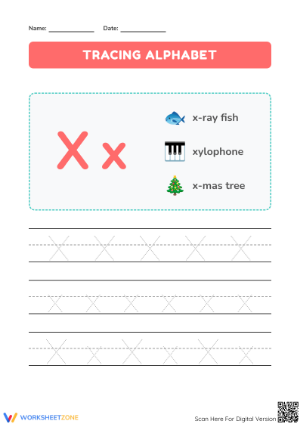
- Tracing and independently forming uppercase and lowercase X, working through intersecting diagonal strokes that differ from the horizontal and vertical lines they've built muscle memory around since fall
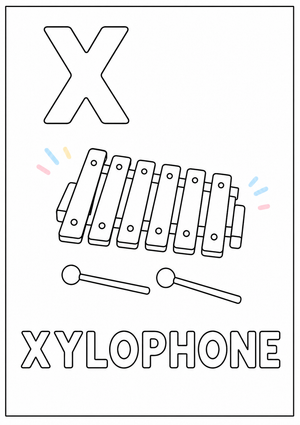
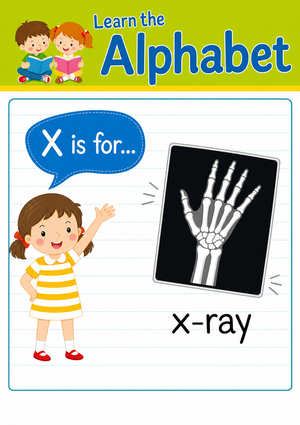
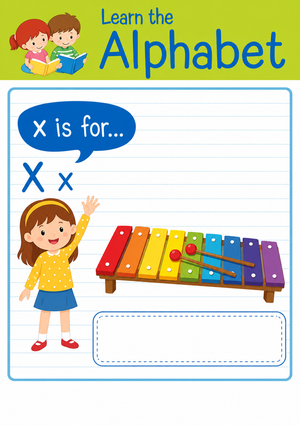
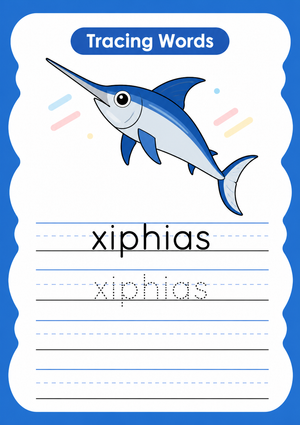
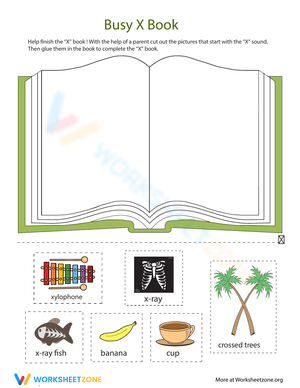
- Coloring and labeling pictures of X-ray and xylophone to reinforce the sound-symbol link through repeated naming
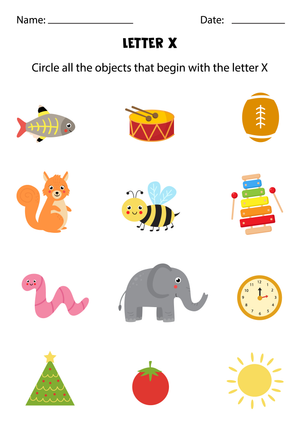
- Sorting pictures into beginning-X and not-beginning-X categories — a task that surfaces the /z/ confusion directly and gives teachers real-time data on where each student stands
- Circling the letter X within a row of visually similar letters; K, Y, and V are the most useful distractors because children misread them at a higher rate than more obviously different letters
- Identifying the beginning sound of spoken words and marking the letter that matches
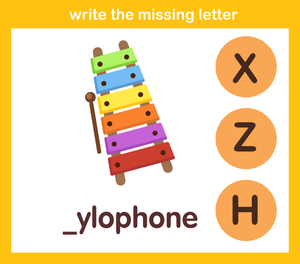
- Writing the missing letter X to complete a beginning-sound word
The formation work deserves a separate note. X requires two diagonal strokes that intersect near the center — a motor pattern that doesn't appear in most of the uppercase letters kindergartners learn in the first half of the year. Students who have built strong habits with L, T, E, and F often rush the X and produce something that reads as K or a crossed V. Stroke-order practice built into each worksheet addresses this before it becomes a habitual formation error.
Building These Worksheets Into Your Weekly Rotation
X week typically falls in April or May in most curriculum calendars — late enough that students have settled routines but early enough to allow at least one review cycle before end-of-year assessments. That timing matters for how the resources fit into instruction. By spring, small-group rotations are running smoothly, which means a teacher can introduce the /z/ and name-sounds of X with three or four students while the rest of the class works independently on a tracing and coloring worksheet. Students who finish early can move to the picture-sort task without needing redirection.
Morning warm-up is another natural fit. A single X worksheet takes most kindergartners eight to twelve minutes — long enough to count as settled, purposeful work at the start of the day, short enough that the teacher can circulate and catch students who are already mapping xylophone to Z before the whole-class lesson begins. That early scan is useful formative data: a student who circles xylophone under Z during morning work tells the teacher exactly what small-group conversation needs to happen before instruction moves forward.
These kindergarten letter x beginning sound worksheets also travel home without requiring parent prep notes. Because the target vocabulary is narrow — most families recognize X-ray and xylophone immediately — parents can support the letter-sound work without a companion guide.
Student Errors Worth Anticipating Before the Lesson
The most consistent error across beginning-X instruction is the /ks/ transfer. Students who have worked with fox, box, and six store /ks/ as the universal X rule. When a worksheet shows a picture of a xylophone and asks for the starting letter, these students write Z — not because they don't recognize the letter, but because they correctly process the /z/ and have no prior rule that says X can produce it. The fix is explicit before the worksheet ever comes out: say the word, show the print, have students repeat "X says /z/ at the start of xylophone" three or four times. Trying to correct this error mid-task is slower and less reliable than a thirty-second priming conversation before the worksheet begins.
A second pattern appears during letter-recognition tasks. Students identify the capital X reliably — it lives on the alphabet strip at the front of most classrooms. The lowercase x trips up students who haven't spent time comparing the two side by side on lined paper. The difference is almost entirely scale, and scale is hard for five-year-olds to judge in isolation. A worksheet that places uppercase and lowercase X next to each other with a midline reference point makes that size distinction concrete in a way that verbal explanation alone doesn't.
Standard Alignment
These worksheets address CCSS.ELA-LITERACY.RF.K.3a: Demonstrate basic knowledge of one-to-one letter-sound correspondences by producing the primary sound or each of the most frequent sounds for each consonant. The phrase "most frequent sounds" is doing real instructional work in this standard — it's precisely why beginning-X instruction requires two sound models rather than one. In classroom terms, the standard asks teachers to build enough consistency that students can decode the letter at sight. The sort and identification tasks in each worksheet generate the evidence needed to confirm that mastery before the class moves on.
Handwriting formation work connects to many state-level kindergarten writing standards that require students to print uppercase and lowercase letters legibly. Where those standards are in place, the stroke-order practice on each worksheet counts as direct standards-aligned instruction rather than supplemental busy work.
Adjusting the Set for a Range of Learners
Students still working on basic letter recognition benefit most from the tracing and coloring worksheets in the set. These keep the cognitive demand low enough that the child can succeed while still building the motor pattern. Pairing this worksheet with an alphabet strip lets the student cross-reference without interrupting the teacher, which preserves the independent work flow and keeps small-group instruction unbroken.
For students who have already internalized X-ray and xylophone and can produce both sounds reliably, the extension is to write additional beginning-X words from memory. Most will attempt X-Men or Xbox — both legitimate beginning-X words and genuinely interesting entry points for a conversation about whether those follow the same sound rules. Students working well above grade level can also self-categorize: which beginning-X words use the name-sound, and which use /z/?
English language learners may carry a prior-language value for the letter X that doesn't match either target sound. Spanish-speaking students in particular encounter X in words where it can represent several different sounds depending on word origin, and some arrive at a third pronunciation that matches neither X-ray nor xylophone. The picture-labeling tasks in the kindergarten letter x beginning sound worksheets set anchor the sound to a specific image rather than asking the student to generate it from an abstract rule — which is exactly where ELL students need the most concrete support in letter-sound work.
Frequently Asked Questions
Why does the letter X make a /z/ sound at the beginning of some words?
Most beginning-X words in English come from Greek, where the letter xi (Ξ) represented a sound that doesn't map cleanly to standard English consonants. When these words entered the language, the spelling stayed while the pronunciation shifted toward /z/. For classroom purposes, the most practical explanation for a five-year-old is: "X borrowed the /z/ sound for some special words that came from a different language a long time ago." That's enough to name the exception without making it feel arbitrary or overwhelming.
Should I introduce the /ks/ ending sound at the same time as beginning-X instruction?
Briefly, yes. Students are going to notice that fox ends in X, and avoiding the topic creates confusion when they encounter it independently. The cleaner approach is to name it directly: at the end of words like box and six, X makes a /ks/ blend; at the beginning of words like xylophone, it sounds like /z/. Each worksheet in this set focuses on beginning position, so the ending-sound discussion is a one-minute framing moment at the start of the lesson — not a parallel instructional sequence competing for time.
How do I handle students who keep writing Z instead of X on beginning-sound tasks?
This is the most common sorting error in the set, and it comes from accurate phonological processing — the student heard /z/ and wrote the letter they know makes that sound. Correct it by anchoring to the picture: point to the xylophone image, say the word together, write X on the paper while the student watches, then have the student trace the X and say the word again. That sound-picture-letter sequence, repeated across two or three short sessions rather than corrected once in the moment, fixes the Z substitution more reliably than any single intervention does.