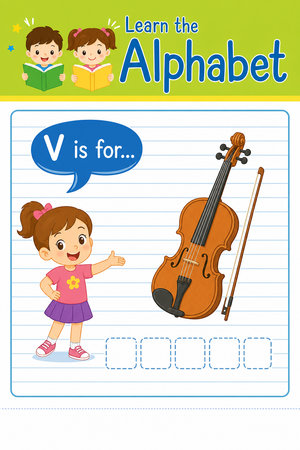
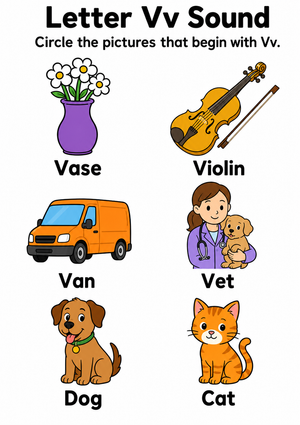
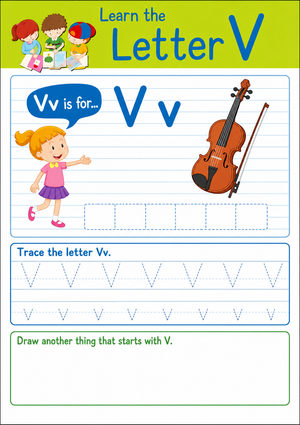
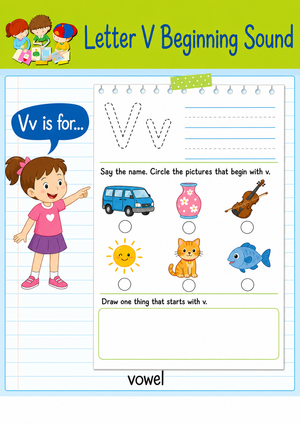
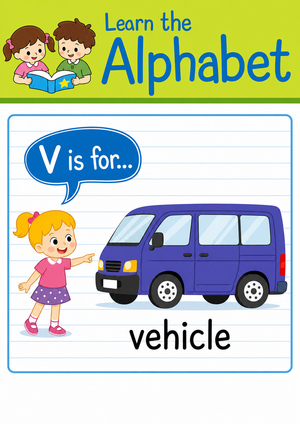
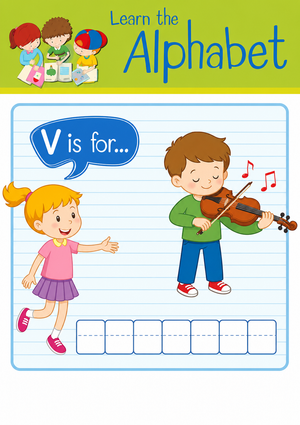
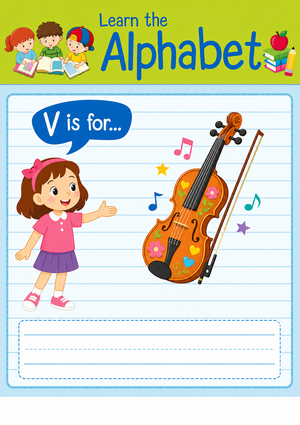
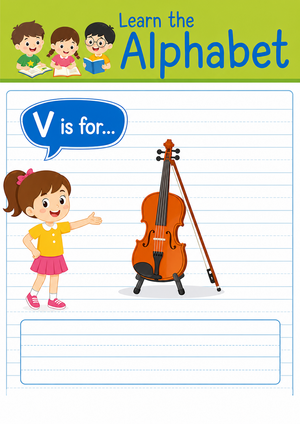
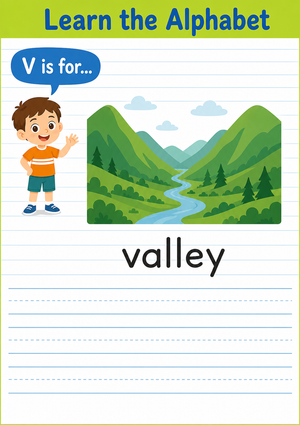
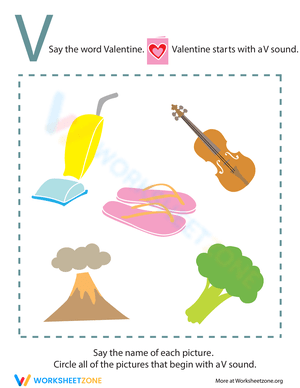
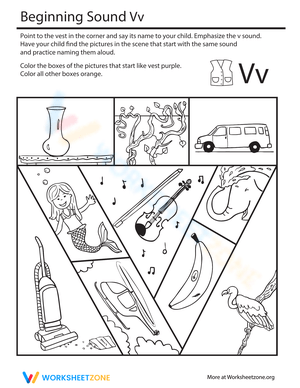
These kindergarten letter v beginning sound printable worksheets give teachers a set of focused phonics resources for one of the more sonically tricky consonants in the early literacy sequence. Each worksheet targets the initial /v/ sound through picture identification, letter tracing, and sound-sorting tasks sized to fit a 10-to-15-minute phonics block. The vocabulary used across the set — van, vest, volcano, violin, vet, vase — appears throughout because each word produces a clean, unambiguous /v/ at the beginning, which matters when students are still learning to trust their own ears.
Where the /v/ Sound Gets Confused — and What to Watch For
The /v/ and /f/ sounds are made in exactly the same mouth position: top teeth resting against the lower lip, air pushing through the narrow gap. The only difference is that /v/ is voiced — the vocal cords vibrate — while /f/ is not. Kindergarteners do not naturally attend to voicing as a distinct feature, so a child who correctly identifies a fish picture as /f/ will often assign that same label to a vase or a van. This is not sloppiness; it reflects a genuine gap in phonemic awareness that explicit instruction addresses directly. The most reliable fix: have students place two fingers lightly on the front of their throat and alternate between /v/ and /f/. The vibration is noticeable enough that most five-year-olds catch the difference on their own. Worksheets that ask students to sort /v/ and /f/ pictures into separate columns double as a diagnostic — the pattern of mistakes tells you at a glance which students still hear these two phonemes as the same sound.
Skills These Worksheets Build
Each worksheet in the set isolates a specific phonics task rather than loading multiple demands into a single activity. That constraint is deliberate. When a kindergartener has to identify a beginning sound, trace a letter, and sort pictures all at once, the cognitive load often swamps what the phonics practice is worth. Keeping each worksheet narrowly focused lets students attend to the sound itself.
- Letter tracing: Students trace uppercase and lowercase V using directional arrows. The diagonal strokes of this letter demand more motor control than simple curves, and students who rush tend to produce a shape that reads closer to a U. Worksheets with marked starting points and dashed guidelines help students slow down.
- Picture coloring: Students identify images, determine the initial sound, and color only the pictures that start with /v/. This format rewards phonemic accuracy without requiring writing, which keeps it accessible to students still developing pencil control.
- Sound sorting: Students sort pictures by placing /v/ words in one column and a foil sound — usually /f/ — in another. This is the task most likely to surface the v/f confusion described above.
- Cut and paste: Students cut out picture squares and glue them into a graphic organizer sorted by beginning sound. The fine motor component here is real — the task requires scissor control and spatial reasoning alongside the phonics work.
- Word-picture matching: Students draw lines connecting printed words to corresponding pictures, reinforcing the link between the letter sequence and the sound they have been practicing orally.
How to Build These Worksheets Into Your Lesson Plans
The most effective sequence is whole-group introduction, brief oral practice, then independent worksheet time. Start by showing pictures of the target vocabulary under a document camera and modeling your own thinking aloud: "I see a volcano. Vvv-volcano. I feel my throat buzzing." That self-monitoring language gives students a procedure to replicate, not just an answer to copy. Keep the oral warm-up to about five minutes so students arrive at the worksheet with the sound still active in working memory.
The kindergarten letter v beginning sound printable worksheets in this set fit cleanly into the transition windows K teachers know well — the eight minutes before pickup on a Friday afternoon, the five-minute warm-up slot after morning meeting, or the independent-practice rotation during a literacy block. Cut-and-paste worksheets work especially well in early-finisher rotations because students who complete the sorting task quickly can be asked to label their sorted pictures, extending the activity without requiring a separate resource.
One small-group use that pays off consistently: pull three or four students who showed the v/f confusion on a previous worksheet, give each a small hand mirror, and have them produce both sounds while watching their lip placement. When students see that their teeth are touching their lower lip for both /v/ and /f/, the voiced/unvoiced distinction becomes the clear differentiating feature. Follow that observation immediately with a sorting worksheet while the tactile feedback is still fresh, and the accuracy improvement is usually immediate.
Adjusting the Set for Mixed Readiness Levels
For students still working on basic phoneme isolation, reduce the number of pictures on any given sort to four or six, and choose the most visually unambiguous /v/ images — van and vest rather than violin or vase, where an unfamiliar object adds a vocabulary hurdle on top of the phonics task. Working with these students in a small group while classmates work independently lets you provide real-time correction before an incorrect sound-symbol association gets reinforced through repetition.
Students who already isolate /v/ reliably can use the same kindergarten letter v beginning sound printable worksheets as a quick fluency check, then move to an extension: writing the full word below each sorted picture, or generating new /v/ words not pictured on the worksheet. Asking a student to produce their own examples — "Tell me something else that starts like van" — is a stronger measure of phonemic generalization than a completed sort.
Standard Alignment
These worksheets address CCSS.ELA-LITERACY.RF.K.3.a, which calls for students to demonstrate one-to-one letter-sound correspondences for all consonants. In classroom sequencing, this standard arrives after students have built basic phonological awareness — rhyming, syllable clapping — and are ready to attach sounds to specific letters. The /v/ sound is typically introduced mid-to-late fall of kindergarten, once students have secured the more common initial consonants (m, s, t, b) and are working through the less frequent ones. The sound-sorting and picture-identification tasks in these worksheets provide the explicit, repeated practice the standard requires before students can apply the correspondence independently in early reading and writing.
Frequently Asked Questions
Which vocabulary words work best on a /v/ sorting worksheet?
Van, vest, vet, vase, volcano, and violin are the most useful because each produces an unambiguous /v/ at the start and can be illustrated clearly enough for a five-year-old to name without prior vocabulary instruction. Avoid words where the /v/ sound follows a vowel at the start — oval, event — because those are medial sounds, not initial ones, and they muddle the task for students just learning to isolate beginnings. Among the kindergarten letter v beginning sound printable worksheets in this set, the picture bank draws consistently from this core vocabulary to keep the phonics focus clean.
How do I help a student who keeps mixing up /v/ and /f/ even after repeated practice?
Persistent v/f confusion usually means the student is attending to lip-and-teeth position but not to voicing. The most direct intervention is the two-finger throat check: the student places fingers on the front of their throat, says /vvv/, then /fff/, and identifies which one makes the fingers buzz. If that does not work, try the back-of-hand check — holding the hand close to the mouth, /f/ produces a sharp burst of air while /v/ produces almost none. Either technique should be followed immediately by a sorting worksheet while the physical feedback is still in working memory.
Do these worksheets work for whole-group instruction, or are they better in small groups?
Both, depending on which worksheet you choose. Coloring and tracing worksheets run well as whole-group independent practice after a shared introduction. Cut-and-paste sorting worksheets tend to work better in small groups or with partners because the physical manipulation naturally generates conversation — students talk through their decisions aloud, which reinforces the phonemic reasoning in a way that silent independent work does not. Save your /v/ versus /f/ sort worksheets for settings where you can observe and note which students are hesitating or self-correcting, since that pattern is worth documenting for small-group follow-up.