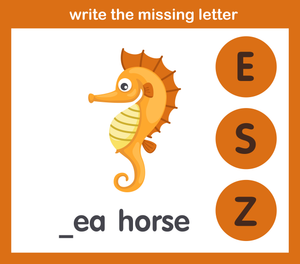
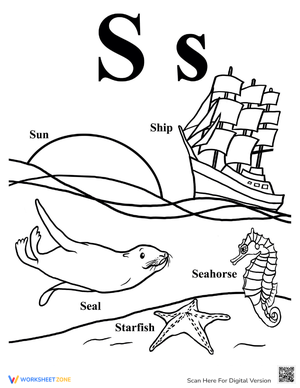
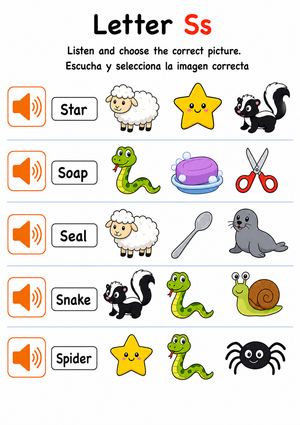
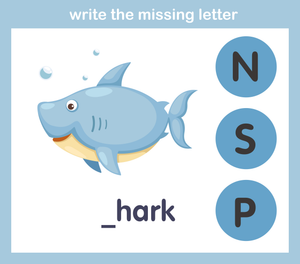
These kindergarten letter s beginning sound pdf worksheets give early readers structured, repeated practice with one of the most teachable phonemes in the alphabet. The /s/ is a continuous fricative — students can hold the sound in their mouths and hear it clearly — which makes it far easier to isolate than stop consonants like /p/ or /t/ that vanish the instant they're produced. That acoustic quality is exactly why most kindergarten phonics sequences introduce /s/ in the first few weeks of instruction.
The Specific Skills Each Worksheet Targets
Each worksheet centers on initial phoneme identification through two or three task types — enough variety to hold a five-year-old's attention without piling unrelated demands onto the same activity. The core tasks across the set include:
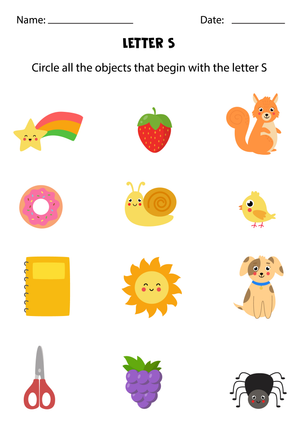
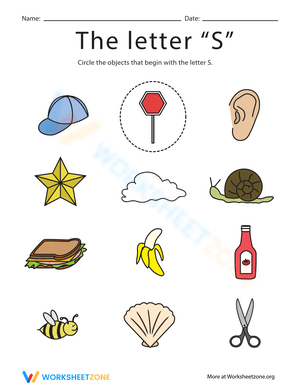
- Picture-sorting exercises where students mark or circle images that begin with /s/ while setting aside images that do not — a task requiring genuine phoneme isolation, not just visual pattern matching.
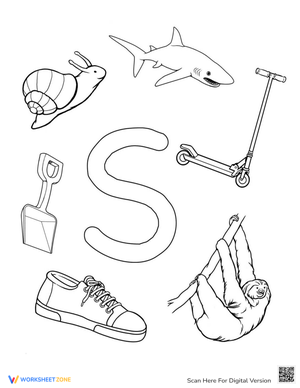
- Letter-tracing practice for both uppercase and lowercase S, which builds fine motor control while students connect the grapheme to the sound they've been producing aloud.
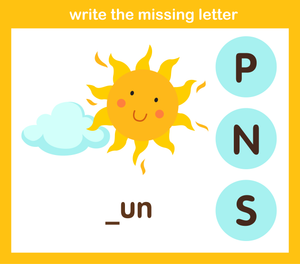
- Matching activities that ask students to draw a line from a picture to the letter S, reinforcing the relationship between the spoken sound and its written symbol.
- Coloring or circling tasks built around high-frequency S-words — sun, sock, seal, sandwich, star — chosen because kindergarteners recognize them immediately and won't stall trying to name the image.
That last point matters more than it might seem. When a child struggles to name a picture, attention shifts away from the phonics task entirely. Worksheets that use immediately recognizable images keep the focus where it belongs: on the beginning sound, not the vocabulary.
Fitting These Worksheets Into Your Literacy Routine
Displayed on a projector, these materials support whole-group explicit modeling — the teacher says the word, stretches the /s/, and points to the picture before students attempt the same task independently. That demonstration step is essential for students who are just beginning to understand that sounds and letters connect in consistent ways. Kindergarten letter s beginning sound pdf worksheets fit naturally into independent literacy centers once whole-group modeling has happened; students have already seen the task, know what's expected, and can often complete it without sustained adult support.
One technique worth building into center time: give each student a small handheld mirror. Ask them to watch their own mouths while producing the /s/ sound — teeth together, lips slightly pulled back, air moving steadily between the teeth. That physical, visual feedback turns an abstract phoneme into something a five-year-old can actually observe, and setup takes less than a minute. These worksheets also make solid morning work during the first ten minutes of the day, when students need a quiet, familiar task while attendance and lunch counts happen. The combination of a recognizable format and a previously taught sound is exactly what makes the activity work in that low-structure window.
Student Errors That Come Up When Teaching the /s/ Sound
The most consistent error on sorting tasks: students place "shoe" or "shark" pictures in the /s/ column. The letter S is right there at the start of the word, the visual cue is strong, and the sounds /s/ and /sh/ both involve air moving through the front of the mouth. The distinction is subtle enough that a child just beginning to listen for initial phonemes will miss it regularly. When this pattern appears on completed worksheets, it signals the need to put the two sounds side by side — say "sss" then "shh" slowly, ask students to feel the difference in their mouths, and name the contrast explicitly before they sort again.
A second pattern shows up with words that begin with /s/ blends. When students hear "star" quickly, some process the /st/ cluster as a single unit rather than isolating the /s/ alone. This is developmentally normal in early kindergarten — phoneme segmentation within blends develops later than simple onset identification — and it's useful to know so you don't misread that error as confusion about the /s/ sound itself.
Standard Alignment
These worksheets address CCSS.ELA-LITERACY.RF.K.3a, which requires students to demonstrate one-to-one letter-sound correspondence by producing the primary sound for each consonant. The sorting and matching tasks also connect to RF.K.2d, which asks students to isolate and pronounce the initial sound in a spoken word. In classroom terms, RF.K.3a governs the tracing and matching work, while RF.K.2d governs the sorting. Both standards belong in the same phonics block because students need to work on sound isolation and grapheme recognition together — treating them as separate skills practiced in separate weeks slows the whole process down.
Tiering the Set for Mixed-Readiness Classrooms
For students who are not yet reliably distinguishing initial sounds, reduce the number of pictures in a sorting task from eight or ten to four. Present two clear /s/ words — sun and sock — alongside two that are obviously different, like dog and fish. That narrower field lowers the demand on working memory and lets students experience success before the complexity increases. A simple reference card with the letter S next to a picture of a sun, kept at the top of the worksheet during practice, gives those students an anchor without requiring teacher proximity the whole time.
Kindergarten letter s beginning sound pdf worksheets can be extended for students who have already mastered phoneme isolation. Ask those students to skip the coloring and instead write the letter S next to each matching picture — or, if they're ready, attempt to write the full word using inventive spelling. Both extensions keep students working at a genuinely harder level on the same phonological skill rather than racing through tasks they've already internalized.
English language learners benefit from a brief vocabulary preview before they see the images. A two-minute walk through the pictures — "this is a sock, say sock, what sound do you hear first?" — removes the added demand of guessing or translating the image name and keeps the task focused on the phonics work rather than vocabulary retrieval.
Frequently Asked Questions
Which picture words are safest to use for the beginning /s/ sound?
Stick to words where S reliably makes the /s/ sound: sun, sock, seal, star, sandwich, snake, seed, six. Avoid words where the spelling misleads early learners — "sugar" begins with /sh/, and "city" or "cereal" begin with /s/ but are spelled with C. Either type will confuse students who are building a consistent sound-letter connection, and a well-designed worksheet avoids these traps entirely.
How do I use completed worksheets for assessment?
A finished sorting or matching worksheet gives you an immediate formative read on each student. If a child correctly identifies sun, sock, and seal but marks "shark" as /s/, that's a specific error — /s/ vs. /sh/ confusion — not a general failure to grasp the task. That specificity tells you exactly what to address in the next small-group lesson. Kindergarten letter s beginning sound pdf worksheets also work well as quick one-on-one checks: point to an image and ask the student to say the beginning sound aloud rather than writing or circling anything — the verbal response often reveals more than the marked worksheet does.
How many times a week should students practice with these?
Two to three focused sessions per week is enough to consolidate the sound-letter connection without burning out the material before students have internalized it. Distribute practice across different parts of the day — one worksheet during the phonics block, one as morning work on a different day — rather than running through multiple worksheets in a single sitting. Spacing practice across sessions produces stronger retention than massing it into one block on the same morning.