


























Views
Downloads

Grade K Letter D Sounds — Printable No-Prep Worksheet
Paste this activity's link or code into your existing LMS (Google Classroom, Canvas, Teams, Schoology, Moodle, etc.).
Students can open and work on the activity right away, with no student login required.
You'll still be able to track student progress and results from your teacher account.
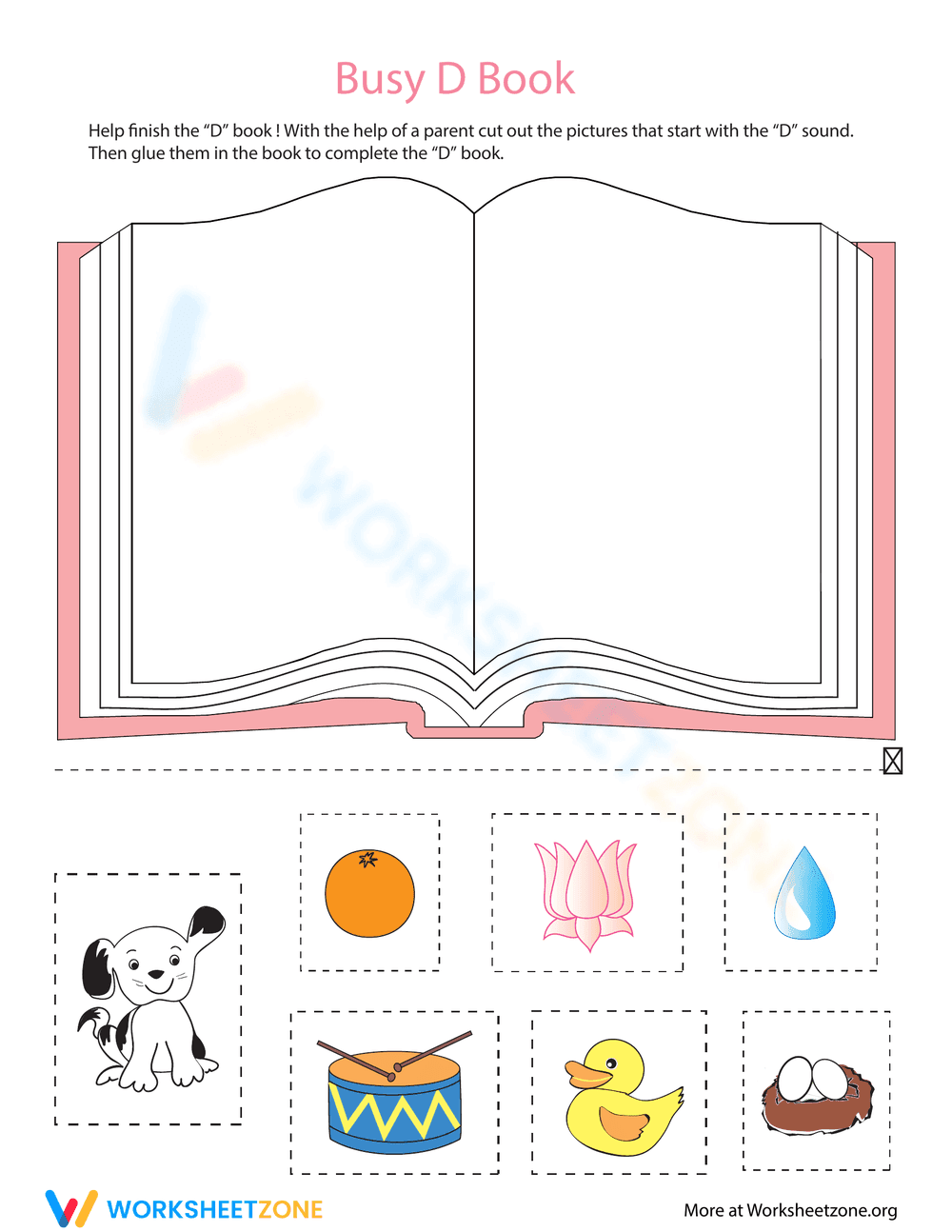
This foundational phonics worksheet develops early phonemic awareness by focusing on the initial /d/ sound. Students evaluate seven picture prompts, isolating the beginning phoneme of each word to determine which items belong in the interactive letter book. This hands-on sorting activity reinforces letter-sound correspondence through engaging practice.
At a Glance
- Grade: Kindergarten · Subject: ELA
- Standard:
CCSS.ELA-LITERACY.RF.K.2.D— Isolate and pronounce initial sounds in spoken words- Skill Focus: Letter D Beginning Sounds
- Format: 1 page · 7 problems · Answer key included · PDF
- Best For: Independent phonics practice
- Time: 15–20 minutes
This single-page resource features an illustrated open book template alongside seven picture tiles. The illustrations depict familiar vocabulary items including a dog, orange, lotus, water drop, drum, duck, and nest. Students name each picture aloud, identify the initial phoneme, cut out target images starting with the /d/ sound, and paste them onto the book pages. An answer key ensures quick verification of correct selections.
Zero-Prep Workflow
- Print (1 minute): Generate the single-page PDF for the class. No complex assembly required beyond standard scissors and glue sticks.
- Distribute (1 minute): Hand out activity sheets while students prepare cutting supplies.
- Review (1 minute): Model the activity by naming the first picture tile aloud and demonstrating how to glue correct matches into the book.
Total teacher preparation time is under two minutes. The highly visual format makes this worksheet excellent for substitute teacher plans or independent literacy centers.
Standards Alignment
This activity aligns with primary standard CCSS.ELA-LITERACY.RF.K.2.D, requiring students to isolate and pronounce initial, medial vowel, and final sounds in spoken words. By articulating vocabulary words and filtering for the initial /d/ phoneme, the task builds essential auditory discrimination skills. Supporting standard CCSS.ELA-LITERACY.RF.K.1.D is also reinforced as students connect spoken phonemes to printed letters. Both standard codes can be copied directly into lesson plans, IEP goals, or district curriculum mapping tools.
How to Use It
Deploy this worksheet during literacy centers after direct instruction on the letter D phoneme. Alternatively, assign it as a small-group intervention activity for students requiring tactile reinforcement with initial consonant sounds. Formative assessment observation tip: listen closely as learners whisper the name of each picture tile, noting whether they successfully isolate the first sound. Expected completion time ranges from 15 to 20 minutes.
Who It's For
This resource is designed for kindergarten students mastering early phonemic awareness. For differentiation, provide English Language Learners with a verbal preview of picture vocabulary before cutting. Advanced learners can write the letter D beneath each glued picture. This activity pairs naturally with an introductory phonics anchor chart or a whole-class read-aloud.
Developing robust phonemic awareness through explicit practice with initial phonemes is a cornerstone of early literacy acquisition. Aligning with CCSS.ELA-LITERACY.RF.K.2.D, this activity targets the essential plain-English skill of isolating and identifying beginning consonant sounds in spoken words. According to foundational research by Fisher & Frey (2014), structured independent practice incorporating tactile, multimodal elements significantly enhances student engagement and skill retention in early childhood classrooms. By combining auditory discrimination with a physical cut-and-paste sorting task, the worksheet provides necessary cognitive repetition for phoneme mastery. This evidence-based approach ensures young learners solidify their understanding of letter-sound correspondences, establishing the critical decoding foundation required for future reading fluency. Teachers can rely on this structured format to deliver meaningful, standards-aligned phonics instruction supporting diverse learning profiles.


