


























Views
Downloads
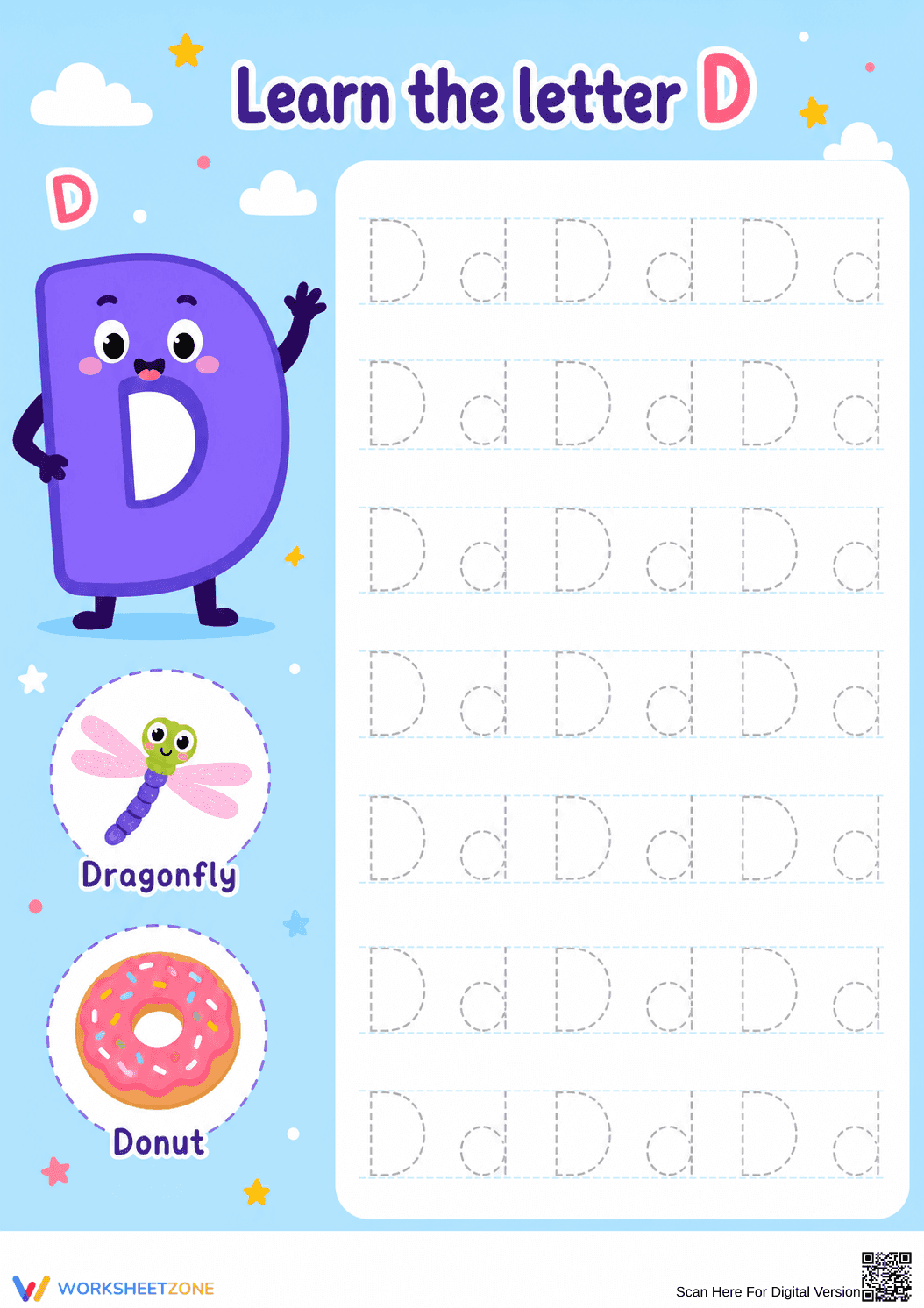

Letter D Beginning Sound Worksheet | Grade K Essential
Paste this activity's link or code into your existing LMS (Google Classroom, Canvas, Teams, Schoology, Moodle, etc.).
Students can open and work on the activity right away, with no student login required.
You'll still be able to track student progress and results from your teacher account.
This essential Grade K phonics worksheet helps early learners master the letter D through structured tracing and visual association. Students develop fine motor skills while connecting the letter shape to familiar objects like dragonflies and donuts. It provides a clear path from letter recognition to confident handwriting and phonemic awareness.
At a Glance
- Grade: Kindergarten · Subject: ELA Phonics
- Standard:
CCSS.ELA-LITERACY.RF.K.1.D— Recognize and name all upper- and lowercase letters of the alphabet- Skill Focus: Letter D formation and beginning sounds
- Format: 1 page · 28 tracing pairs · Answer key included · PDF
- Best For: Morning work or literacy centers
- Time: 10–15 minutes
The worksheet features a large, friendly letter D character to engage young students. It includes 7 rows of guided tracing for both uppercase 'D' and lowercase 'd', totaling 28 practice pairs. Two clear illustrations—a dragonfly and a donut—reinforce the beginning sound 'd' through visual cues and vocabulary labels that help students bridge the gap between letters and words.
Zero-Prep Workflow
- Print: Generate the single-page PDF in seconds for your entire class.
- Distribute: Hand out the sheets for independent morning work or guided literacy center rotations.
- Review: Conduct a quick visual check of student tracing and sound identification in under two minutes.
This resource is an ideal sub-plan or emergency activity because it requires no teacher setup and provides clear, self-explanatory instructions for the student.
Standards Alignment
This activity aligns with `CCSS.ELA-LITERACY.RF.K.1.D`, focusing on the recognition and formation of uppercase and lowercase letters. It also supports `CCSS.ELA-LITERACY.RF.K.3.A` by linking the letter D to its primary phoneme through visual anchors. Both standard codes can be copied directly into lesson plans, IEP goals, or district curriculum mapping tools.
How to Use It
Use this worksheet during the "You Do" phase of a phonics lesson after introducing the letter D sound. It serves as an excellent formative assessment tool; teachers can observe pencil grip and stroke order as students trace. The expected completion time is 10 to 15 minutes depending on student dexterity and focus levels.
Who It's For
This resource is designed for Kindergarten students, though it provides valuable remediation for Grade 1 learners or enrichment for Pre-K. It pairs naturally with a letter D anchor chart or a read-aloud book featuring "d" words. The visual supports assist English Language Learners in building basic vocabulary while mastering English letter forms.
According to the RAND AIRS 2024 report, consistent tactile practice through tracing is a foundational component of early literacy development, significantly improving letter recognition speed. This worksheet targets the CCSS.ELA-LITERACY.RF.K.1.D standard by providing 28 specific opportunities for students to practice the distinct shapes of uppercase and lowercase D. By integrating visual anchors like the dragonfly and donut, the material reinforces the phonemic connection between the grapheme and its sound. Research from Fisher & Frey (2014) emphasizes that such structured, independent practice is vital for moving students toward handwriting automaticity. This resource ensures that students receive the high-frequency exposure necessary to internalize letter forms before progressing to word-level writing. It serves as a reliable tool for teachers seeking to bridge the gap between initial letter introduction and independent literacy mastery in a classroom setting.


